
Western Sahara: questioning the theory of moroccan infringement

Timeline
Index of acronyms
Introduction
An unusual case of decolonisation
The Sharifian Empire and its unique political grammar
A late and peculiar colonisation process and model
Borders, an unresolved issue at independence
The patchwork of Spanish possessions
Independence in stages
The ‘three ages’ of international law
The coronation of sovereignty (1648-1945)
Priority given to stability and prohibition of annexations (1945 to the present day)
Self‑determination as a mean for decolonisation
Evaluating the green march
The ‘pre-history’ of the Green March
The scope of the Green March
War and the diversification of legal sources
The position of the International Court of Justice
The Security Council enters the scene
Security Council resolutions
Phases of the conflict
Moroccan inflections
Ceasefire and preparations for a referendum
Mohammed VI, development and the autonomy plan
From legal polycentrism to tokens55
Legal guerrilla warfare in Luxembourg
A judicial intrusion into foreign policy
The Court’s judgments in relation to European law
Court rulings with regard to international law
Towards a resolution of the conflict
The argument of ‘historical rights’: advantages and constraints for Morocco
Advantages and disadvantages of legal avoidance for France
Enriching the Moroccan reference framework
Fairness and legality
Conclusion
A former student of ENA and lecturer at Sciences Po, Dominique Bocquet is writing a book on the Western Sahara conflict. He has served as an advisor to Hubert Védrine and was Head of the economic department at the French Embassy in Morocco. He is a Senior Fellow at the Policy Centre for the New South in Rabat. This report was prepared at the request of Dominique Reynié, Director General of Fondapol, and written on behalf of the foundation.
Sâ Benjamin Traoré is a professor of public international law. He defended his doctoral thesis entitled ‘The Interpretation of United Nations Security Council Resolutions: A Contribution to the Theory of Interpretation in International Society’ at the Faculty of Law of the University of Neuchâtel. He teaches at Mohammed VI University in Rabat.
Summary
For 50 years, the Western Sahara conflict has been pending before the international fora.
In 1975, Morocco claimed sovereignty over this vast desert territory – which had previously been a Spanish colony – as it considered this territory had previously belonged to her. This view is contested by the Polisario Front, an independence movement supported by Algeria. The international community has adopted an ambivalent attitude, accepting the idea that Morocco has violated international law, while at the same time becoming increasingly conciliatory towards Morocco, which exercises de facto sovereignty over the aforementioned regions.
This ambivalence creates a situation that is difficult to understand and untangle.
This report examines the origins of the antagonism between Algeria and Morocco, as well as the geography and history of Western Sahara. It revisits the theory of Moroccan violation through a re-reading of applicable international law. It advocates overcoming the conflict by addressing its root causes.
Dominique Bocquet,
Former student of ENA and lecturer at Sciences Po Paris
with Sâ Benjamin Traoré,
Professor of Public International Law
Map of Morocco featured on the official website of the French Ministry for Europe and Foreign Affairs since October 2024
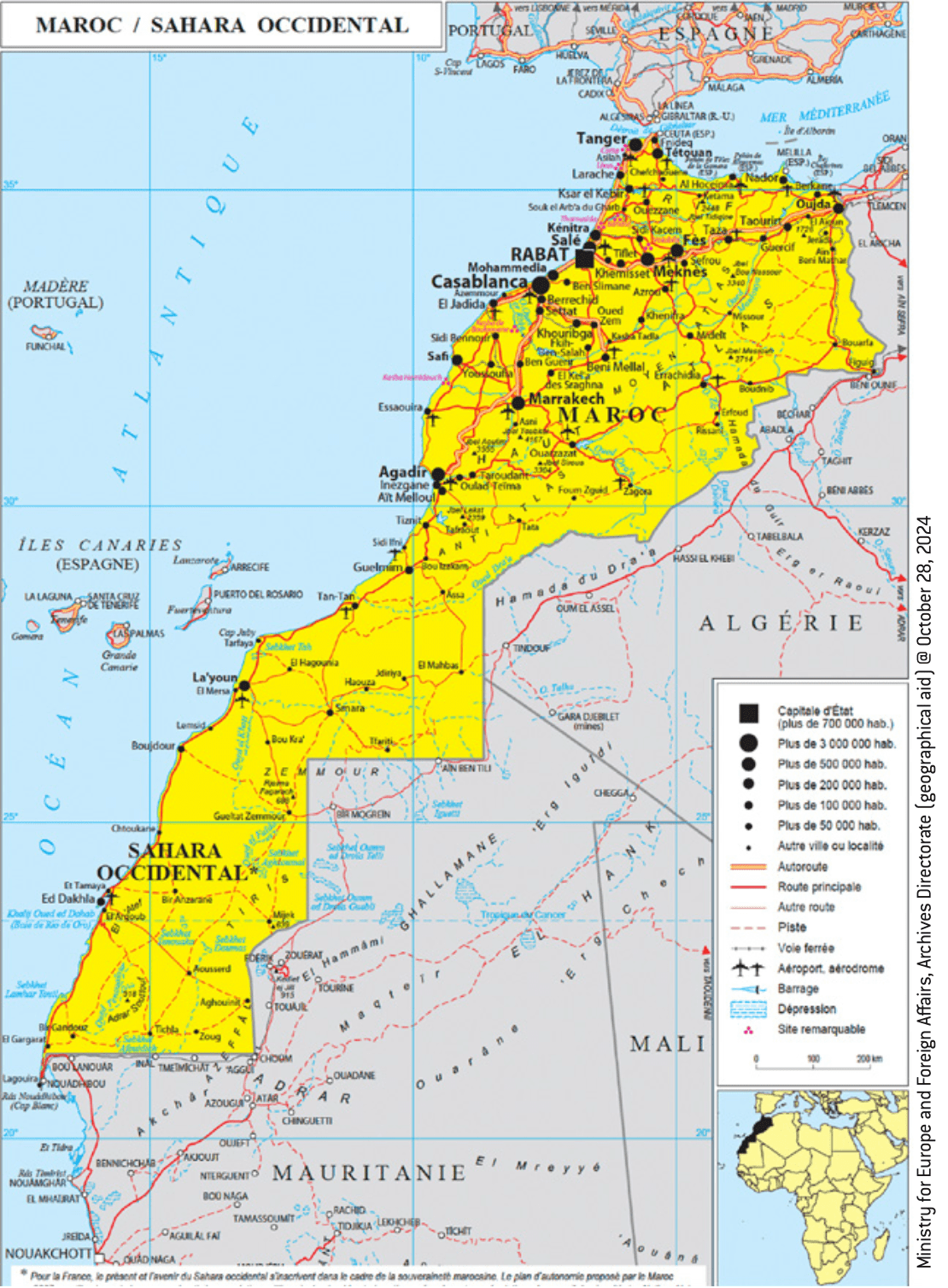
Source :
France Diplomacy, Presentation of Morocco [online].
Map of Greater Morocco published in 1956 by the Istiqlal party
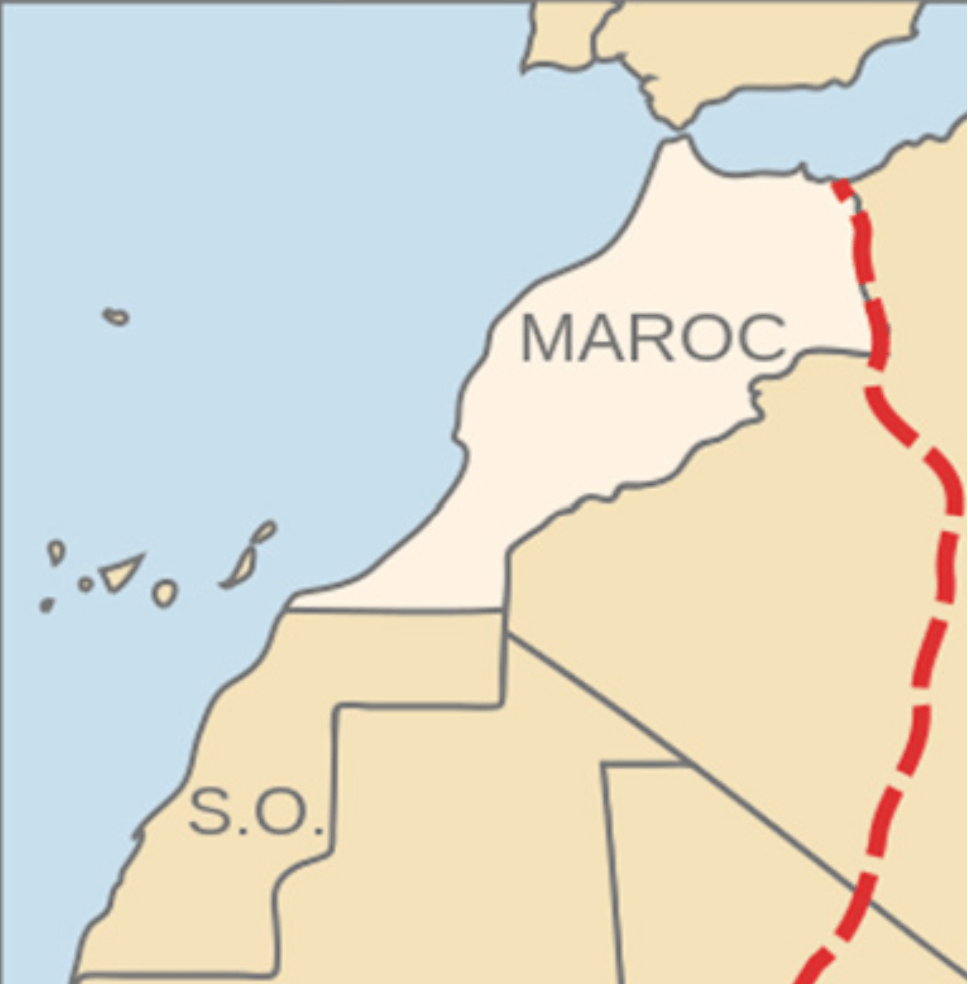
Source :
Press conference of Allal El Fassi, Cairo, July 4, 1956.
Universalis map 2025
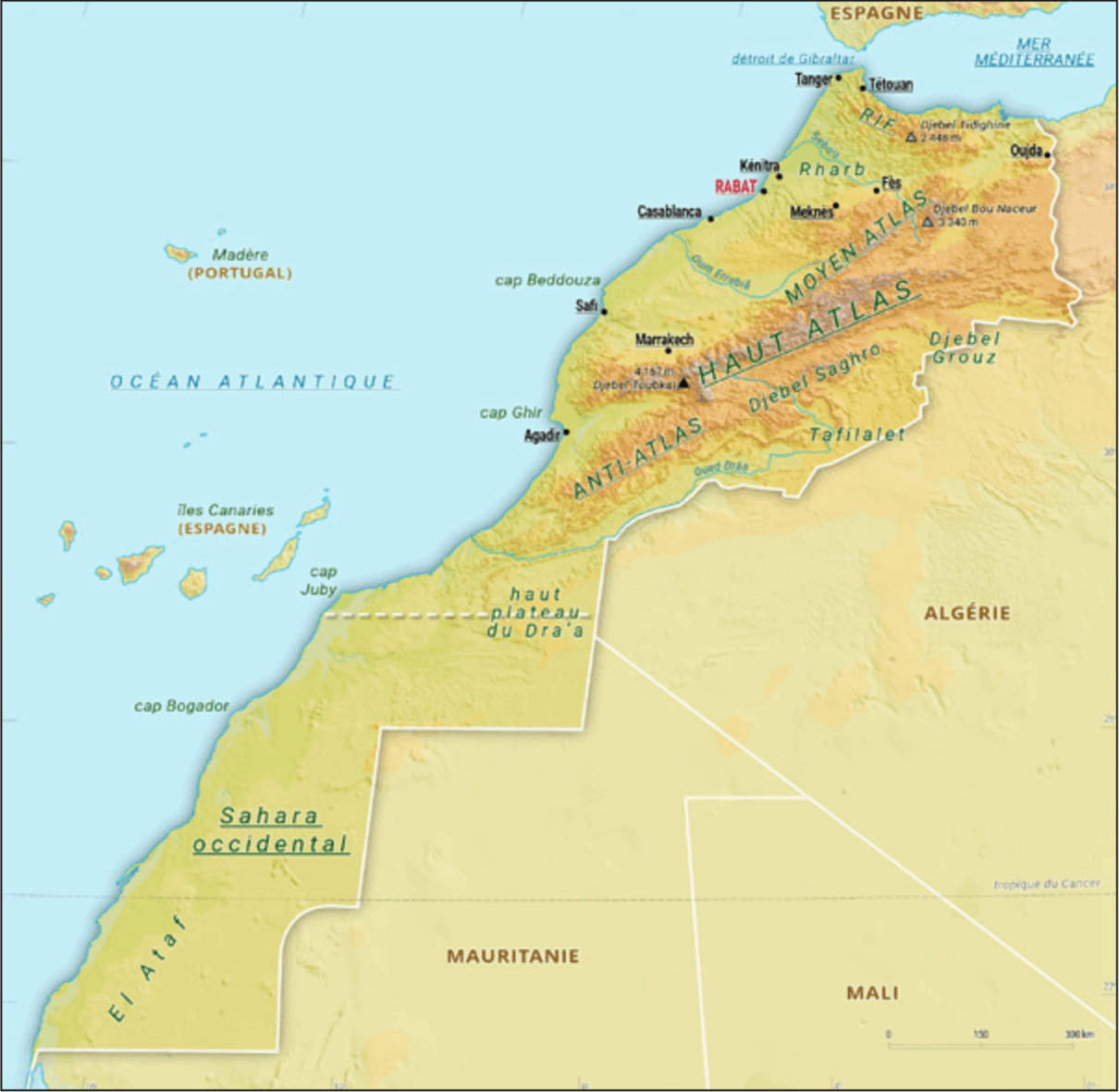
Source :
Universalis, Physical Map of Morocco [online].
1884: the Spanish gain control of Rio de Oro (southern part of Western Sahara).
1912: the Treaty of Fez establishes the Franco-Spanish Protectorate in Morocco.
1920: the Spanish gain control of Saqia El Hamra (northern part of Western Sahara).
1956: the Protectorate ends and Morocco becomes independent. Spain retains Western Sahara, Tarfaya, Ifni, etc.
1957-1958: the Moroccan Army of Liberation takes action in Western Sahara and Mauritania, French reaction (Écouvillon).
1958: the Tarfaya strip returns to Morocco.
1963-1966: the case of Ifni and Western Sahara is raised at the UN. They are then added to the list of Non-Self-Governing Territories.
1969: the city of Ifni is returned by Spain to Morocco.
1972: demonstration in Tan-Tan (Morocco) in favour of the reunification of Western Sahara with Morocco.
29 April 1973: the Polisario Front is founded in Zouerate (Mauritania).
6 November 1975: Green March (350,000 Moroccan civilians enter Western Sahara).
14 November 1975: Madrid Accords, division of Western Sahara (Morocco-Mauritania).
27 February 1976: the Polisario Front proclaims the SADR with the support of Algeria.
1976-1980: the Polisario attacks the Moroccan and Mauritanian armies, refugees in Tindouf.
1979: Mauritania evacuates Western Sahara, Morocco enters.
1981: Hassan II raises the possibility of a referendum.
1982: the SADR is admitted to the OAU.
1984: Hassan II commits to the referendum at the UN (September);
Morocco leaves the OAU (November).
1991: a ceasefire is signed and the UN Security Council establishes the MINURSO (6 September)
2006: Mohammed VI announces an internal autonomy plan.
2007: the UN Security Council welcomes proposed autonomy plan as ‘serious basis for negotiation’.
2017: Morocco rejoins OAU (now African Union) without precondition of SADR exclusion 2020: ‘Abraham Accords’ and US recognition of Moroccan sovereignty over Sahara.
2022: Spain declares the autonomy plan to be the ‘most serious and credible basis’ for a settlement.
2024: Letter from President Macron to the King (Moroccan sovereignty ‘present and future’ in the Sahara).
2025: 50th anniversary of the Green March (6 November).
Index of acronyms
AU: African Union (since 2002)
CJEU: Court of Justice of the European Union (Luxembourg)
CORCAS: Royal Advisory Council for Saharan Affairs
EU: European Union
FAR: Royal Moroccan Armed Forces
FLN: National Liberation Front (Algeria)
GPRA: Provisional Government of the Algerian Republic
ICJ: International Court of Justice (The Hague)
Istiqlal: Independence Party (Morocco)
MINURSO: United Nations Mission for the Referendum in Western Sahara
NSGT: Non-Self-Governing Territories (UN list)
OAU: Organization of African Unity (1963-2002)
OCP: Sharifian Office of Phosphates
Polisario: Popular Front for the Liberation of Saguia el-Hamra and Rio de Oro
SADR: Sahrawi Arab Democratic Republic
UN: United Nations
UNFP: National Union of Popular Forces
UNGA : United Nations General Assembly
UNSC: United Nations Security Council
USFP: Socialist Union of Popular Forces
Karim El Aynaoui kindly shared with me, in a spirit of mutual independence, his personal insights into the causes of the conflict. The role of revolutionism as an ideological determinant was one of them.
Half a century ago, Morocco asserted its sovereignty over Western Sahara, previously occupied by Spain. On 6th November 1975, a crowd of 350,000 Moroccans, led by King Hassan II, entered the territory, forcing Madrid to negotiate. Despite the desert nature of this vast territory, mainly inhabited by nomads, a conflict arose and remains unresolved fifty years later. Its ins and outs remain a mystery.
As countries that have long been associated with the Moroccan cause, France and Spain are in a difficult position, for, on the one hand, both countries see Moroccan sovereignty over this territory as effective and legitimate, while, on the other hand, they refrain from declaring it legal.
Legal uncertainty created by non-recognition is a hindrance to business, a brake on investment and an obstacle to development. It allows the Polisario Front, an armed movement supported by Algeria, to claim independence in the name of international law.
How can this imbroglio be resolved? The answer is political, but not solely so. Morocco is scoring decisive points politically. Its diplomacy has become more effective. The circle of countries supporting her is widening. The Security Council increasingly recognises the autonomy of the territory as the most serious basis for settlement, to the detriment of the independence thesis.
However, legally, Western Sahara remains a ‘non-self-governing territory’. The list is drawn up not by the UN Security Council but by the UN General Assembly, which has jurisdiction over decolonisation. Classifying the territory as non-decolonised amounts to challenging Moroccan sovereignty. The right to self‑determination is invoked to accuse Rabat of violating international law. Another aspect is the ‘intangibility of borders inherited from decolonisation’, a concept specific to Africa which prohibits any modification of borders, even through negotiation. Morocco is said to have violated this prohibition by erasing its border with the former Spanish Sahara. With this argument, the Polisario and Algeria secured admission for the Sahrawi Arab Democratic Republic (SADR) to the Organization of African Unity (OAU) in 1982.
What are these arguments worth? Surprisingly, they have been little contradicted in public debate. The tactic initially used by Morocco and France is not unrelated to this. It consisted of sidestepping a biased legal debate. 1975 was a pivotal year. Back then, a revolutionary ideology demonising the regime of Hassan II and glorifying armed liberation movements was especially pervasive in the international fora.3 The West was intimidated and Morocco was pre-emptively condemned.
Inevitable in the short term, this legal avoidance was bound to have major consequences on the intellectual debate: it gave the impression of a guilty plea. Since it was little criticised in the public discourse, the thesis of ‘Moroccan infringement’ of international law appeared unequivocal, even to those who felt sympathy towards the country.
Today, if the French and Spanish do not address the legal issue at its root, Morocco’s success will be presented by some as a setback for the law and a fait accompli. Is this a good outcome for the law? Is it the best outcome for Morocco? Is it a positive outcome for the other parties involved (including Algeria)? This study highlights the weaknesses of the initial international resolutions and invites researchers to reinterpret them.
In other words, an opaque block whose results we are asked to accept without any right to scrutinise how they were arrived at.
| Methodology of the report
This report focuses on the main points of reasoning. It does not claim to list all the facts, but strives to restore the nuances that have been lost in a Manichean debate, which has largely contributed to this image of a frozen conflict. It focuses on the spirit of the law and its interaction with the historical and geographical context. This would not have been possible without the help of Professor Sâ Benjamin Traoré. His thesis on The Interpretation of Security Council Decisions, defended in Neuchâtel, is authoritative. He kindly engaged in extensive discussions to facilitate the drafting of this text and then reread it carefully. This report owes him a great deal. In the case of Western Sahara, international law was often invoked as a black box.4 Drawing on Professor Sä Benjamin Traoré’s reflections on interpretation (in general) and the Sahara (in particular), I propose the opposite to the reader: to open the bonnet of the engine and show how this law works. |
PART 1
The formation of the legal knot
An unusual case of decolonisation
This angle of analysis was suggested to me by Sâ Benjamin Traoré. His perception as a lawyer well versed in decolonisation issues converged, on this point, with my historical research on the notion of ‘Moroccan singularity’. See Dominique Bocquet’s article, ‘Moroccan Singularities and French Perplexities,’ Commentaire, issue 182 (Summer 2023) [online].
The method of analysing international relations advocated by Raymond Aron has sometimes been defined, in formal language, as ‘idiosyncratic realism’.
If the Western Sahara issue appears indecipherable, it is because its history and specific characteristics have been erased. It was believed to be a classic case of decolonisation. On the contrary, it was rather atypical.5 We must accept this complexity if we want to shed light on a subject that simplification can only distort.
Everything about this issue is atypical. First, there is the history of Morocco, a thousand-year-old empire with a unique political structure in the world. Then there is its strategy of decolonisation, independence in stages rather than all at once. Finally, there is the ‘nature’ of Western Sahara: a territory that is more desert-like than Patagonia and only crossed by nomads.
The history of Moroccan-Algerian relations is worth mentioning. While Algeria is officially only a third party as it has no territorial claims and only a very limited common border with Western Sahara, it is cited in the proceedings as ‘interested in the conflict’, an unusual qualifier in international law, even for a neighbouring country.
We shall start by discussing these specificities, bearing in mind Raymond Aron’s methodological argument that each situation must be studied on its own terms, outside pre-established frameworks.6
The Sharifian Empire and its unique political grammar
This proposal was rejected. The Sultan was a notorious polygamist. The King of France did not want to see his daughter in a harem. Nevertheless, bilateral relations (established since at least the reign of Francis I) were revived.
Morocco is not a ‘standard’ case of decolonisation.
In sub‑Saharan Africa, colonisers often arrived in the 19th century in regions marked by linguistic and ethnic fragmentation. The question of whether or not a State already existed remains controversial. What is certain, however, is that it was not present everywhere and that tribal logic continued to play a predominant role. In this context, colonisers are often considered to have promoted the notion of the modern State through ‘colonial states’, which would later serve as the foundation for independence.
In North Africa, large entities existed and linguistic diversity was limited (Arabic dialects and Berber languages). In Morocco, colonisation found a pre-existing State: a thousand years old, with trade relations on several continents and embassies in Europe.
Independence was embodied by a Sultan, endowed with religious legitimacy as ‘Commander of the Faithful’. His role was to defend the country, particularly against Spain. For eight centuries (8th-15th centuries), Muslims and Christians had shared the Iberian Peninsula, engaging in deep interaction interspersed with wars. We remember the wars, but we have forgotten the interaction. Despite the cruel expulsion of Muslims and Jews at the end of the 15th century, Spain is the European country with the strongest Arab-Muslim cultural influence. Conversely, the influx of Andalusians made Morocco the southern Mediterranean country most familiar with the Christian West.
Spain was then the world’s leading power. It was this empire (admittedly monopolised in the 16th century by the conquest of America) and the Ottoman Empire (present as far as Algeria) that the Moroccans resisted. Their method was to unite behind the Sultan when their land was attacked. In addition, in the 17th century, the army was reorganised by Sultan Moulay Ismaël, one of the first of the current Alawite dynasty, and gained a reputation for invincibility that lasted for several centuries.
Sultan Moulay Ismaël sought the hand of one of Louis XIV’s daughters in marriage. France indeed appeared to be Spain’s rival. There was a convergence of interests and also the seeds of an elective relationship before the colonial episode. This was Morocco’s second significant link with Europe.7
The sultans were not European-style kings, relying on a feudal hierarchy and seeking cultural and administrative unification. Except in times of war, their role was limited. The country was dominated locally by tribes. The tribal nature of the Maghreb was counterbalanced by tangible factors of unity (languages, religion, etc.). Nevertheless, conflicts remained numerous, to such an extent that a traditional distinction was made between the ‘bled makhzen’, the part of the country that regularly paid taxes to the Sultan, and the ‘bled siba’, the more rebellious part, where the Sultan had to wage war to obtain his tribute.
The relationship with the Sultan was one of allegiance. Allegiance is a symbolically important bond, formalised by written oaths. It is part of the Moroccan legal corpus. It guarantees solidarity in the face of external enemies but does not imply absolute obedience in all areas. Hence the term Sharifian ‘empire’ (rather than ‘kingdom’), which was used until the 1950s to refer to Morocco.
A late and peculiar colonisation process and model
Journal official de la République française, 27th July 1912, Decree of 20 July 1912, Publication of the Treaty of Fez, 30 March 1912, relating to the organisation of the French protectorate in Morocco [online].
Conversation with Mehdi Benomar, Director of Research at the PCNS.
For Pascal Ory, ‘the presence of a local legal institution, in the case of French North Africa, Morocco and Tunisia, completely changes the identity data’, Qu’est-ce qu’une nation ?, Gallimard, 2020, p. 68.
French diplomat, Resident-General of France in Tunisia (1882–1886).
With one major difficulty during the Hassan II period: the lack of high-level executives, an area in which Morocco has made enormous progress since then.
The first major Alawite defeat came in 1844, against France, which was completing its conquest of Algeria. France forcibly prevented the Sultan from supporting Algerian tribal rebellions against it. But the sovereign retained considerable military capabilities. Paris did not venture to conquer the country. However, the latter continued to weaken due to widespread internal anarchy (the Sultan having to fight on several fronts) and persistent archaism in the face of a Europe in full economic ascent and tending towards imperialism.
In 1912, when the monarchy was ready to compromise on sovereignty, it was too late for France to commit significant military resources given the increasingly tense military situation in Europe. The same context prevented her from imposing herself alone in Morocco. The Protectorate was thus established by the Treaty of Fez on 30 March 1912.8 The territory was divided: Spain was given back control of part of the Protectorate while also retaining possessions outside its perimeter.
If the texts emphasised the unity of the country, reality suggested otherwise and the duality of colonial powers proved to be a source of disunity. This partially centrifugal effect of colonisation is another specific feature of Morocco: it is the opposite of the strongly centripetal dynamic often observed in sub‑Saharan Africa during colonisation.9 This is not a minor point: if Western Sahara had had the same coloniser as the regions further north, would anyone have considered for a moment that it might have a future separate from Morocco? Added to this is the multiplicityo f statuses among the territories under Spanish colonisation. Sacralising the borders inherited from colonisation is a premise that is hardly acceptable to Moroccans.
In 1912, Morocco’s military capabilities forced France to compromise, establishing a protectorate that was defined as temporary and allowing the monarchy to remain in place. The preservation of a national institution (as in Tunisia with the Bey) represented a major difference from the legal status of Algeria, which was considered an integral part of French territory.10 General Hubert Lyautey, a romantic military man, fond of tradition and an admirer of the Maghreb, was the right man for the job. The first Resident-General saw himself as serving the Sultan. Waging war in his name against rebel tribes, he unified or ‘pacified’ the country.
During his lifetime, he did his utmost to curb the abuses associated with colonisation, abuses he had observed during a previous stay in Algeria. Like Paul Cambon,11 who had preceded him in Tunisia, his obsession was ‘not to repeat French Algeria’. Nevertheless, he set up a colonial State apparatus, with a developmentalist purpose, certainly, but with a Jacobin spirit.
After Morocco’s independence, this apparatus was taken over and completed, then brought closer to the model of the modern ‘Weberian’ State.12 This model did not fit in with traditional Sharifian governance, which was extremely flexible. This is one of the reasons why Hassan II, a strong-willed ruler who came to the throne in 1961, was described as a ‘tyrant’ by some of his opponents, and one of the reasons for the upheavals in Morocco in the 1960s and 1970s, when the drama of Western Sahara unfolded. These upheavals also reflected the emergence of new forces with the civic engagement of the middle and upper classes. The struggle for independence had been the crucible for this, with the ‘national movement’ of the 1930s, which founded Morocco’s first political party, Istiqlal (‘independence’ in Arabic), in 1943. This civic action was crucial, not only for independence, but also for the emergence of a political space and an articulated national consciousness in Morocco. Istiqlal split in two in 1959 (Istiqlal ‘remained’ in the centre-right, and the National Union of Popular Forces – UNFP, a left-wing party that became the Socialist Union of Popular Forces – USFP in 1975). This was rather healthy: with independence, new parties emerged and, with them, a form of political diversity.
The monarchy therefore had to contend with modern political forces. Initially, those political forces had military units founded during and for the struggle for independence, whereas Sultan Mohammed V was unarmed, for defence had previously been the responsibility of the colonial powers under the Protectorate. One of his priorities was to create the Royal Armed Forces, with the help of France. He entrusted command to his eldest son, Prince Hassan.
When the latter became king upon his father’s death in 1961, the struggle for power became fierce. This explains (without excusing) the serious human rights violations that subsequently took place in a country that was generally concerned with tolerance and conciliation.
In 1961, the new king chose to preserve, ‘Moroccanise’ and develop the centralised, developmentalist State sketched out by the French. But he had the intelligence – rare at the time – to allow party pluralism to take hold. At the end of his reign, he restored flexibility to governance through a compromise with the national movement and its democratic demands. The political crisis was overcome by gradually allowing elected officials to play a role in managing the daily lives of Moroccans.
Hence, at the end of the 20th century, the emergence of a pattern of alternation in legislative elections: victory for the socialists in 1998, for the moderate Islamists in 2011, and their dismissal at the polls in 2021.
This led to the new profile of the sovereign embodied by Mohammed VI, who ascended to the throne in 1999: a king who remained the cornerstone of the system but who took as little part as possible in disputes, unlike his father, a sovereign who threw himself into the fray. The current king is committed to promoting a ‘vision’ for the country’s future. The term ‘vision’ (officially used) aims to add another quality to the traditional legitimacy of the monarchy: its concern for the country’s long-term interests.
This is the secret behind the ‘surprise’ felt by many at Morocco’s contemporary development: the negative feelings towards Hassan II’s repressive beginnings were by no means a sign of things to come. A country unlike any other, and already misunderstood (though slightly less so in France and Spain).
Borders, an unresolved issue at independence
An agreement on the demarcation of the border, putting an end to Morocco’s claims, was signed on 15 June 1972. Algeria ratified this agreement on 17 May 1973 and published it in her official gazette on 15 June of the same year. According to the UN, the ‘exchange of instruments of ratification’ took place on 14 May 1989. The Moroccan Parliament does not appear to have taken a position, at least not at that date. According to the Official Bulletin of the Kingdom of Morocco of 1 July 1992, the Convention was ‘made public’ on 22 June of that year.
According to some observers, Algeria initially sought to obtain for itself, within its territory, a corridor of access to the Atlantic, an ambition which she subsequently abandoned.
The Sharifian Empire had boundaries but no precisely defined borders, a concept that was adopted in Europe later than is commonly believed. Many other empires and states had been in the same situation. Consider, for example, the vagueness of the Roman Limes (even though the Romans were a highly organised people).
The Sultan’s sovereignty was traditionally based on the allegiance of tribes, some of which were nomadic and others turbulent. At independence, the absence of clearly defined borders became a headache. This was because, in the meantime, the concept had become widespread worldwide.
Due to its predominance in the Maghreb, French colonisation had little reason to push for the establishment of borders between countries: on both sides, the coloniser was often the same. However, a line approximately 120 km long, starting at the Mediterranean and running southwards, was drawn by France in 1845 to distinguish French Algeria from Morocco, which remained independent at the time. This line roughly corresponded to the former dividing lines between Moroccan and Turkish influences (the Regency of Algiers). It was hardly questioned thereafter. Further south, however, ‘the Algerian-Moroccan boundaries were vague’.
This vague definition allowed France, under pressure from its army in Algeria, to expand the territory controlled by the latter to the detriment of Morocco. The extent of this expansion is controversial, but its existence is undeniable. French archives are full of protests from French politicians against the encroachments demanded by the military, which were contrary to the obligations of the protectorate.
In 1961, with Algerian independence looming, Charles de Gaulle proposed to Mohammed V that the problems identified be resolved while the country was still under French sovereignty. Morocco, in solidarity with the Algerian struggle, consulted Ferhat Abbas’ Provisional Government of the Algerian Republic (GPRA). In July 1961, an agreement was signed. The Algerian side undertook not to invoke the colonial border. Mohammed V did not follow up on de Gaulle’s offer. Alas! After independence and its seizure of power (1962), the FLN considered itself not bound by the GPRA’s commitments (the various commitments of the GPRA, not only those towards Morocco).
In 1963, a brief ‘Sand War’ ensued between the two countries. Despite Morocco’s superiority on the ground, Hassan II agreed to a return to the status quo in the disputed desert acres. Algeria had won a resounding political victory. Its diplomacy had succeeded in accrediting the thesis of an attack on its young independence and, better still, in rallying the rest of the world against Morocco, particularly sub‑Saharan Africa, which was concerned about the idea of border rectification.
The poison of mistrust had been instilled. On the Moroccan side, there was a sense of injustice. On the Algerian side, there was a sense of insecurity, stemming from doubts about the acceptance of its borders. Far from being temporary, as the Moroccans believe, these doubts would recur.13 This is one of the driving forces behind the conflict. Algiers’ subsequent involvement in the Western Sahara affair, a territory that it officially does not claim,14 stems in part from this concern. Whether justified or not, it made any means of exerting pressure on Morocco desirable for Algiers.
The patchwork of Spanish possessions
Treaty of Tordesillas, following the papal bull Inter cætera.
French historian born in Constantine, specialist in the Maghreb and the Algerian War.
‘66th anniversary of the National Revolution: message from the President of the Republic’, Algerian Embassy in France, 31 October 2020 [online]. See, for example, the statement made by President Tebboune on the 66th anniversary of independence. He refers to ‘an Algeria where every inch of land has been watered with the blood’ of martyrs.
As for Spanish possessions, the historical situation was full of paradoxes. After the discovery of America, Spain had little colonial ambition in Africa. It was absorbed by the New World. A division had been agreed with Portugal: Madrid would take western America, from the southern cone to Mexico; to Portugal, the East, i.e. Brazil and… Africa.15
However, this was only a partial satisfaction for Morocco because, due to its proximity (14 km across the Strait of Gibraltar), the few Spanish incursions into Africa were concentrated on it. But, second paradox, without much planning. No fewer than four different situations:
– the tiny Spanish enclaves on the Mediterranean coast (Ceuta, Melilla and a few islets). Appearing as early as the 15th century, they still exist in the 21st century, in accordance with the wishes of the inhabitants to remain Spanish;
– a minority part of the ‘protectorate’. In 1912, France granted Spain control over part of the protectorate imposed on Morocco by the Treaty of Fez: Tetouan, part of the Tangier peninsula, the Mediterranean coast and the Rif. Hence the term ‘Franco-Spanish protectorate’. In 1956, this Spanish part returned to Moroccan sovereignty in the wake of the French withdrawal;
– Spanish possessions to the south, partly included in the protectorate, partly not included but enclaved within it, which Spain would only agree to relinquish after 1956: the Tarfaya Strip (1958), City of Ifni (1969);
– further south, the vast ‘Spanish Sahara’, retained by Francisco Franco until 1975.
South of the Spanish Sahara lies Mauritania, a State created by France and still marked today by a strong Moroccan cultural influence. To the west of Mauritania, Mali includes several regions that were, at certain times (long ago), part of the Sharifian Empire.
In addition, the Central Sahara had mainly been explored by the French. As Algeria was then perceived by Paris as destined to remain French forever, it was associated with that country (rather than with the French colonies in West Africa, for example). This led to a substantial increase in the size of the Algerian territory, which thus became the largest in Africa under colonisation. Despite the weight of her history, Morocco found herself with a neighbour five times its size. Its sense of territorial injustice could only be heightened, even coupled with concern in terms of geopolitical balance.
Conversely, one could deduce that Algeria was ‘saturated’, an expression once used by Chancellor Metternich (1821-1848) in reference to Austria. But in 1962, it began to see its situation differently. Towards the end of the war, believing that the FLN was dragging out the peace talks, Charles de Gaulle threatened to keep the central Sahara as a means of pressure. As a result, the Algerian leaders turned the territory into a symbol, a component of a ‘dearly paid’ independence, according to Benjamin Stora’s expression.16
To understand the orientations and vision of the Algerian leaders, it is necessary to decipher the language used to sanctify the territory: it invokes the blood of the martyrs of the struggle for independence.17 In other words, the magnitude of the sacrifices made prohibits, in their eyes, any questioning of the territory, which is seen as their fruit. Without wishing to be insistent, let us recall one element that may help us understand the Algerian point of view: if France expanded the territory of French Algeria as it did, it was because it considered it to be French ‘forever’. It was precisely this assumption that led it to refuse independence for so long, depriving Algerians of their civil rights and leading to bloodshed. Following this thread, we can see a link between the extent of the sacrifices and that of the territory: this initial belief in an Algeria that was ‘French forever’.
Let us go back to 1956, the year the protectorate was abolished. At that time, Morocco had only a reduced territory. Neither Spain, nor France, nor the Algerian GPRA of 1961 seriously disagreed with this. They did not subscribe to all the ‘rights’ invoked by Morocco, but few recognised none of them.
Independence in stages
Nizar Baraka, Secretary General of Istiqlal and Minister of Equipment and Water, introduced me to this concept. Larabi Jaïdi, Senior Fellow at PCNS, emphasises the importance of the border issue in the eyes of Moroccan historians.
Everything should have been laid out on the table. The international community could have recognised the problem of Morocco’s borders and sought a fair solution. As Moroccan historian Abdallah Laroui writes, a logical procedure would have been to hold an international conference to establish them within the framework of a balanced geopolitical vision. But this method, practised in the past, was no longer in keeping with the spirit of the times.
On the African continent, it would have been reminiscent of the colonial conferences of yesteryear, such as the Berlin Congress and others. To complicate matters further, the city of Tangier was under international status, with powers able to find opportunities there to extend their titles. Morocco did not want this. So there was no starting from scratch. Rabat was forced to improvise. It would be independence in stages.18 The road would prove to be fraught with pitfalls.
The Sultan took the precaution of stating the rights he considered his. Allal El-Fassi, leader of the Istiqlal, published a Map of Greater Morocco in March 1956 that caused a sensation. It encompassed not only the Spanish Sahara but also, for good measure, the whole of Mauritania, a large part of Algeria and part of Mali.
Intended to avoid the fait accompli of a diminished Morocco, the map could only cause concern among the countries concerned. Hence the first pitfall. This concern would above all poison relations with Algeria. But relations with Mauritania, which Morocco officially claimed until 1969, would not emerge unscathed. Rabat managed to establish friendly relations with Mauritania, but without completely dispelling Nouakchott’s concerns, with Algeria sometimes seen as a balancing factor.
The term ‘Moroccan expansionism’ became popular. The map was broad. Even within the Istiqlal party, many believe in hindsight that it was too extensive. To be fair, there was a dilemma: if it had been insufficient, it would have meant renouncing the territories not included. In short, there was no good solution, only a choice between pitfalls. Morocco remained calm, convinced of its rightful claim. However, the law in those days was fluid.
The ‘three ages’ of international law
To avoid repetition, this report uses the term ‘international law’ to refer to public international law. Private international law follows a different logic. Similarly, we sometimes refer to the Sahara to mean Western Sahara when the context is clear.
Raymond Aron expressed a certain scepticism about international law. The opposite view we express here is inspired by a conversation with Gilles Andréani, former head of the Centre for Analysis and Forecasting at the French Foreign Ministry and himself a great connoisseur of Aron’s thinking.
Public international law19 is not like other types of law: it depends on the agreement of States, the very subjects that it is supposed to bind. Hence its weakness and uneven application.
This leads some authors to doubt its reality. This is excessive: international obligations do exist, with a stabilising effect and reciprocity that encourages actors to comply with them.20 We simply need to remain clear-headed about the nature of these obligations and tirelessly return to the essential: the intention behind each provision. This will be our guiding principle.
To help understand the evolution of international law over the centuries, we offer a stylised interpretation. It deliberately simplifies its content by focusing on the main feature of each era.
The coronation of sovereignty (1648-1945)
The Treaties of Westphalia, concluded in 1648, ended the Thirty Years’ War and enshrined the affirmation of state sovereignty. They thus constitute a founding stage in the evolution of public international law and the principle of non-interference.
As Pierre Manent, philosopher and president of the Association des Amis de Raymond Aron, writes, the concept of ‘political form’ is an essential contribution to political science. It allows for the classification of different types of political organisation (Cours familier de philosophie politique, Gallimard, 2001).
The uti possidetis juris principle allows States to own the territories they hold, in order to avoid territorial disputes. This expression literally means: ‘You shall possess what you already possessed.’
Starting with the Treaties of Westphalia (1648),21 international law took shape, with the priority of consolidating the sovereignty of states. States gradually became the main political form, to the detriment of cities, tribes and empires.22 Modern State sovereignty requires precise boundaries. This has promoted the notion of borders.
In most countries, the sequence was first to assert de facto sovereignty through political and military power, and only then to potentially enshrine it in a treaty. In other words, the majority of borders in most countries around the world were the result of power relations, with a significant military component.
This point is worth reminding those who, assuming that Morocco had no rights to Spanish Sahara, conclude that it therefore scandalously abused its power.
Let us start, for a moment, from their assumption (which we do not share) about the absence of rights. In this scenario, what Morocco would have done is what many countries around the world have done, namely carve out a territory through the balance of power. Criticism in terms of current law is understandable, but there is a big difference between that and expressing it in grandiose terms.
Moreover, Morocco operated in a territory that was virtually uninhabited. To present it as having, in a manner of speaking, killed its father and mother is a discourse that can be held outside the realm of reality, in a particular forum heated by ideology. In France and Spain, countries familiar with Morocco, this type of exaggeration does not go down well.
Since its inception, international law has favoured the title of the last possessor (Uti possidetis juris23). As a result, so-called ‘historic’ rights, i.e. those based on the invocation of past sovereignty, are relativised. However, they were not completely disregarded: sometimes, states that were temporarily forced to yield to force claimed such rights (‘it was ours before’). They reserved the right to return to the fray, by force if necessary. Politically, historical rights often remained accepted.
Priority given to stability and prohibition of annexations (1945 to the present day)
After the catastrophes of the two world wars, the imperative of stabilising borders took precedence. This was the (natural) watchword of the victors. It became international law, especially since the two rival camps of the Cold War, the Atlantic Alliance and the Soviet bloc, shared this goal.
Hence the establishment of the UN Charter in 1945, which set out provisions for maintaining and restoring peace. The use of force was prohibited, except in self-defence, as were annexations. In fact, the latter became rare (without completely disappearing). The consequence this time was to truly turn our backs on the notion of historical rights, seen as a source of conflict. Priority would be given to the recognition of established and stable situations in the present.
This was a thorny issue for Morocco. However, it could plead the exception: its borders had not been stabilised (which was recognised). Consequently, its historical rights still had meaning. Moreover, colonisation had hindered their exercise. It could count on the help of a third right that was emerging, that of decolonisation. Unfortunately, its content would not fit well with Morocco’s specificities.
Self‑determination as a mean for decolonisation
Declaration on the Granting of Independence to Colonial Countries and Peoples, Resolution 1514 (XV) of the United Nations General Assembly adopted on 14 December 1960, United Nations [online].
Annuaire français de Droit international, quoted in the bibliography.
Incidentally, it allowed for cases where such consent was verified (e.g. the French overseas departments) to be dealt with.
United Nations, Resolution 2625 (XXV) of the United Nations General Assembly, entitled Declaration on Principles of International Law concerning Friendly Relations and Cooperation among States in accordance with the Charter of the United Nations; 24 October 1970 [online].
These terms are as follows: ‘to bring to a swift conclusion the process of decolonisation, taking due account of the freely expressed will of the peoples concerned.’
Policy Paper, The intangibility of African borders in the face of contemporary realities, PCNS, 2018, op. cit.
Another concern was to avoid any dismemberment initiated by the coloniser..
There are doubts about the validity of intangibility as a legal concept. In Africa, many borders were unclear. Can we freeze what we do not know? And forbid future generations from changing it?
This is how the secession of Eritrea from Ethiopia (1993) and then South Sudan from Sudan (2011) were accepted.
Even in Algeria, the Regency of Algiers was unified by the Turks several centuries before colonisation.
Loulichki, op. cit.
After developing countries joined the UN in the 1950s, the call for independence for colonies became irresistible. A specific right to decolonisation took shape.
This right had to take into account the principle of last possession (Uti possidetis juris). This principle could be used to perpetuate colonial rule. But it was impossible to go back on this principle, which was a ‘factor of peace’. There was no question of reforming ‘general’ international law in this way. That is why the law of decolonisation was to create an ad hoc framework.
Dilemmas of decolonisation and self‑determination
What should this special framework contain? One could have imagined emphasising historical rights, with the case of states that existed prior to colonisation: India, Egypt, Ethiopia, Tunisia, Morocco, etc. But in 1960, these countries were already independent. Attention was focused on the countries that remained to be decolonised.
In their case, recognising past rights seemed irrelevant. What about the form of statehood that was generally absent before colonisation, as was often the case in sub‑Saharan Africa? New blows were therefore dealt to the notion of historical rights, in favour of a progressive idea: self‑determination.
This notion was not new perse. It appeared in political philosophy as early as the 18th century, with Immanuel Kant. Its original meaning was the right of every subject, individual or collective, to determine their own destiny autonomously and freely. It began to emerge on the international stage in the 19th century with the welcome appearance of the notion of ‘the right of peoples to self‑determination’.
However, this was a very general principle. It was to be reconciled with other concepts, notably territorial integrity, which is essential to the stability of states. In other words, general international law did not enshrine the right of any population to secede from a state. A preliminary debate is required: how strong is the national claim and what is the relevant level for the exercise of sovereignty? Without this control, the principle would have been destabilising, contrary to the purpose of international law.
What was at stake here was to reconcile the right of peoples to self‑determination with the need for territorial integrity of states. The latter is a geopolitical necessity: to have viable states, capable of flourishing internationally, ideally with a balance between them.
It would be hypocritical to ignore this necessity in the name of democracy: it is not in the interest of the people to systematically favour small units over large ones. There are substantial advantages to belonging to a state of a certain size: its viability, the opportunities offered by a larger space, its influence abroad, etc. Wishes alone are not enough to justify secession; there must be a debate.
Providing material for debate does not weaken a principle, far from it. As early as the 19th century, nations with a clear identity broke away from multinational empires (Greece from Turkey, Italy from Austria). With the emergence of public opinion and intellectuals (such as Lord Byron), the rights of peoples and the principle of nationalities were able to exert an irresistible influence. However, this claim was very well supported. From 1960 onwards, a change took place: such a demand no longer seemed essential with regard to the coloniser.
Self‑determination, between principle and automatism
On 14 December 1960, the UN General Assembly adopted a resolution that was to serve as the basis for the right to decolonisation: the famous Resolution 1514 or simply ‘1514’ on the ‘independence of colonised peoples’.24
In principle, the UN General Assembly does not have the power to enact binding norms. Some legal experts believe that it exceeded its authority. The legal scope of ‘1514’ could therefore be contested. However, we do not advocate this interpretation. Self‑determination represents progress, and decolonisation has been recognised as a competence of the General Assembly. For these reasons, the international community has validated the resolution, gradually but clearly. This is the argument put forward by Michel Virally.25 On the other hand, this process means that it must be seen as a (fundamental) principle and not as a rule to be followed blindly: its scope and modalities can legitimately be debated.
The enshrinement of the principle made it possible to address two problems.
The first was the risk of seeing the ‘right of the last owner’ invoked by the coloniser. Self‑determination removed this obstacle. Another concern was that colonisers claimed the consent of the people, an assertion that could not be verified. Self‑determination elegantly solved this problem by taking the colonial powers at their word.26
The day after Resolution 1514 was passed, the UN General Assembly adopted another resolution, 1541, dated 15 December. It specified that the decolonisation of a territory could take different forms, not just independence. Integration into an independent State is one of them. This allows the reunification of Western Sahara with Morocco to be seen as decolonisation and provides scope for historical rights. Furthermore, the General Assembly subsequently felt the need to revisit the issues raised in 1960. Resolution 2625 of 24 October 1970 emphasised territorial integrity.27 It emphasised the value of self‑determination but defended it in nuanced terms, far removed from any automatism.28
Nevertheless, the special procedure took on a life of its own. The Decolonisation Committee made self‑determination a rule, the verification of which depended on itself. It should be noted that a question should have been asked, but was hardly ever raised: could the right to self‑determination against the coloniser, for the reasons we have seen, be invoked in the same way against a country that was a ‘victim’ of colonisation? Was this really the original intention of the authors of the norm? This is a crucial question.
The intangibility of borders: a useful taboo and a questionable rule
In 1963, a legal ‘UFO’ landed on the African continent: the notion of the intangibility of borders inherited from colonisation. Intangibility means that borders cannot be touched, and therefore cannot be changed, even through negotiation and agreement. In other words, it goes so far as to prohibit discussion of possible rectifications. While negotiation is the very essence of international law, the possibility of it is excluded.
This strange concept was only introduced on the African continent. As Mohammed Loulichki has shown, stability does not require such a straitjacket. It only requires inviolability, the prohibition of modifying borders by force, a proven concept in international law.29
When Latin America achieved decolonisation in the early 19th century, Loulichki points out, it was the inviolability of borders that it proclaimed. In 1945, the same notion was enshrined in the UN Charter.30 Why did the OAU opt for such a drastic notion, closing the door to any negotiation?
There was an imperative: to consolidate the young states of sub‑Saharan Africa. The leaders of independence had chosen the colonial states as their foundations. These were sometimes artificial creations, overlooking tribal realities that were still very much alive. Destabilising the young states would have exacerbated Africa’s already considerable difficulties.
Freezing the borders was a way of setting the states within an untouchable perimeter. Intangibility was introduced in 1964 by an amendment to the OAU Charter. It is not essential for the legal protection of states against external attacks. Inviolability is sufficient. Intangibility makes it possible to combat centrifugal forces.31 In the name of this political necessity, it has severely restricted the expression of populations. It is for this reason that we use the word ‘taboo’ rather than ‘principle’, a term implying intrinsic justification: intangibility is not a fair concept. It is a prohibition deemed necessary.32
Its adoption had sparked bitter debate. One group of countries campaigned in its favour, the Monrovia Group. Another group campaigned against it: the Casablanca Group. The latter initially included Morocco, as the reader might expect, and Tunisia, as one might guess, since it had also suffered some encroachments. But it included another country: Algeria. Nevertheless, intangibility quickly became established after the creation of the OAU. Over time, it fulfilled its purpose: constant solidarity was shown in favour of sub‑Saharan states threatened with secession or annexation. Then, the taboo was eventually relaxed.33
In the absence of justification by ‘justice’, the intangibility of borders can only be accepted if it responds to an urgent need. This need does not exist at all in North Africa.
The existence of large entities was well established there (Egypt: several millennia, Morocco and Tunisia: around a millennium, Algeria: several centuries thanks to the Regency of Algiers).34 It is no coincidence that Morocco, Tunisia and Algeria initially found themselves together among the countries opposed to intangibility.
Morocco obviously aspired to groupings by comparison with the borders of the Protectorate. In its view, intangibility amounted to ‘accepting the consequences of colonial injustices’.35 It expressed reservations when this notion was added to the OAU Charter. As the latter has no normative power over its members, it cannot be legally opposed to Rabat. If we accept this point, a large part of the legal criticism against Morocco collapses. It is the least serious part, let us agree. Nevertheless, its futility (in the specific case of Western Sahara) has not prevented it from having an impact (on this same issue). Many have long believed that Morocco is in breach on this point. Their judgement on other points of law has been affected.
Intangibility has had a huge political impact in Africa: many sub‑Saharan states felt it was vital. Algeria, which benefited from territorial acquisitions under colonisation, rallied to this notion and brandished it before the sub‑Saharans. This was not unrelated to its political triumph in the ‘Sand War’. In the Western Sahara conflict, intangibility was invoked to add to the list of breaches attributed to Morocco. It contributed to the admission of the SADR to the OAU, an organisation that was supposed to admit only states. Elsewhere (UN, ICJ, other continents), the concept of intangibility has hardly been taken up.
Philosophically, intangibility and self‑determination are antinomic. The former restricts the latter: it prohibits populations that are divided into two or cut off from their roots from making claims. This calls for restraint in one’s stance. Blindly brandishing self‑determination is questionable, and doing so while glorifying intangibility is even more so.
Taken literally, intangibility limits self‑determination to a single possibility: demanding the departure of the coloniser within the territorial framework established by the latter. This is why the referendum seemed adequate, despite its limitations. We ended up forgetting another path: pluralistic elections and deliberation by elected bodies. These are more fruitful for democracy, as proven by India and South Africa.
Elections require pluralism, the establishment of institutions, the protection of freedoms, a civic culture – in short, laying the foundations for democracy. Referendums do not require this. They are suited to simple issues such as ending colonial dependence. They are a source of disappointment when it comes to deciding complex issues, in that it forces voters to decide without having all the facts at their disposal. As British historian Lord Acton wrote, referendums ‘separate decision-making from deliberation’. They are less faithful to the promise of democracy than we might think.
Geopolitically speaking, the coexistence of the concepts of self‑determination and intangibility is highly instructive. On the one hand, the right to self‑determination is proclaimed. On the other, intangibility introduces a safeguard. This is no coincidence. It confirms that self‑determination is rarely an absolute right, even in the case of sub‑Saharan decolonisation. It must be part of a balanced approach.
The fact that it is invoked against Morocco without any reservations or nuances is something of an exception. It is as if, because of its atypical nature, the Western Sahara issue finds itself in a blind spot of international law.
Evaluating the green march
The assertion of sovereignty over the Sahara is often presented as having begun with the ‘Green March’. This is an oversimplification. First, it is part of the general issue of Morocco’s borders (Spanish enclaves, border disputes with Algeria, etc.). Secondly, it has its own antecedents.
The ‘pre-history’ of the Green March
Reported by the Revue des Deux-Monde in 1960 and corroborated by Gilbert Meynier in his book Histoire intérieure du FLN (the latter did indeed face reprisals from Madrid). The context of Moroccan solidarity with Algeria and close ties between liberation armies made the FLN’s participation quite natural.
Abdallah Laroui cites the Republic of China and North Vietnam in this regard.
I must thank Fathallah Oulalou, economist and former USFP Minister of Finance, for sharing his invaluable experience. Among other things, he was El Ouali’s professor at the University of Rabat.
Driss Benhima introduced me to this literature, among other things.
Op. cit. The author is Sophie Caratini. The book was recommended to me by Mohamed Brick.
Issue examined in Pascal Ory, Qu’est-ce qu’une nation ? (What is a nation?) op. cit.
Georges Pompidou restored them after his election in 1969.
Western Sahara is located in a vast region of Moroccan influence that stretches from northern Morocco to Mauritania (inclusive). This influence can be seen in everyday objects, travel practices and prayer performed everywhere in the name of the Sultan, the only Muslim ruler in a region where the Ottoman Caliphate did not penetrate.
The Sultan collected oaths of allegiance from the tribes. According to Moroccan historian Abdallah Laroui, this is how he measured his sovereignty, while knowing that it was unevenly effective. The weakening of Morocco in the 19th century and the intervention of Spain in the 20th century in relations with the Sahrawi tribes are factors that have weakened ties.
Upon independence, Mohammed V reaffirmed ‘his rights’. At the same time, he refused to go to war with Spain (or France). At the time, the Istiqlal did not take the same line. However, this party had an army, the liberation army. In 1957 and 1958, it managed to oust the Spanish and take control of a large part of Western Sahara. An interesting detail is that units of the Algerian FLN took part in these military operations aimed at reunification with Morocco.36
Carried away by its momentum (and perhaps intoxicated by its success), the Liberation Army made the mistake of attacking Mauritania, then a French colony. Paris had its powerful army in Algeria and decided to respond. This resulted in Operation Écouvillon, a successful temporary alliance with Madrid. The Moroccan regular army, meanwhile, remained neutral on the orders of the Sultan.
The attempt did at least result in the return of the Tarfaya strip further north, with Spain showing sensitivity to Mohammed V’s elegance of attitude. After his death in February 1961, the issue was dominated by the caution of the young King Hassan II, who was grappling with internal dissent and legal uncertainties abroad. Compared to the national movement, made up of militants inclined to take risks, he was more cautious: his throne and his dynasty were at stake.
Meanwhile, the ‘Sand War’ (1963) dashed any hopes of rectification with Algeria. At the same time, claiming Mauritania proved unrealistic for several reasons: the Spanish Sahara formed a barrier between that country and Morocco; the stubbornness of Mauritania’s first president, Ould Dada, who was committed to an independent state; and France’s support for this project. It was not until 1969 that Morocco officially renounced its claim. However, it did not wait until then to realise that Western Sahara was its only remaining option for redressing the territorial injustices of which it considered itself a victim.
In 1963, Hassan II decided to refer the matter to the UN on the basis of Resolution 1514, requesting that Western Sahara (and the Spanish enclave of Ifni) be included on the list of Non‑Self‑Governing Territories, where it still appears today. This referral gave the UN a hand, something that other countries facing territorial disputes have refrained from doing.37 Some Moroccans now wonder whether this decision was wise. Nevertheless, it led to a second recovery of territory: the city of Ifni in 1969. Such are the constraints of ‘independence in stages’: it requires compromises that can be used against you later. Intransigeance does not have this disadvantage.
In the Sahara, General Franco put up resistance. For Spain, its occupation was a means of securing the Canary Islands, which it owned just opposite. More seriously (for Morocco), Madrid cherished the hope of independence for the territory, separate from Morocco, in favour of a state that it would keep under its influence. Relations with Algeria went through ups and downs: Algerian statements in favour of the Moroccan cause in Western Sahara, but also pressure from that country on Spain to organise a referendum before its departure (to which Franco seems to have committed himself).
All this fuelled local unrest. In the early 1970s, a Sahrawi student in Rabat, a certain El Ouali, asked the Moroccan nationalist parties for weapons to ‘liberate’ Western Sahara (reunite it with Morocco). He was rebuffed by his interlocutors, who now considered this a matter for the state. Morocco had just experienced its first bloody coup d’état (Skhirat, 1970). El Ouali was unable to gain access to official contacts. In 1972, he organised a demonstration in Tan-Tan, a Moroccan town close to the Spanish demarcation line. It was repressed by General Oufkir, still Minister of the Interior, and that was when history took a turn.38
The Sahrawis
The leader, who saw himself as Moroccan but whom Rabat had just alienated, belonged to one of the most warlike tribal groups in the entire Sahara, the Reguibets. Many French writers have written about these valiant nomads.39 Among them is Le Clézio, who is married to a Sahrawi woman and is a Nobel Prize winner for literature.
This group nomadises in a vast area including eastern Western Sahara, southern Morocco within its 1956 borders, Algeria, Mauritania and Mali, often at a relative distance from the sea. These are camel tribes (better equipped for combat than tribes whose herds consist mainly of goats and sheep). They travel and raid, moving closer to the coast when the rains bring up temporary pastures for their animals. This group of tribes is believed to have frequently dominated other tribal groups in the region. It was to become the spearhead of the Polisario Front.
In the north-west of Western Sahara, closer to the sea, there is another group of tribes, the Teknas, often described as more peaceful, living and nomadising on both sides of the former Spanish-Moroccan demarcation line in the Sahara. Further south, but also near the sea, is a third group: the Ouled Delim.
The conflict plunged these three tribal groups into a tragedy: the brutal sedentarisation of people who had been living a nomadic lifestyle. This is a way of life: people live in tune with the elements, following the animals as much as they are followed. It is an imaginary world: ancestors, oral culture, the next departure. The group is everything, with its songs and its leaders. Private property does not exist.
All this was interrupted by the guerrilla war between the Polisario Front and the Royal Armed Forces. The former drove part of the population into camps, those of Tindouf in Algeria. The Moroccan authorities gathered another part in the cities under their control.
This brutal sedentarisation is an undeniable tragedy. It is rarely mentioned. This very real human tragedy is overshadowed, in the minds of some of the international community, by the more abstract tragedy of the absence of an independent state. This state would have united the different tribal groups that crossed paths in this vast space. But did these groups really come together and merge into one nation?
A French anthropologist sympathetic to the Polisario Front recounted the beginnings of this organisation in a book poetically entitled La République des Sables40 (The Republic of Sands). Reading it, we discover the appeal of the UN resolution on self‑determination. An assembly of tribes was convened. According to her account, the participants were presented with the prospects that would open up to them if they renounced their tribal identity and proclaimed themselves a people: a state, a seat at the UN, wealth. They were invited to forget their origins (especially their tribal affiliations) overnight in order to qualify for self‑determination.
It is up to each of us to reflect on this episode. It can be seen either as a leap into political modernity legitimising a State, or as an artificial act masking the tribal reality. Historians who have studied nations around the world have generally described their formation as a process rather than a sudden rupture.41
The convergence of histories
Shortly after its creation, the Polisario Front obtained external support, first from the distant and turbulent Libya of Muammar Gaddafi, then from Algeria. This is where the two histories, that of relations between the Maghreb’s major powers and that of the conflict, converge. Algeria, as we have seen, did not create the conflict out of thin air; it would be a mistake to believe so. But its support for the Polisario was massive, to the point of becoming decisive.
The Polisario Front became dependent on it, particularly financially. Algeria gained considerable influence over the Front. This allows us to view the conflict as a Moroccan-Algerian affair, dependent on relations between the two countries. Algiers sometimes rejects this interpretation but insists on its role as a ‘third party interested in the conflict’ and makes its ‘resolution’ a prerequisite for rapprochement between the two countries.
In addition to this conflict between neighbouring countries, Morocco faced internal quarrels. After the accession of Hassan II, some members of the Moroccan Left settled in Algiers. During the ‘Sand War’, some of them did not hesitate to take the side of Algeria, which was haloed with a revolutionary image. The case of Ben Barka, a Moroccan opposition figure who was kidnapped in Paris and then tortured to death by Oufkir and his henchmen in October 1965, further fuelled the hatred. It seems that members of the Moroccan ‘left’ introduced the Polisario to the Libyans, then to the Algerians, to weaken Hassan II.
Internal dissensions within Morocco therefore had a major role in triggering the conflict. It is a little-known factor: no country likes to talk about its internal tensions. However, by glossing over this aspect, the Moroccan narrative deprives itself of a perspective that is rather favourable to its arguments. It gives the conflict a national, ideological cause. This does not point to an ‘international’ affair, pitting ‘Moroccans’ against ‘Sahrawis’, but rather to an internal conflict exploited from outside.
Hassan II’s ‘Pont d’Arcole’
In the early 1970s, the Western Sahara issue began to take a worrying turn for Rabat. The international community showed indifference to the peaceful methods favoured by Morocco until then. The Vietnam War ended with the complete victory of the North and the South Vietnamese NLF in 1975. After the political success of the Algerian FLN against France, this military success against the United States and its allies marked a triumph for the liberation fronts against the Western powers. And in the West, part of public opinion viewed these armed movements with admiration.
Morocco’s peaceful options were viewed with disdain by this faction of public opinion, as if they confirmed the archaism of the regime. This was a serious misjudgement. However, Spain and France could not completely succumb to it. Deep down, they knew what they owed to these options: the irreplaceable value of lives saved and the inestimable value of friendships preserved.
This was Morocco’s hope of recourse in the face of the wall of incomprehension it was about to encounter. Contrary to popular belief, France and Spain did not listen to Morocco simply out of friendship. Foreign policy does not obey feelings. But, when a friend is the victim of an injustice, your sense of honor is affected.
Hassan II cultivated the friendship of Morocco’s two former colonial powers with high dedication. With Spain, the game was long hampered by that country’s local calculations against Morocco and the Polisario’s links with part of Spanish civil society.
With France, initially, it was worse: the king had his share of the difficulties. The Ben Barka affair was a murder, an affront to French sovereignty, and this political scandal broke out in the middle of the presidential campaign, in October 1965. Outraged to the highest degree, General de Gaulle recalled the French Ambassador to Morocco and interrupted all contact at his level with the King, which he did not restore during his presidency.42
The Ben Barka affair had effects comparable to those of the Sultan’s deposition, but in reverse. After its huge blunder in 1953, France had strived to repair its relations with the Moroccan monarchy. Similarly, Hassan II did a great deal between 1965 and 1975 to restore harmony with the French authorities. The role of crises is a strange feature of the relationship between the two countries. It is true that the official break had not erased the exceptional closeness of human relations between the two countries.
As 1975, the year of the Green March, approached, Franco-Moroccan friendship was at its zenith. Fortunately for Morocco, it was not its only Western friendship, but it was the strongest. The horizon was clouded. After two attempted coups (in 1970 and 1972), the domestic democratic opposition refused to negotiate with Hassan II. Spain and Algeria, each with their own dreams but believing they had the same interests, envisaged an independent Western Sahara close to them. A formidable group of tribes took the path of the Siba, the rebellion against the Sultan that punctuated the history of Morocco.
As for the international authorities, they revelled in themselves after discovering the philosopher’s stone of self‑determination. There was no question of the Third World high mass being disrupted by Moroccan peculiarities. Many conditions are therefore in place to forge an independent state in Western Sahara, condemning Morocco to a permanent stunted territory.
The use of force remained an option, in this case against Spain, the occupying power in Western Sahara. But this had three drawbacks for Morocco. The first was that it would lose some of the moral credit for its pacifist choices. But, after all, since it was hardly credited with any… The second was more troublesome: it would deal a serious blow to Spanish friendship. But with colonial power, difficult to avoid, decolonisation was a necessity. The third drawback was even more formidable: the prerogatives of the UN and the Security Council in matters of peacekeeping and peacemaking. These allowed the latter to mandate a military force to evacuate the Royal Armed Forces.
Divided, misunderstood, cut off from Africa, targeted by supporters of the international revolution, could Morocco afford such a luxury? Perhaps it could play on its friendships, but how far could it push its luck? The distant United States indicated its opposition to unilateral action by Morocco in an official letter addressed to the king in September 1975 by Secretary of State Henry Kissinger.
The French rope proved to be stronger. However, Paris could not ruin its credibility by appearing to be a pirate of international law. Morocco possesses that Mediterranean virtue of not putting its allies in a difficult position. It would incorporate French constraints into its reasoning.
For the rest, the king found himself, politically and legally, in a situation that could be compared to that of Napoleon at Arcole: having to cross a narrow bridge, with enemy weapons trained on him.
The scope of the Green March
Statement by Yahia Zoubir. 25,000 Moroccan soldiers had entered the territory at the end of October.
Daniel Calleja-Crespo, Director of the European Commission’s Legal Service, experienced the events as a Spanish student. This brief account owes much to him.
Interview with the author.
As at Arcole, three conditions had to be met in order to proceed: calculate the risks, accept a certain level of damage and, once the decision had been made, go ahead, whatever the cost.
Given the close bilateral relations, the reflections brought together the Moroccans and the French. Alexandre de Marenches, the romantic and eloquent head of French intelligence, boasted that he had come up with the idea for the ‘Green March’. Let us refrain from such conjecture. After a brainstorming session, everyone believes they were the first to come up with the idea. If the March had been a fiasco, no one would have disputed the king’s authorship. He was indeed the mastermind, even if he knew how to consult others.
The extraordinary spectacle of an unarmed and determined crowd is the flagship event of Morocco’s assertion of sovereignty in the Sahara. How can one be insensitive to such a symbol? Nevertheless, let us make an effort to keep a cool head and listen to Algerian criticism. The Green March was not ‘so green’ after all. In fact, the royal armed forces had entered the territory.43 Legally, this remains a unilateral action. On this point, it is impossible to dismiss the Algerian point of view. In other words, the damage accepted was Morocco’s image in the eyes of the law and the exploitation that would result from it. It was at this precise moment that the legal loophole opened, which has not been closed.
But for the King, it was an inevitable evil. He did not believe it was realistic to imagine that, by remaining well-behaved, Morocco would then see the international community descend from Olympus to grant it sovereignty over Western Sahara. The history of international relations teaches us otherwise.
Likely, this reasoning did not suit Paris, given the diplomatic adventure that lay ahead. Yet it was accepted, more out of intimacy than friendship: it was impossible to tell the Moroccans they were wrong when, deep down, the French agreed with them. An alliance was sealed. It was based on a strong but politically incorrect conviction, binding the two countries but difficult to proclaim publicly.
As for the Green March, the symbol it represents is not negated by the army’s role in taking control of the territory. To those who describe Morocco as an aggressor, the March provides a retort: are there so many aggressors who oppose guns with their unarmed chests? Can we imagine Saddam Hussein’s Iraq or Vladimir Putin’s Russia carrying out such a gesture in Kuwait or Ukraine?
The method is a call for justice whose sincerity is difficult to dispute. The nobility of the physical risks taken filled Moroccans with pride. It obviously helped France to lend its support, weathering criticism but controlling the risks.
On 6th November 1975, the crowd gathered in Tarfaya at the end of a road built by the Bouygues group began to move. Morocco had created an element of surprise. Few thought it would dare. To avoid suspicion, the enormous logistical requirements were partly covered by orders placed through a company based in Savoie. This surprise effect had a downside: it made it impossible to prepare international opinion. But it was worth the risk. Madrid did not dare to fire. That was Hassan II’s gamble.
Francisco Franco was in a coma, Juan Carlos was taking his first steps as interim head of state, and the Spanish people’s hearts were filled with hopes for democracy. Tarnishing the moment with bloodshed would have spoiled it. Under shock, Madrid agreed to negotiate. The king knew how to calculate.44
The negotiations led to the Madrid Accords of 14th November 1975. They provided for the division of Western Sahara between Morocco and Mauritania (approximately two-thirds to one-third: the northern part known as Saqia El Hamra for the former, the southern part known as Rio de Oro for the latter). For Rabat, this was an act of decolonisation and a legal basis for its sovereignty. For others, a colonial power could not dispose of its former possession and the Spanish signature was worthless.
In reality, Moroccan sovereignty was to be exercised, initially over two-thirds of the territory. In 1979, Mauritania, eager to end the conflict, withdrew from Rio de Oro. It recognised the Sahrawi Arab Democratic Republic (SADR), no doubt to avoid trouble with the Polisario Front and Algeria. However, as the latter was far from the area in question, Morocco settled there without difficulty. Its de facto sovereignty then extended to most of Western Sahara.
Domestic political manoeuvre or historic compromise?
The domestic repercussions of the Green March, like other aspects of the conflict, have been cited more than studied. Let us begin with an obvious fact, confirmed by all visitors: the deep, visceral support of the Moroccan people. It is not unreasonable to conclude that national unity around the king was a central objective. From this fairly accurate premise, some deduce that the king acted to increase his power by paralysing the opposition. The premise is plausible, but the conclusion is false.
History will remember that the Green March was part of a process of consolidating the monarchy. But this came at the cost of a historic compromise and a gradual limitation of his powers.
The domestic situation was as follows: the national movement, historically the champion of the territorial cause, demanded a reduction in royal prerogatives. It had only paid lip service to condemning the assassination attempts (1971, 1972). The Istiqlal, the National Union of Popular Forces and the PPS (former Communist Party) had allied to push through constitutional reform. This was the ‘Kutla’, an agreement that revived the unity of the national movement. These parties boycotted the elections, which were revealed to be rigged.
Ali Bouabid, Director of the Bouabid Foundation and son of Abderrahim Bouabid, leader of the UNFP and then of the Socialist Union of Popular Forces (USFP), interprets the sequence as follows: ‘With the Green March, the king touched the patriotic nerve of the national movement. In doing so, he forced them to return to negotiations with him.’45 Over time, these negotiations led to democratic openness, a form of historic compromise in the Moroccan style.
This point in domestic history is important. Internationally, the Green March has sometimes been described as an instrument of despotism. This interpretation, encouraged by certain Moroccan exiles, has been hammered home by the Polisario. It has influenced opinion but is inaccurate: on the contrary, a plausible link can be established between the March and democratic openness. It should be noted here that, after the intellectual bias caused by intangibility, a second misunderstanding distorted the analysis. In our view, the biases that influenced international resolutions are sufficient to justify a critical approach to them.
That said, democratic openness took time. In the short term, the regime did indeed become more repressive. One of the reasons for this was the war.
PART 2
The Untying of the Legal Knot
War and the diversification of legal sources
The UN General Assembly itself specified in 1960 that a Non-Self-Governing Territory within the meaning of the Charter should be interpreted as ‘a territory geographically separate and ethnically or culturally distinct from the administering country’.
This committee has 40 members. Usually, the presidencies and vice-presidencies of multilateral bodies are filled on a rotational basis. Cuba has held a vice-presidency almost continuously since 1983.
In 1974, one year before the Green March, the debate on the Sahara was already marked by two elements emanating from independent international bodies: the addition of the intangibility of borders to the OAU Charter and the inclusion of the territory on the list of ‘non-self-governing territories’ (NSTs) maintained by the UN General Assembly. We have discussed the first at length. Here are some observations on the second.
Western Sahara remains a ‘NSGT’ despite the departure of Spain (which notified the UN in February 1976 of the end of its responsibilities). The reason is the absence of the exercise of the right to self‑determination. Surreptitiously, one metropolis has been replaced by another, designating Morocco as a colonial power. Until then, this designation had always been reserved for distant countries. This is the so-called ‘salt water’ theory, referring to the sea water that is supposed to separate colonisers from colonised peoples.46 Under this theory, Russian domination over neighbouring countries in Central Asia never led to these countries being included on the list of NSGT.
Even today, Western Sahara is the only territory on this list that is adjacent to the country of which it is presented as a dependency. Is this a manifestation of pure law? How can we not fear a ‘double standard’?
The GA’s decisions on the NSGT list are prepared by the Decolonisation Committee. This is a small committee, often described as a stronghold of Third Worldism. Cuba plays a major role in it.47
From 1974 onwards, in just one year, two other legal sources were added to those already mentioned: the International Court of Justice and the UN Security Council.
The position of the International Court of Justice
As with the initial inclusion on the list of Non-Self-Governing Territories, it was Morocco itself that initiated the referral to the International Court of Justice (ICJ) in 1974 (in the latter case, jointly with Mauritania). The legal basis for this referral is worth noting. The Charter authorises the UN General Assembly to request an advisory opinion from the ICJ. This has two consequences: the court is obliged to give its opinion and its opinion is non-binding.
The fact that it is an opinion and not a judgment is not neutral (even though these terms are often confused). In terms of the degree of certainty, the judges do not have quite the same requirements in both cases. This does not detract from the scale of the work accomplished by the ICJ and the parties to the proceedings, which makes it a truly substantial undertaking. Moroccan and French lawyers made a significant contribution to this work. A particularly erudite contribution came from an Algerian lawyer, Mohamed Bedjaoui. This man would go on to become president of the ICJ, and his role is significant in terms of Algeria’s involvement in the ‘new’ international law of the 1960s and 1970s. This law was seen as a lever for Third Worldism.
The question raised by Morocco and Mauritania gave great importance to their historical rights. Rabat produced oaths of allegiance from Sahrawit ribes. The Court recognised the existence of these ties, but with two caveats: in its view, they did not constitute modern-style ties of sovereignty, and Western Sahara’s ties with the Kingdom were compounded by others with Mauritania (co-signatory of the request for referral). The Court recommended self‑determination as the solution.
Following this legal opinion, Morocco did not seek to pursue the legal debate, which it could well have done given its optional nature. Two elements could have fuelled criticism. First, by seeking modern-style sovereignty and omitting the colonial impact, the opinion was part of a form of Western-centrism, a point raised by Judge Ammoun.48 Second, the symmetry with the young Mauritanian state was questionable. Without denying the achievements of those who made this country an independent state, it had neither the historical depth nor the influence of the Moroccan state. The proof: four years later, Nouakchott would renounce its ‘rights’.
Nevertheless, the chances of bringing these nuances to bear in the debate were slim. Hassan II preferred to ‘proclaim victory’, a daring but common technique in legal matters. Morocco had been recognised as having some rights. The head of state acted as if the Court had recognised ‘its’ rights. He immediately launched preparations for the Green March, which began three weeks later. The situation was heading towards political, military and diplomatic confrontation.
The Security Council enters the scene
Among the critics of Morocco’s position who were right on this point, Yahia Zoubir mentioned as early as 1990, in the Middle East Council Report, Morocco’s desire to win over ‘hearts and minds’.
According to the United Nations Charter, any threat to peace justifies the involvement of the UN Security Council. After the OAU, the UN General Assembly and the ICJ, this is the fourth institution to enter the fray. And it is not the least important: the Council has full authority to maintain or restore peace, including the use of force. In particular, it had the power to order Morocco to withdraw from Western Sahara and to mandate an international force to compel it to do so.
Hostile countries were legion, led by the communist bloc and southern revolutionaries. Some Africans and moderate non-aligned countries followed this group. Western countries feared ‘leaving them alone’ in the face of communist advances. It all resembled a pack of wolves chasing Morocco.
Only France’s veto power in the Security Council could balance the scales. Joining the chorus of condemnation against Morocco was unthinkable for France. But using the veto was extremely delicate. France has always feared that its position as a permanent member of the Security Council would be challenged, as its place among the victors of the Second World War was hard-won in 1945. To legitimise it, she positions herself as a defender of international law. Furthermore, to show that she does not abuse her veto, she only uses it when its direct territorial interests are threatened.
However, the French veto was indeed used for several decades to protect Morocco. Having mentioned the ‘biases’ unfavourable to Morocco, it is worth mentioning here the persistent obstacle that hindered its opponents. Nevertheless, due to its solitary nature, the veto exposed Paris to considerable risk. This was in stark contrast to Morocco’s opponents, who either worked together or invoked grand principles.
Paris received its share of insults from Morocco’s opponents, but it managed to limit the damage. Its diplomatic expertise alone cannot explain this performance: it was also based on close coordination with Rabat. As a result, France found itself ‘married’ to the Moroccan national cause, to the point of being accused of unconditional support. This term is not accurate. French support has proven unwavering, decade after decade. It could not be unconditional.
Morocco did not ask for it. It lived up to the support it received, i.e. it was demanding of itself. Apart from compromising its sovereignty, which it considered a matter of basic justice, it would do everything it could to uphold the law and its spirit, or would eventually do so: approval of international conventions on human rights and the protection of indigenous peoples, a methodical approach to their implementation, actions in favour of local populations, etc.
These actions reinforced French confidence. But they stemmed above all from the meaning that Morocco intended to give to its sovereignty, especially since the accession of Mohammed VI: integration into a country committed to diversity and striving to guarantee the rights of its people. Ethnic tolerance is, moreover, part of its historical DNA. The French historian Charles-André Julien, for example, saw the balance between Arab and Berber components as the very ‘soul’ of Morocco.
Measures in favour of the people are one of the ‘hidden sides’ of the issue. Some opponents of Morocco’s position have recognised this, while others have refused to believe it.49 In doing so, they have fallen into a new error of judgement. To portray Morocco as ‘going underground’ in relation to international law is to ignore the actions that point in the opposite direction. It also ignores one of the reasons for the reversal of the situation: those who limited themselves to accusing Morocco of ‘contempt of the law’ failed to grasp that the ground was gradually shifting beneath their feet.
On the French side, support for Morocco caused some teeth to grind: not everyone shares in the friendship between the two countries. Nevertheless, the diplomats who took part in this support had few qualms because of the territorial injustice suffered by this country. Even the sceptics recognised that it did not live up to the caricatures. Some felt that France was going too far. None had any qualms of conscience, including among the many specialists in international law.
Security Council resolutions
Some NGOs insist on the remaining limits to the freedom of expression in Morocco.
In the Security Council, the situation was subtle. Paris, ready to use its veto, preferred not to have to trigger it officially. This would have meant the very visible blocking of a text approved by a majority of members, with the political damage that one can imagine. It was better to win over the hesitant countries. Let’s not hide the fact that this amounted to manoeuvring. In concrete terms, this meant allowing formulations that were unpleasant for Morocco to pass, as long as it could ‘live with’ them, while threatening to veto those that really bothered it.
For decades, Rabat resigned itself to this: the priority was to reduce its isolation. Hence the ambivalence of the resolutions: they emphasise self‑determination rather than the creation of an independent Sahrawi state, which would have been vetoed by France (and met with reluctance from many other members). This does not prevent some commentators from seeing this creation as a right recognised by the UN. They forget that the reference to self‑determination, a notion that no one dares to criticise, is for many a way of avoiding taking a position. Self‑determination served as a ‘wild card’.
The underside of legal cards is often made up of this type of diplomatic equation. Skill is not automatically synonymous with cynicism: sometimes compromises have virtuous effects. Morocco agreed to listen to them. It used them to remedy contested aspects of its action. We return to the essence of international law: dialogue, consultation, negotiation.
The United States of America remained a key player, with whom dialogue was essential. The US has been a benevolent but long-standing difficult partner for Morocco. Obtaining its agreement, whenever possible, was highly sought after by France and Morocco. It is generally the Americans who hold the pen in the Security Council on the Sahara, a sign of their pivotal role. More often than not, they tipped the balance in Morocco’s favour, but sometimes only after giving it a hard time first. In 1975, for example, after writing to Hassan II to dissuade him from entering Western Sahara, Henry Kissinger discreetly pushed Spain to satisfy him through the Madrid Accords.
Faced with the communist threat in the Third World, Washington positioned itself as a defender of the principle of self‑determination. In addition, the United States maintains good relations with Algiers, which has always discreetly ensured this. Between 1977 and 1980, President Jimmy Carter extolled ‘self‑determination, an American value’. In 2003, under the (Republican) presidency of George W. Bush, the Baker II Plan recommended holding a referendum on independence within five years. France fought long and hard in the Security Council against this demand, threatening to use its veto. It won the day without causing any major diplomatic damage because, at a time when the United States was at war in Iraq, it was very much afraid of France’s veto. In 2013, President Barack Obama insisted on including human rights in the MINURSO mandate, an issue that Morocco considers to be a matter of its sovereignty.50 It was on this specific occasion that the French veto proved to be the most unpopular and was most severely criticised by the press.
The Security Council did not approve the Green March, as one might imagine. It called for the ‘immediate’ withdrawal of the marchers and soldiers. Subsequently, it adopted a series of resolutions over the years, reiterating the principle of self‑determination for the people and recommending a referendum. This reference stemmed from the position taken by the Special Committee on Decolonisation and the General Assembly.
Phases of the conflict
One example that comes to mind is the case of Abraham Serfaty, who was imprisoned for seventeen years.
The ambush war
The Royal Armed Forces (FAR) gained a foothold in Western Sahara from 31st October 1975 onwards, avoiding any clashes with the Spanish. They then experienced their first skirmishes with the Polisario. From 1976 onwards, they were systematically attacked by the Polisario, which was strengthened by its rear base in Algerian territory and the aid it received from both Algeria and other countries ranked in the ‘communist camp’.
Initially, there were reports of Algerian National People’s Army (ANP) soldiers disguised as Sahrawis, but then the guerrilla warfare led by the Sahrawis themselves, mainly Reguibets, gained momentum, with strong external support.
France supported Morocco and warned Algeria against intervention, but, given the lack of persistent Algerian incursions, did not send troops to Western Sahara itself.
The Polisario Front decided to attack Mauritania, which it and Algeria held responsible for signing the Madrid Accords with Morocco. The capital Nouakchott was threatened.
Paris then decided to intervene militarily, on the basis of defence agreements with that country. This was Operation Lamantin (1976-1977), in which the French Air Force, in particular, dealt severe blows to the Polisario Front.
Operations continued in Western Sahara with support from revolutionary and communist camps in the Polisario. The ambush warfare was cruel for the Royal Armed Forces. Nevertheless, it was one of the rare cases of guerrilla warfare benefiting from strong external support being defeated by a regular army. Some would say that the terrain offered little shelter. Others will see it as a sign of the courage and motivation of the Moroccan soldiers.
The wall and the camps
From 1981 onwards, Morocco built a wall to prevent the Polisario from entering Western Sahara. Around 80% of the territory was concerned, with Rabat making concessions by leaving a no man’s land.
The terrain problem was not limited to military operations. In 1976, at the invitation of President Boumediene, the Polisario brought a significant portion of the Sahrawi people (including certainly the majority of the Reguibets) to camps located in Tindouf, Algeria. It convinced them that the Moroccans were going to massacre them. These camps became a source of tension, with the Polisario controlling this population. Morocco is presented as the cause of this situation. But are we sure that it is responsible for the population flight in 1975-1976? Are we sure that the Royal Armed Forces violated the ‘rules of engagement’ and intended to attack civilians? Although taken for granted, these assertions have never been proven.
The Moroccan authorities gathered the populations under their control in towns, the only way to keep them safe from the ambush warfare raging in the desert.
State of war and freedoms
It is rare for a military conflict not to be accompanied by restrictions on freedoms. This does not excuse the serious human rights violations perpetrated at the beginning of Hassan II’s reign, which began well before the Green March. The situation initially worsened at the start of the conflict. Repression fell upon Moroccan left-wing figures who rejected the Moroccan identity of the Sahara51 and upon Sahrawis who supported the Polisario Front, labelled as ‘separatists’. It then eased as Morocco’s position strengthened.
Morocco is unique in that it later officially recognised the violations committed. This process was led by the Equity and Reconciliation Commission (IER), which was largely run by human rights activists. Inspired by the process established by Nelson Mandela in South Africa (‘Truth and Reconciliation’), this process was set up by Mohammed VI in 2004. It is unique in the Arab world. Approximately 3,000 victims of serious human rights violations under Hassan’s reign were identified and compensated (arbitrary arrests, illegal detentions, torture, assassinations, disappearances). Of these 3,000, approximately 900 were reportedly linked to the Western Sahara conflict. The truth was acknowledged while the conflict was still ongoing.
Moroccan inflections
Interview with the author.
There was one occasion when French support almost faltered: in May 1981, with the arrival of the left at the Élysée Palace after 23 years in opposition. Many of its leaders had previously been committed to Algerian independence or opposed the repression of left-wing forces in Morocco. The Socialist Party was then leaning towards the Polisario Front. Hassan II, who was friends with President Giscard d’Estaing (1974-1981), had not anticipated his defeat.
His successor, François Mitterrand, was under intense pressure. However, he was imbued with historical awareness. Under the Fourth Republic, he had left the government shortly after the deposition of Mohammed V. He encouraged one of his young advisers, Hubert Védrine, to maintain his family’s close relations with three Moroccan political figures: Abderrahim Bouabid, Mohamed Boucetta and Majoubi Aherdane.
On 21st June 1981, the second round of legislative elections confirmed the Socialists’ decisive victory, giving them an absolute majority in the National Assembly for five years. On 25th June, after informing François Mitterrand, Hassan II accepted the idea of a referendum in a speech delivered to the OAU in Nairobi. He specified that this would be a ‘controlled’ referendum.
According to Hubert Védrine, this acceptance greatly helped to safeguard French support for Morocco at the time.52 Subsequently, this support was never again called into question, regardless of changes in government.
From 1981 to 1987, Morocco built the Berm, a wall of stone and sand to prevent incursions. In 1988, Hassan II pardoned Polisario leaders and their followers. According to Rabat, 8,000 to 10,000 people then returned to Morocco. Some became elected officials, senior civil servants or ministers.
Ceasefire and preparations for a referendum
The French Embassy in Rabat closely follows MINURSO’s activities. It has enlightened me on this point, as on many others.
On 6th September 1991, a ceasefire agreement was reached under the auspices of the UN. From that date onwards, a series of negotiations took place. Above all, joint efforts were made to draw up the electoral lists needed for the referendum. Hence the name of the UN force: United Nations Mission for the Referendum in Western Sahara (MINURSO).
The issue is complex. The Polisario Front refuses to allow Moroccans who arrived in the territory after the Green March (bringing the total population to over 600,000) to participate in the vote. Rabat argues that some of them (a smaller number) were originally from the territory they left after Operation Ecouvillon in 1958. It is also necessary to ensure that the Sahrawis registered on the basis of their presence in 1974 were indeed in the territory at that date. The task proved impossible. In 1999, this work came to an end. However, MINURSO was extended.53
Mohammed VI, development and the autonomy plan
The accession of Mohammed VI in 1999 ushered in a new era for the Western Sahara issue. The new king performed flawlessly. Through methodical efforts, he overcame most of the obstacles.
First, he never confronted the National Movement. The Movement is present in all his governments, and his reign has resulted in major advances in human rights, modernity and the country’s economic and social transformation. He then gradually turned the situation around in relations with Africa, making numerous trips there and showing great availability. Initially, this was the rise of bilateral relations compensating for Morocco’s absence from the multilateral forum of the African Union (formerly the OAU). Then came the return to this forum, supported by the majority of the continent’s states (2017).
In 2006, he launched the Western Sahara autonomy project, which was immediately supported by Paris. Morocco’s position was then structured around this plan. The King established a Royal Advisory Council for Saharan Affairs (CORCAS), bringing together Sahrawi dignitaries who supported Moroccan sovereignty. After consulting this body, the plan was forwarded to the Security Council, which took note of it and welcomed ‘Morocco’s serious and credible efforts to move towards a settlement’ (Resolution of 30 April 2007).54
In 2011, a process of regionalisation in Morocco, including the direct election of regional councils, was launched. As a result, pluralistic elections are held at all levels: municipalities, regions, and the national parliament. They are also held in the Sahrawi regions, where the party sometimes presented as the king’s party regularly loses to the Istiqlal party. Elections are a form of self‑determination, even if the population of the camps, who are refugees in Algeria, do not participate in them.
Under the reign of Mohammed VI, the ‘national cause’ took on a new dimension: local development efforts and the vision of Morocco as a bridge to sub‑Saharan Africa gave it new meaning. The view of Morocco would never be the same again. The initial international resolutions would seem out of step.
From legal polycentrism to tokens55
A token is a digital asset created, held and exchanged on a blockchain (a technology for storing and transmitting information that operates without a central authority).
I would like to thank Hélène Le Gal, Director-General for North Africa and the Middle East at the European Union’s External Action Service, for bringing this point to my attention.
As one of the institutions of the United Nations, the Security Council must refer to the resolutions of the General Assembly. Hence the references to the presence of Western Sahara on the list of Non-Self-Governing Territories. Similarly, it is part of the United Nations system. Although advisory, its 1975 opinion is often cited. Finally, the OAU is a regional organisation recognised by the UN. All these institutions must respect the purposes of the Charter, as shown in Sâ Benjamin Traoré’s thesis.
Nevertheless, at the other end of the chain of reasoning, the law requires an assessment of the facts: does this specific group of people constitute a ‘people’? Does this specific form of consultation constitute a form of self‑determination? These are just some of the questions that arise. This assessment involves ‘qualifying’ these facts so that they can become part of legal reasoning, but there is little guidance on how to do so.
It is sometimes assumed that before referring to classifications issued by another body, an institution will verify them and only add its authority to these classifications after forming its own opinion. This is not how things work. Anyone who has worked in the multilateral field has experienced this: in the name of division of roles, one body often has to take the positions of others for granted. This is the price of international consensus.
This creates a risk of collective consolidation of approximations. Certain assessments made under pressure of circumstances begin to circulate in the UN space, like tokens, those dematerialised assets that can be exchanged in the digital space.
The assimilation of Western Sahara with Palestine: a revealing shift
In search of reference points, international law is eager for analogies.56 After the departure of the Spanish, Morocco could be described as an ‘occupying power’. Some stakeholders then extrapolated. This is how the equivalence between Western Sahara and Palestine came about. It is based on a presupposition: that the right to self‑determination has been violated in both cases. The Polisario Front plays on this parallel.
Not only do the texts differ profoundly, but the facts also contradict this comparison. We are a thousand miles away from the ethnic opposition between Israelis and Palestinians: on both sides of the former Spanish demarcation line, the religion and languages are the same. Apart from the fact that settlement probably began earlier in the north, the society and history are identical. Furthermore, the term ‘colony’ is sometimes used to castigate Moroccans who came from north of the former line. This designation is only verbal: in this vast space, there is no competition for land. It would be difficult to find in the Sahara the equivalent of the Palestinians of the West Bank who were driven from their fields. Another difference: Israel denies the right of return to Palestinians who left in 1948 (the population density is not unrelated to this). Morocco is calling for a return.
The comparison does not stand up to scrutiny. But it is nonetheless prevalent in people’s minds, fuelling articles and statements. Morocco is identified with the settlers in the West Bank. There are attempts to replicate the sanctions. This is, in all its glory, the law understood as a ‘black box’.
Legal guerrilla warfare in Luxembourg
After the 2019 European elections, the Commission was elected on the basis of its presentation as a ‘geopolitical Commission’. It was the Commission, together with the Council of the EU, that faced the appeal lodged by the Polisario Front.
International law is largely political in the way it is developed and applied. European law is quite different: it is based on a tight set of rules and a comprehensive judicial framework. These guarantee its effectiveness.
The Polisario Front has embarked on a legal guerrilla war to defend its point of view. With little success in international courts, it naturally tried its luck with the EU. The Court of Justice of the European Union (CJEU), based in Luxembourg, was seized of the matter. In 2024, in particular, it handed down two judgments annulling EU agreements with Morocco, one on fishing and the other on agricultural trade. The reason for this is related to Western Sahara. In the face of such rulings, there are two possibilities: to rejoice that the European judge is lending his support to a loosely woven international law, or to denounce the questionable mixing of standards and, above all, procedures of different essences.
The nature of the EU is one of the questions raised. More than any other entity in the world, it has been built on the basis of law. At the same time, it must integrate the geopolitical realities of a world that has become more dangerous. This is obviously the lesson of the war in Ukraine. But it is a more general choice made by the Union and its Member States. The agreements with Morocco are no exception.
These agreements aim to achieve mutual economic interests while being part of a political approach.57 The Union sees Morocco as a strategic country: geographical position, link with Africa, stability, commitment to international cooperation, etc. The consensus among Member States on this assessment can be measured by several signs: the unanimous approval of the agreements, but also the quality of their own bilateral relations with Morocco. On the European continent, not a single country recognises the SADR. In other words, the rulings go against the grain.
A judicial intrusion into foreign policy
Interview with Sâ Benjamin Traoré.
The Court of Luxembourg is sometimes compared to a European ‘Supreme Court’. In a democracy, the highest court must rely on indisputable principles when dealing with elected authorities.
This is particularly clear in the case of an international agreement, which involves compromises with the other party. In many countries, unless there is a procedural irregularity, the judicial annulment of a treaty is unthinkable. In France, the Council of State classifies the signing of treaties as ‘acts of government’ that cannot be annulled: it refuses to interfere in the conduct of foreign policy. In the United States, it is the concept of Political Question that leads to this result.58
The CJEU refrains from such caution, even though the centre of gravity of its powers is rather economic in nature. Following the rulings, the European Council solemnly reiterated its prerogatives in foreign policy and the importance of relations with Rabat.
Judicial review and the interests of the European Union
The European Union is not alone in seeking partnerships with Morocco and the economic benefits that these entail. It is in competition with other entities. Europeans and Russians, for example, are competing for fishing rights off the coast of Morocco. In Moscow, no judge interferes in negotiations with Rabat. One might argue that the law must take precedence over interests. Fair enough. If it is indisputable.
The Court’s judgments in relation to European law
Official Journal of the European Union, Treaty on European Union (consolidated version), published on 26th October 2012 [online]. Article 21 of the Treaty of Rome (now the Treaty on the EU) begins as follows: ‘The Union’s action on the international scene shall be guided by the principles which have inspired its own creation, development and enlargement, and which it seeks to promote in the wider world: democracy, the rule of law, the universality and indivisibility of human rights and fundamental freedoms, respect for human dignity, the principles of equality and solidarity, and respect for the principles of the United Nations Charter and international law.’
On 31st August 2024, on the sidelines of a meeting with the UN Secretary-General, Polisario Secretary-General Brahim Ghali reportedly stated that ‘the Sahrawi people were still waiting to experience democracy’.
According to the Court, its judgments have their legal basis in Article 21 of the Treaty of Rome. It provides that the Union’s external action is based on international law and a set of principles and values.59 These are very general principles. They are supported by public opinion, so that they are taken into account in practice, even without the intervention of the courts.
Furthermore, foreign policy responds to a global logic, the assessment of which is a matter for the political authorities. To constrain them by means of a rigid judicial interpretation is antithetical to the very notion of foreign policy. Restricting the EU’s external action is contrary to the emergence of a common foreign policy, which the treaties call for. Is this the role of the CJEU?
In addition to the Union’s initial objectives, there is now the idea of ‘European sovereignty’. This implies independent decisions in the external sphere. However, the judgments refer to certain UN decisions, requiring the Union to comply with them without even having a say. Is this not a form of limitation of its sovereignty?
In substance, Article 21 refers to ‘democracy’. In this respect, recognising the Polisario’s power to intervene before the Court is not obvious. It does not have legal personality. It is an armed movement without electoral legitimacy.60 The Court considers the Union to be bound by the inclusion of Western Sahara on the UN list of non-self-governing territories. However, this list is largely dependent on the Special Committee on Decolonisation, which is characterised in particular by the influence of Cuba, another single-party system. It is to these types of actors that the rulings oblige the European Union to be accountable.
Judicial review of manifest errors could be conceivable. If the Commission or the Council had deliberately ignored the rights of the Sahrawi people or the disputes over Moroccan sovereignty, annulment would be conceivable. This is absolutely not the case. The European Commission is an institution deeply imbued with the rule of law. Contrary to a common misconception, the legal coherence of European integration does not rest solely on the Court, but also on the Commission, the “guardian of the treaties”. Through the Commission, the law is taken into account at the outset of any decision-making process.
In negotiating the agreements, the Commission and the Council had taken great care to consider the Sahrawi people. They had even gone so far as to propose consulting the Polisario Front, which refused. The Court ruled that these efforts were unsatisfactory. This is a detailed review, carried out far from the ground, with all the risks that entails.
Court rulings with regard to international law
See, in particular, the following judgments: Van Gend en Loos (1963) [online] and Costa v ENEL (1964) [online].
The distinction between these two forms of law is well established. See David Ruzié, Gérard Teboul, Droit international public (Public International Law), Dalloz, 2019, cited in the bibliography.
According to the Court, Morocco has ‘categorically’ rejected the designation of ‘administering power’. The country refuses to accept any designation that denies its sovereignty. However, there is nothing to prevent third parties from recognising effective sovereignty. The term ‘categorically’ is inaccurate: the OCP, for example, has published audits showing that its activity in Western Sahara is compatible with the standards of an ‘administering power’.
The CJEU is responsible for interpreting European law. This law is specific: it organises an integrated legal system, which is different in nature from general international law. It is infinitely more ‘judicialised’ because it must guarantee the equal application of European standards.
It is the Court itself that has emphasised the specificity of European law in landmark rulings.61 It can directly impose obligations on individuals, which is normally excluded in international law, as international law only concerns states. It is effective and its violation is sanctioned, which is rarely the case in international law.
Should we congratulate the Court for coming to the aid of international law? As international law is perceived as a just cause, some see every circumstance as an opportunity to engage in it. Academic circles are not insensitive to this reasoning. We find it questionable. If there is one area where the end cannot justify the means, it is the law.
On closer inspection, the Court’s reasoning amounts to taking a standard designed within the flexible framework of public international law and giving it the rigour of European law. Was this the intention of the authors of the standard? Designed to interpret European law, the Court in Luxembourg is ill-equipped to interpret UN decisions, a task that normally falls to UN member states (which is not the case of the EU) and, possibly, to the UN institutions themselves. Only they know how the UN General Assembly deliberates. Its votes are political. Ideological motives play a central role. In the Security Council, compromises and the demands of short-term peacekeeping carry great weight.
Ignoring this context leads to misinterpretations. The Court takes for granted the existence of a nation in view of UN resolutions referring to the ‘people’ of Western Sahara. In English, the words “people” and ‘population’ are one word (people). In the context of decolonisation, it was used spontaneously to refer to both the inhabitants of the city of Ifni (integrated into Morocco in 1969 at the request of the UN itself) and those of Western Sahara. In the latter case, a liberation movement did emerge (Polisario). But it was not this movement that drove out the coloniser. It was Morocco.
Another question that escapes the CJEU’s frame of reference is how to assess the strength of a national claim. To do so, it is necessary to study its history: has a national idea emerged over time? Has there been a shared life, constituting a national identity uniting the nomadic tribes of Western Sahara? In fact, this is a question of political science, not law.
It is one thing to gloss over these questions in political debates, but it is quite another to set the answers in stone in European law without even identifying the questions. The Luxembourg rulings highlight the fallacy of burying a question of political science in law.
Similarly, the Court takes at face value the idea that the Polisario, an unelected organisation, is the ‘representative of the Sahrawi people’. This phrase was certainly used by the General Assembly in 1979 and 1980, i.e. twice in fifty years.
Let us recall the context: some African countries were affected by rivalries between liberation movements, to the point of provoking civil wars (as in Angola). The UN had set itself the task of determining which movement should be considered legitimate. Referring to the Polisario as the ‘representative of the Sahrawi people’ was a way of discouraging any such rivalry at the local level. Did this attest to the existence of a Sahrawi nation?
By fetishising UN phrases taken out of context, the Court is blurring the distinction between international political law and international judicial law. The former is produced by political institutions, with risks of distortion that call for caution in its application. The latter emanates from the International Court of Justice and arbitral awards, the result of purely legal reasoning that justifies their binding nature. In this case, the European Court referred to political law as if it were judicial law.
Admittedly, this is not a formal distinction and one can pretend to ignore it. Political law does not qualify itself as such (it strives to achieve the greatest possible authority). But it is an essential distinction and one that is well supported in doctrine.62
Practice follows the same line: it permeates the functioning of the UN. The proof is that neither the resolutions of the General Assembly nor those of the Security Council are subject to appeal before the ICJ. This clearly shows that they belong to a different category than judicial law. This does not imply that political law is worthless: it formalises a balance at a given moment. States and public opinion are attached to it, which gives it authority. Diplomats develop cooperation processes based on the foundations they have laid.
But its implementation is modulated by politics, i.e. debates, power games, negotiations, etc. Not sanctioned by a judge, political law is flexible in its application. Its solemn, even thunderous wording should not be misleading: it is offset by this nuanced application. To put it bluntly, international law can be all the more harsh in its wording because it is uncertain in its enforcement.
The Court of Luxembourg has splendidly ignored this interpretation: the lack of nuance in its rulings is striking. It refers to Morocco’s ‘alleged sovereignty’ over Western Sahara. However, this sovereignty has been fully effective over most of the territory for decades. It is contested, of course. But international law has forged a concept for this type of situation: the notion of ‘administering power’63. This concept is dismissed by the Court. However, it protects the populations. It provides that the natural resources of the territory concerned may be exploited, but in a sustainable manner and in the interests of the populations.
The term ‘alleged sovereignty’ is at odds with the decisions of the Security Council, which has shown great pragmatism with regard to Western Sahara. Over most of the territory, Moroccan sovereignty is a fact, protected by MINURSO, the force it has mandates, which since 1999 has ceased to work on a referendum project.
In 2007, the Council decided to take into consideration the Moroccan proposal for an autonomy plan, described as a ‘serious basis for negotiation’, with growing support. The Court is therefore out of step with the Council itself in its interpretation of its own resolutions.
It is true that neither academic circles nor France and Spain have openly refuted the thesis of Moroccan infringement. In this context, the CJEU’s reaction is more understandable.
Towards a resolution of the conflict
Doubts about Morocco’s violation have always been present. This explains France’s support from day one. It motivated the Security Council’s caution, which toned down and then modified its statements. But this doubt remained implicit because the Moroccan cause faced great adversity: communist hostility, revolutionary temptations in the south, and American fears of seeing the latter swing towards the East. The atypical nature of the Western Sahara issue would have required a detailed approach, far removed from ideology.
At the time, the strategy of wheathering the storm seemed to be the only option. Morocco and France agreed on this for more than four decades. But this covered two distinct rationales.
The argument of ‘historical rights’: advantages and constraints for Morocco
According to philosopher Philippe Raynaud, ‘historical rights are the argument that most easily unites the country claiming them and is least convincing outside it’.64 This equation corresponded exactly to the data from 1975. Externally, in any case, the chances of being heard were limited in the short term, regardless of the arguments put forward. Internally, on the other hand, unity was vital. The country had paid dearly for its divisions. Giving priority to the argument that best promoted national unity was a rational choice and, in this respect, it was a complete success. Combined with France’s right of veto abroad, historical rights represented a ‘successful Maginot line’. It was impossible to take away from Morocco what it considered to be ‘its’ Sahara. Keeping a low profile allowed the political situation to turn around. International opinion is now open to the idea of Morocco’s legitimacy in the Sahara. This brings an end to the conflict within reach.
However, the argumentative equation has changed: it is necessary to finish convincing. Otherwise, success will be attributed by some to a fait accompli.
From this perspective, the argument of historical rights becomes less relevant for Rabat. It still comes up against the same reservations on the part of the international community, which sees this notion as a source of conflict in general. Moreover, this argument does little to highlight the merits that Morocco has acquired over time: its internal evolution, its efforts to develop the territory, and its willingness to engage in dialogue with the international community. These are all elements that other countries claiming historical rights would find difficult to invoke. Morocco is in the rare position of being a country whose behaviour is more popular than its rhetoric.
Historical rights can hardly settle a dispute. As researcher Brahim Oumansour points out, the past to which they refer is vague: how far back in time should we go? Certain regions of Mauritania and the central Algerian Sahara (the Touat) had pledged allegiance to the Sultan. Of course, Morocco does not claim them. Its sincerity is not in question, but its neighbours see things differently: if the international community were to endorse the criterion of allegiance, could it not be invoked elsewhere?
Morocco must deploy new arguments to win its case. But it faces two risks. The first is giving up the real thing for the shadow. It cannot reduce its dependence on historical rights without solid arguments. The second risk is appearing hostile to international law if it criticises certain UN resolutions.65 Since 1975, it has faced the dilemma of a victim of miscarriage of justice: to accept a verdict is to accept guilt; to challenge it is to aggravate its case.
The former colonial powers do not expose themselves to this risk, but they do have other concerns to deal with.
Advantages and disadvantages of legal avoidance for France
Viewpoint reiterated in spring 2025 by President Tebboune: Algeria–France crisis: new statements by Tebboune, TSA – Tout sur l’Algérie, 23 March 2025 [online].
Whether in France or Spain, refraining from refuting the legal arguments put forward against Morocco has long had major advantages: avoiding criticism, reassuring the hesitant and not having to take a position on ‘historic rights’.
Furthermore, France is bound by its approach to international law, namely the positivist approach. According to this approach, the law does not ideally have to adhere to absolute intellectual rigour. It is taken as a quasi‑factual given: the balance point of the international community at a given moment, necessarily imperfect but stabilising. Incidentally, this positive law is easily accepted in Europe. Spain is in a similar situation, without being a permanent member of the Security Council, a position that encourages France to present itself as a ‘good student’ of international law. Despite the recognised quality of its lawyers, the French administration is reluctant to officially produce an alternative interpretation of this positive law. The solution could have come from academic work that the authorities could have referred to. Unfortunately, the state does not always have the reflex to encourage such work.
France preferred to develop this famous positive law, and Morocco willingly agreed with this opinion. This proved to be a winning bet in the long term: the results can be seen today in the Security Council. Nevertheless, the observation made about historical rights also applies to positive law: this line of argument has become less advantageous over time. The need for clarification increases as the outcome approaches.
Formal respect for positive law went hand in hand with discretion, which was perceived by Algeria as a form of French moderation.
Quickly informed by Paris of its support for Rabat, Algeria responded: ‘This is compatible with good relations with us if you remain discreet.’66 This discretion suited Morocco perfectly.
Recently, this balance has been shattered:
– Morocco wanted to feel more recognised, which Paris was slow to understand;
– American constraints seemed to evaporate. Unencumbered by international law, Donald Trump abruptly recognised the ‘Moroccanity’ of the Sahara in 2020 (in exchange for diplomatic relations between Morocco and Israel). The American position at the UN remained largely unchanged until 2025. But French precautions suddenly seemed excessive to the Moroccans;
– feeling in a stronger position, Rabat put pressure on Paris.
A bilateral crisis arose, leaving France with a choice: give in, or risk ending up, after nearly half a century of support, with a dissatisfied partner. The diplomatic sequence is surprising: having taken risks by supporting Morocco when it was isolated, France appeared hesitant when the international community shifted in its favour.
The ideal solution would have been to raise the level of debate by deploying a new legal argument justifying Moroccan sovereignty without unnecessary collateral effects on Algeria. This would have required the authorities to draw on academic work, which was lacking at the time.
As a result, France found itself intellectually unprepared. In fact, it had to face its long-standing fear in the Maghreb: an ‘either/or’ choice between the two neighbours. In July 2024, President Emmanuel Macron wrote to King Mohammed VI that he ‘considered that the present and future of Western Sahara were part of Moroccan sovereignty’.67 This major gesture towards Morocco was facilitated by tensions with Algeria. But, for that very reason, it was perceived as even more hostile by the latter, paralysed by historical rights and Western support for Morocco.
This is where an alternative argument could help, albeit modestly. The Algerian government may include cynical officials seeking to hinder Morocco at all costs. We cannot give in to this.
But it also includes sincere diplomats. This is particularly true in the area of international law, a field in which Algeria has invested heavily, as it would deprive them of a way out. Indeed, this amounts to leaving unanswered the assertion that Moroccan sovereignty is incompatible with international law.
Western Sahara has become a matter of pride for Algiers. It is not in Morocco’s interest to have this wound reopened. Ultimately, the solution to the conflict will require the cooperation of both countries, particularly in addressing the crucial issue of the populations in the camps.
Enriching the Moroccan reference framework
While strengthening its diplomacy, Morocco has enriched its thinking and actions. Two institutions, among others, have been driving forces.
One of them is the Office Chérifien des Phosphates (OCP), a public company and world leader in its field. Under the leadership of Mostafa Terrab, the president appointed by King Mohammed VI, the Office has rolled out a corporate social responsibility (CSR) strategy across Morocco. This has taken the form of structural development initiatives in Western Sahara. The profits from the phosphates mined in this region are reinvested in full, with verification by audit. Preference is given to recruiting local staff, and the population is involved in the implementation of development initiatives. The French Development Agency considers this method to be exemplary, and its Director General, Rémy Rioux, sees the development of the territory as a major source of legitimacy for Morocco.
The OCP has also enabled the creation of a think tank in Rabat, the Policy Centre for the New South68, which allows Morocco to broaden its participation in the international debate. Led by Karim El Aynaoui, a figure from the Central Bank, the Policy Centre produces rich and respected work. Its collaborators contribute to renewing the reading of international relations, among other topics. Thanks to researchers such as Mohammed Loulichki and Jamal Machrouh, debates on self‑determination and the intangibility of borders have taken on a new depth.
Less well known abroad, the Southern Provinces Development Agency69 was created in 2002 to accelerate public investment in Western Sahara. Its first director general, Ahmed Hajji, was appointed by King Mohammed VI on the strength of his professional reputation in infrastructure project management. He is also one of the senior officials in the Moroccan Ministry of the Interior who are committed to cultural policies, a little-known aspect of this administration’s work.
This interministerial agency makes the promotion of Sahrawi culture a priority, year after year. It commissions humanities research that provides a more concrete and less ideological reading of the situation (this study owes much to this research).
In addition to the structuring role of institutions, there is also the contribution of new generations of Moroccan historians. Among them is Jillali El-Adnani, who has enriched our knowledge of the links between Western Sahara and the regions further north. His work (cited in the bibliography) contrasts sharply with the literature relating to the national narrative, as it does not ignore facts that contradict his thesis. He honestly acknowledges the weakening of the Sultan’s power in the 19th century in the regions of Western Sahara. He establishes that, during the colonial period, France and Spain sought to weaken the north-south ties linking it to Morocco, in favour of either isolation (Spain) or east-west ties with Algeria (France). Moreover, these ties were not limited to allegiance: economic exchanges, human movements and pastoral practices gave them a density that this historian highlights.
This research goes beyond the classic notion of historical rights. It highlights the injustices of colonial origin. It shows how much Western Sahara is geographically part of Morocco. Furthermore, historian Rahal Boubrik (also cited in the bibliography) makes a compelling observation: in his view, France and Spain recognise that they have in the past damaged the ties between Western Sahara and Morocco. It is difficult to disagree with him.
Fairness and legality
The Achilles heel of positive law in this case is its approximate relationship to the facts. The existence of a Sahrawi nation has been postulated, a political science assertion that has never been proven. The self-proclamation, followed by lip service recognition by certain UN bodies, has been transformed into proof. This transformation was a fallacy.
Academic work should take up the subject. The solution to be sought depends on it. If the Sahrawi populations are considered to be indigenous peoples, of which there are hundreds, even thousands, then the referendum procedure makes little sense.
The solution lies in protecting their culture and restoring their way of life when they so desire. International law offers instruments: the concepts of human rights, non-discrimination, indigenous peoples, and autonomy for cultural purposes.
Since the existence of a nation has not been proven, the idea of independence is weakened. Conversely, there are ways to better establish the Moroccan cause in terms of law. Researchers can work on indicators of sovereignty in three directions:
– The history and geography of the territory. It is an extension of northern Morocco, which held rights.
– The Moroccan state’s relationship to diversity. The Sharifian Empire did not seek to erase cultural differences. The hypothesis of an essentialist tension with Sahrawi identity can probably be refuted. The Moroccan state’s economic and cultural development efforts in favour of the territory point in the same direction.
– Geopolitics. Morocco’s stability makes it a strategic country and a north-south link. Its sovereignty in Western Sahara is compatible with a balanced regional framework, including the inviolability of the current Algerian and Mauritanian borders.
The thesis of Moroccan infringement was established in 1975 on grounds that have proved to be approximate and biased.
It is therefore legitimate and necessary to revisit and deepen the legal debate. This debate should better integrate the contributions of history, political science and other social sciences. The existence of a Sahrawi nation must be questioned.
It will also be necessary to take into account, beyond the historical rights it invokes, the other elements of legitimacy that Morocco could claim.
This requires a calm debate, fuelled by new academic research. The discussion has been hijacked by caricatures and polemics. To resolve the conflict, we must first peacefully reopen the debate.

No comments.