18th of April and 2nd of May 2027. The presidential election: France in turmoil
Key findings
Introduction
What might the post-Macron era look like ?
The end of macronism under Macron
A political class deemed incapable of governing
Who in 2027?
2017–2027 a persistent political crisis
The deepening of divisions and the rise of religion
Disobedience on the horizon: rejection of the “republican front”
A nation and its sovereign election in crisis
The poison of the presidential election
An election against the country
What else can the presidential election bring?
Summary
Emmanuel Macron’s presidency is drawing to a close amid a climate dominated by deep concern. The decision to dissolve the National Assembly, taken on the 9th of June 2024, was incomprehensible and caused political and institutional upheaval that destabilised the entire country. This decision particularly baffled Macron’s supporters. The resulting lack of a majority in the National Assembly is disapproved of by 80% of those who voted for the President’s re-election in the first round of the 2022 presidential election, by the majority of his second-round voters (77%), by those who supported the Presidential Majority list in the European elections on the 9th of June 2024 (87%), and by those who voted for the Presidential Majority in the 2024 legislative elections (85%).
The state of the world, in which France appears to be falling behind, and the challenges it must face, first and foremost for its own sake, which are proving more daunting with each passing year, have led voters to widely believe that their leaders and elected representatives are incapable of addressing the country’s difficulties. This is why the French believe their problem lies not with the institutions but with the political class, whilst the same parties are embarking on a twelfth presidential election that appears to be the most perilous of them all. Three-quarters (74%) of voters express negative emotions as the presidential election approaches.
The cornerstone and pride of the FifthRepublic, this election, which is supposed to offer opportunities for the country, is now perceived as a source of threats and unrest. The left-right divide, far from having succumbed to the ‘both sides’ narrative, has re-emerged; it has even become more polarised and transformed under the influence of the rise of populism on both the right and the left. With Marine Le Pen, the FN/RN is on course to reach the second round for the fourth time since 2002, particularly as public opinion now rejects the use of the ‘barrage républicain’. With Jean-Luc Mélenchon, the divide has also been transformed by the significant rise of religion in politics, driven by and to the benefit of LFI.
Whilst most voters want to restore institutional and political order in 2027, they may not succeed in doing so. Indeed, the discontent that drives some to punish their political class, by electing a protest candidate (RN or LFI) to the presidency, would lead others to use the general election to hastily build a counter-power. In short, the French could grant presidential power to the elected candidate on the 2nd of May 2027, only to strip them of any ability to govern by the summer, thereby prolonging, just as everyone is seeking to move beyond it, the serious upheaval caused by the dissolution of the 9th of June 2024. Such is the French torment.
This document, which forms part of the run-up to the forthcoming presidential election, is Fondapol’s latest major study. It is based in particular on an opinion poll conducted by OpinionWay amongst 3,057 people registered on the electoral roll, drawn from a sample of 3,598 people representative of the French population aged 18 and over. The survey questionnaire was designed and drafted by Fondapol, which also carried out the analysis of the results presented in this publication.
Dominique Reynié,
Director of the Fondation pour l’innovation politique, Professor at Sciences Po, Paris.
2022 The populist risk in France
2022, the Populist Risk in France - waves 2 and 3
2022, the Populist Risk in France - Wave 4
2022 the Populist Risk in France - Wave 5
2022, French presidential election impacted by crises
Political shifts and government majority in right-leaning France
Freedoms at risk: the challenge of the century
Democracies Under Pressure - A Global Survey - Volume I. The issues
Democracies under pressure - a global survey - volume II. the countries
What next for democracy?
Dominique Reynié, Chief Executive of Fondapol
Clotilde Bouchelet de Vendegies, Apolline Charlet, Camilia Colignon, Anne Flambert, Melchior de Préneuf, Maxime de Panafieu, Dominique Reynié, Paul Ropartz, Giovanni Serra, Romain Thirouard
Julien Rémy
Summer 2026
The questionnaire designed by Fondapol was administered by the OpinionWay research organisation. The team: Bruno Jeanbart, Vice-President, and Guillaume Inigo, Head of Consulting, Opinion Division
| The opinion data for this study was obtained from a survey conducted by the OpinionWay institute on behalf of Fondapol between 1 and 8 June 2026, among 3,057 people on the electoral roll, drawn from a sample of 3,598 people representative of the French population aged 18 and over. The survey questionnaire was designed and written by Fondapol. The representativeness of the sample was ensured using a quota method, covering the criteria of gender, age, socio-professional category, conurbation category and region of residence. The survey was carried out in accordance with the procedures and rules set out in standard ISO 20252. The results of this survey should be interpreted taking into account the margins of uncertainty: a maximum of 0.8 to 1.8 points for a sample of 3,000 respondents. |
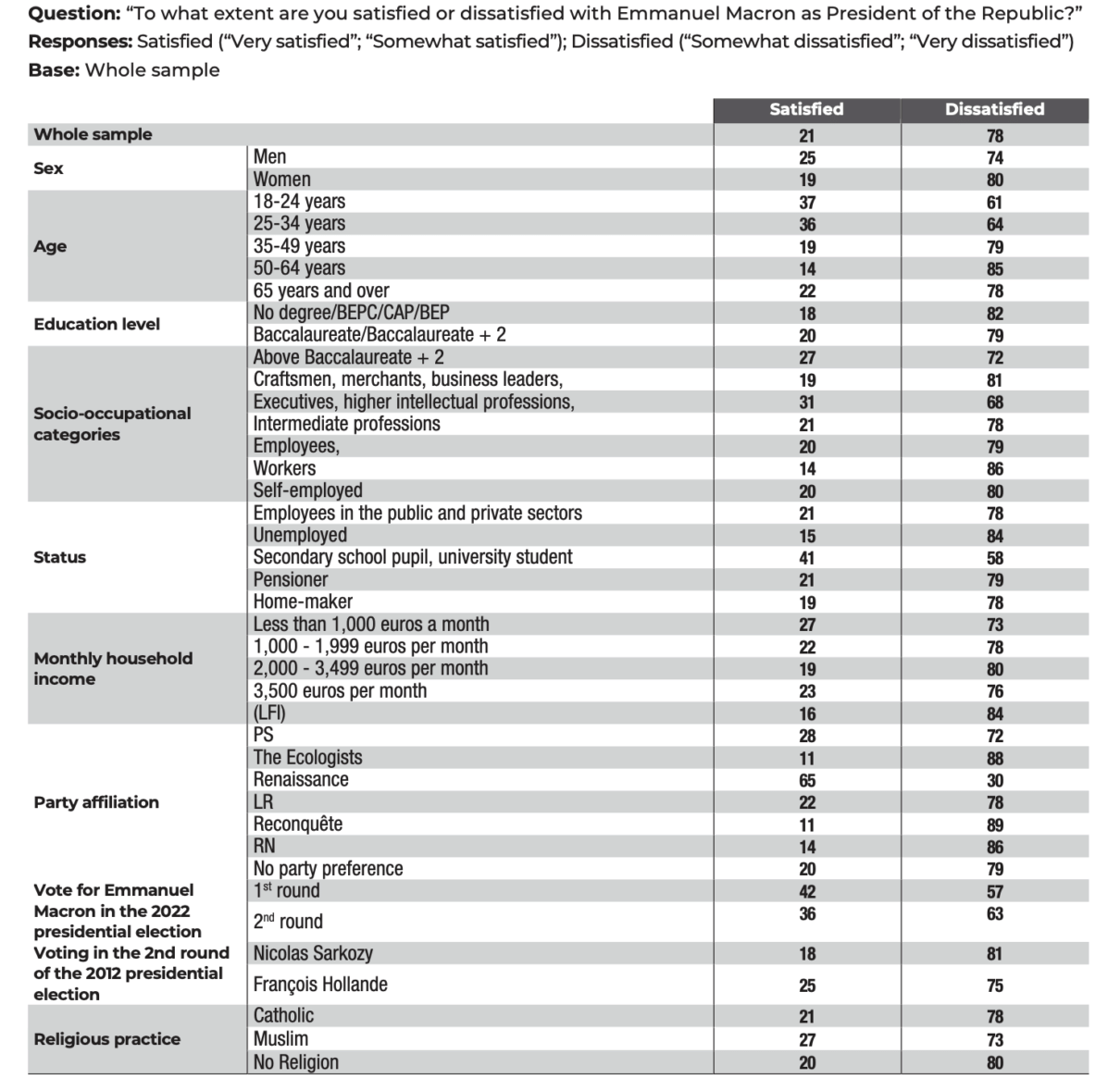
1. Emmanuel Macron’s presidency is drawing to a close amid a climate of serious concern. More than three-quarters of those surveyed (78%) say they are “dissatisfied” with Emmanuel Macron as President of the Republic.
2. The general election on 9 June 2024 shattered the Macronist electorate. The resulting lack of a majority in the National Assembly is disapproved of by the vast majority (80%) of those who voted for the President’s re-election in the first round of the 2022 presidential election, as well as by most of his second-round voters (77%), by most of those who voted for the presidential majority slate in the European elections on 9 June 2024 (87%) and, finally, by most of those who voted for the presidential majority in the 2024 general election (85%).
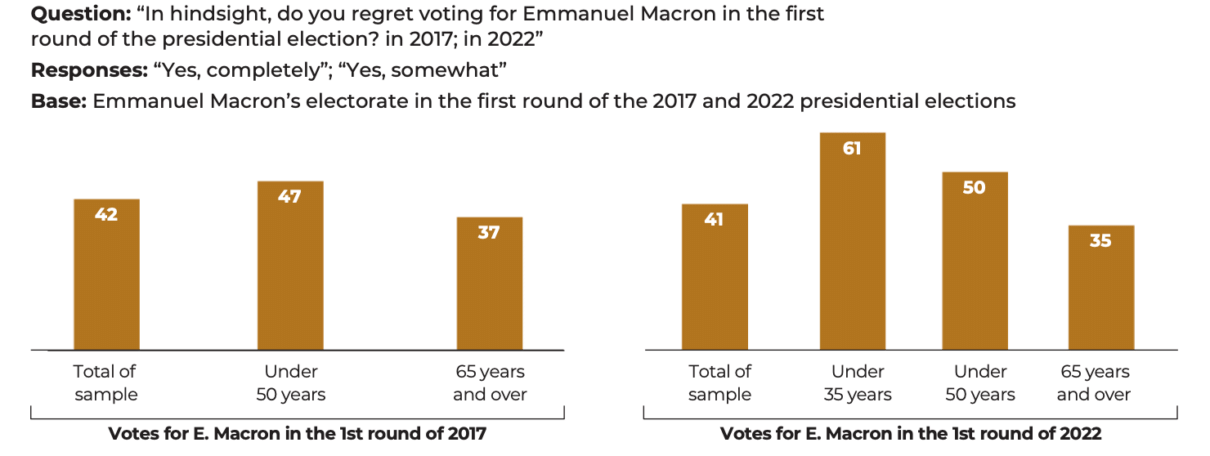
3. Younger people are the most likely to regret having voted for Macron: 61% of voters under the age of 35 who supported his re-election in 2022 now regret it. Conversely, those aged 65 and over are the most likely (61%) not to regret it, but they are also dissatisfied with Macron’s presidency (78%).
4. A minority (16%) of voters would have liked Emmanuel Macron to stand for re-election had he been entitled to do so (83% would not have wanted this).
5. The perceived alignment of the candidates with Emmanuel Macron’s ideas will influence how their candidacies are received, with both positive and negative consequences, given the President’s unpopularity and the desire among a large section of the electorate to cast a protest vote. Gabriel Attal is considered to be the most aligned with Emmanuel Macron’s ideas (56%), ahead of Édouard Philippe (53%), Bruno Retailleau (34%) and Raphaël Glucksmann (23%).
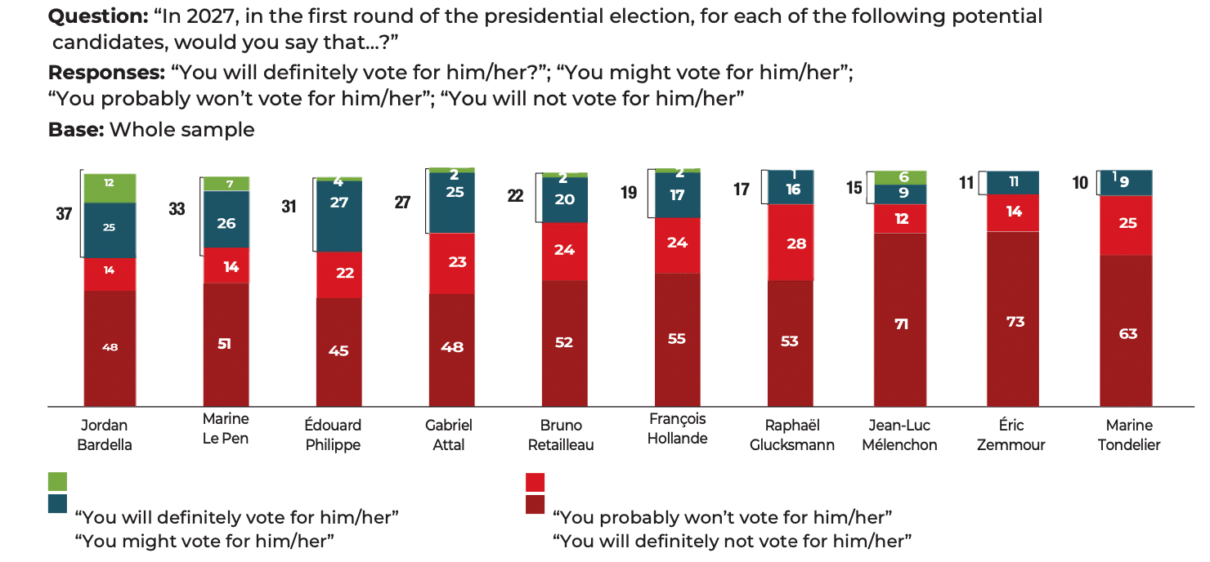
6. Among the declared candidates, Marine Le Pen (33%), Édouard Philippe (31%), Gabriel Attal (27%), Bruno Retailleau (22%) and Jean-Luc Mélenchon (15%) have the highest electoral potential.
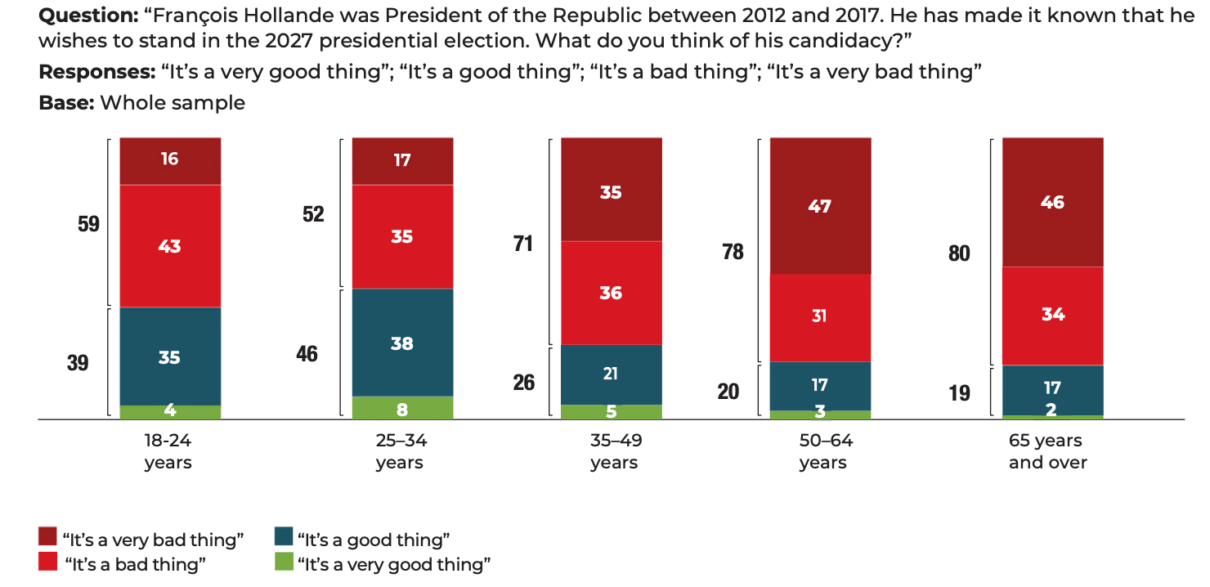
7. The prospect of François Hollande standing as a candidate in 2027 is seen as “a bad thing” by 72% of voters. A majority (59%) of those who voted for him in 2012 believe that another bid for office would be a “bad thing”. Supporters of the Ecologists are just as opposed (58%) to François Hollande standing for re-election as voters who identify as “left-wing” (61%).
8. The two candidates with the highest level of voting certainty are Marine Le Pen (7%) and Jean-Luc Mélenchon (6%).
9. As the presidential election approaches, a sense of anxiety and despondency prevails. With the election approaching, only a handful (3%) of those surveyed are enthusiastic about it. Even confidence is marginal (8%). The predominant feelings are anxiety (52%) and despondency (22%). Overall, three-quarters (74%) of voters are experiencing negative emotions in the run-up to the election. Although it was intended to offer opportunities to the population, the presidential election now appears to be seen as a threat.
10. Given what they know about “global trends in terms of economic growth and technological innovation”, 64% of those surveyed conclude that “France is now lagging behind”.
11. The majority (53%) believe that, in recent years, their standard of living has declined.
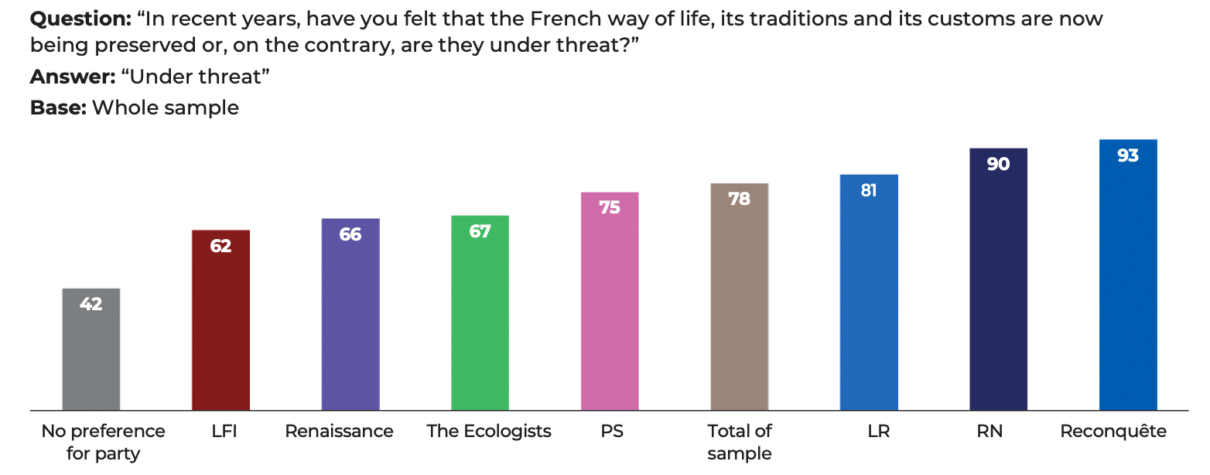
12. More than three-quarters (78%) of voters believe that “the French way of life, its traditions and its customs are under threat today”. This view is shared by 83% of those aged 50 and over, but the proportion among younger people (aged 18–24) is not much lower (70%).
13. For the majority (88%) of those surveyed, France’s level of debt could lead to a major financial crisis in the coming years.
14. At the end of his two terms in office, President Macron has failed to replace the traditional left–right divide with one pitting pro-European parties against populist parties, as he had pledged to do in 2017. On the contrary, the left–right divide has re-emerged as a result of the rise of populism, with the RN on the right and LFI on the left.
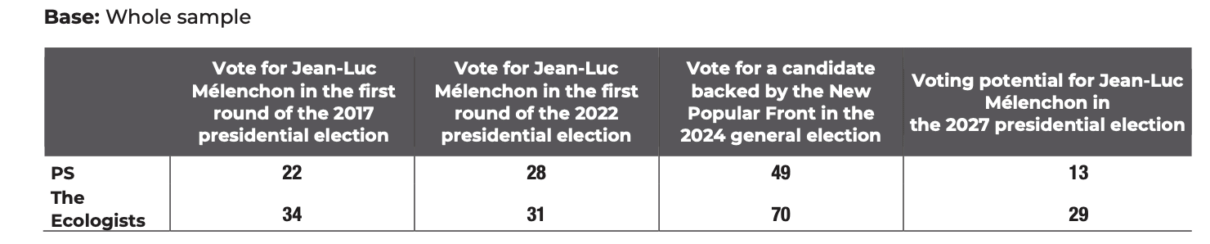
15. The left–right divide is becoming more pronounced and more polarised. All parties are under pressure from the populists of the RN and LFI. On the left, 36% of PS supporters and 62% of supporters of the Ecologists say they have already voted for LFI. On the right, 37% of LR supporters have already voted for the RN.
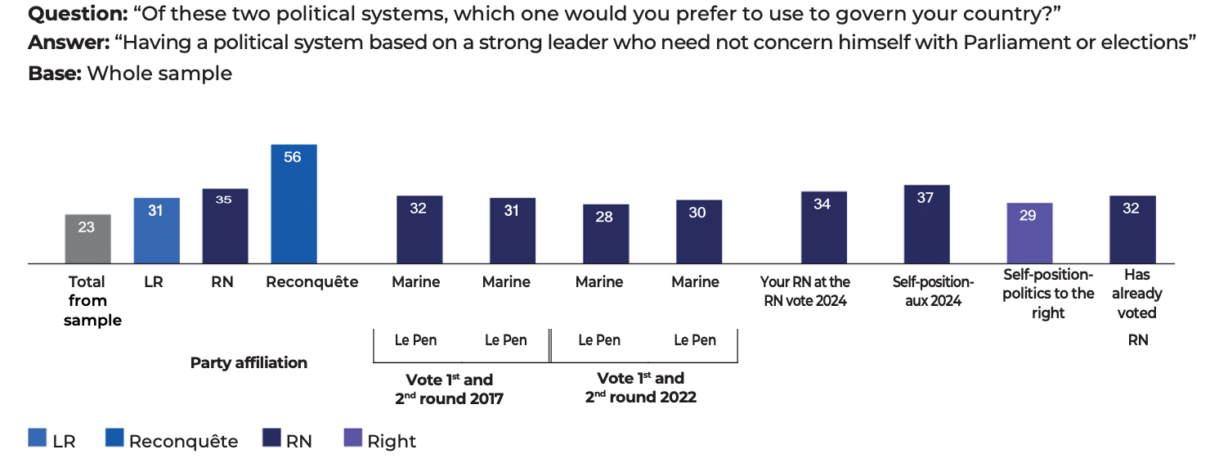
16. There are signs of authoritarian tendencies within a section of the right. A preference for “a political system based on a strong leader who need not concern himself with parliament or elections” is held by 23% of all voters, 31% of LR supporters and 35% of RN supporters, as well as 20% of Renaissance supporters.
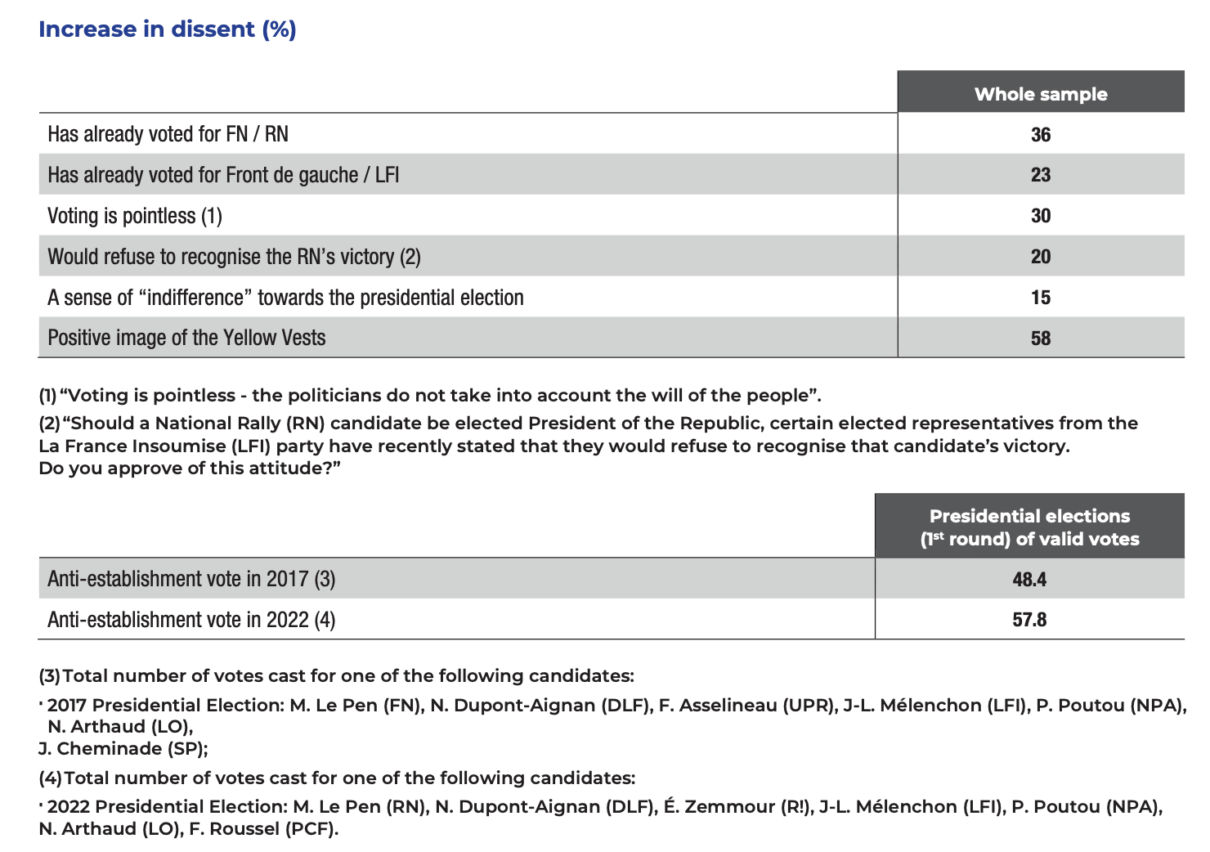
17. Conversely, on the left, there are signs of a tendency towards insurrection. The refusal to recognise the election of the RN candidate as President of the Republic is supported by 20% of all voters, including 54% of LFI supporters, 40% of those on the left, 36% of supporters of the Ecologists and 26% of PS supporters.
18. On the left, the authoritarianism of Mélenchonism is evident: 19% of LFI supporters say they prefer “a political system based on a strong leader who need not concern himself with parliament or elections”.
19. Our survey shows the growing influence of religion in national politics, which has so far mainly benefited Jean-Luc Mélenchon and LFI: 72% of Muslims surveyed say they have already voted for LFI, compared with 23% of all voters, 27% of those who describe themselves as “nonreligious” and 15% of Catholics. Jean-Luc Mélenchon’s dominance over the Muslim electorate appears to be a foregone conclusion, but, conversely, LFI’s extreme dependence on this electorate is now clear.
20. Nowhere are Catholics over-represented to the same extent as Muslims are among Mélenchon’s electorate. However, a higher proportion of Catholics (32%) than the average (29%) consider Marine Le Pen to be “more capable” of finding solutions to the country’s problems; they are also more likely (36%) than the average (33%) to say they will “definitely” vote or “might” vote for Marine Le Pen; finally, a higher proportion of them (30%) say they could vote for Bruno Retailleau than in the sample as a whole (22%).
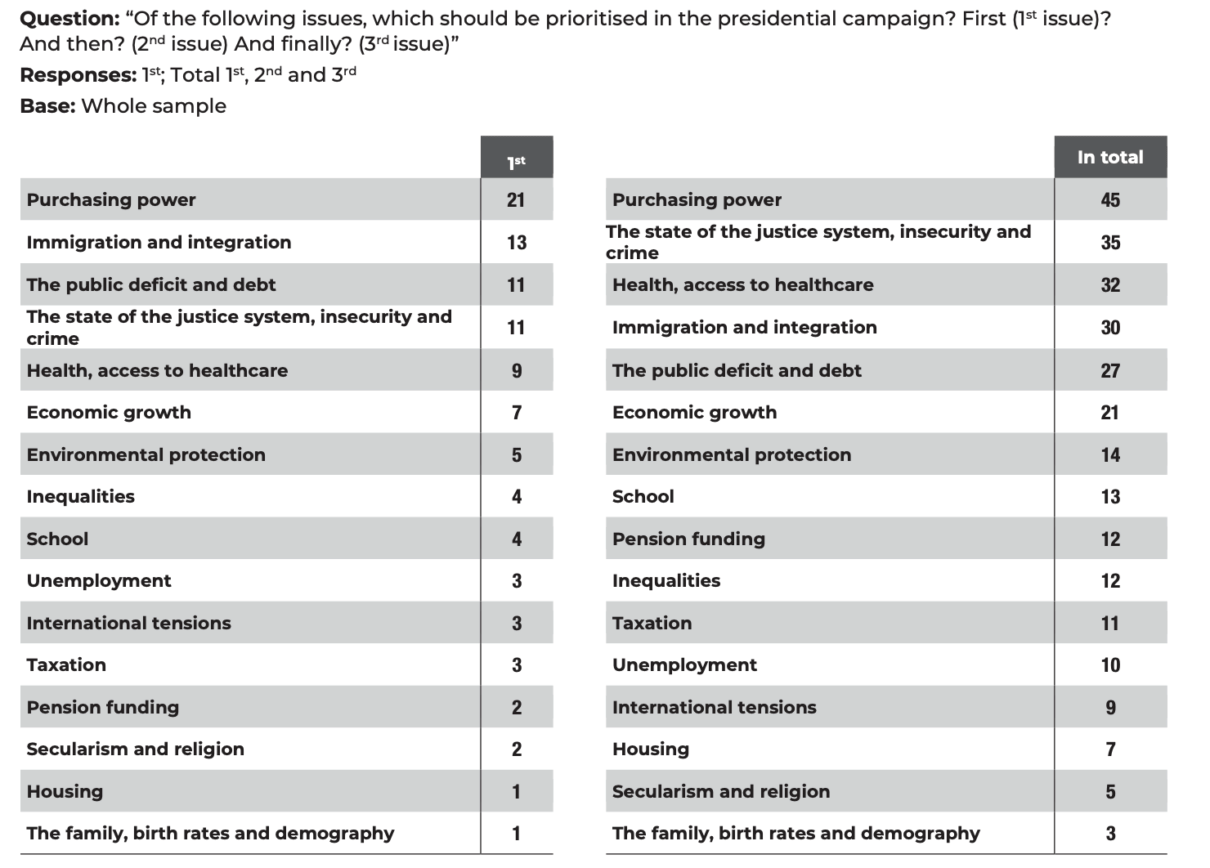
21. What should the presidential campaign be about? The issues considered to be priorities in the presidential campaign are purchasing power (45%), the state of the justice system, insecurity and crime (35%), health and access to healthcare (32%), immigration and integration (30%), and the public deficit and debt (27%).
22. For those who believe that “France is now lagging behind”, the choice of priorities to be discussed in order to help the country make up lost ground reflects a mindset that remains proactive: “re-industrialising the regions” (43%), “cutting taxes and easing the regulatory burden on our businesses” (43%), “restoring a competitive and export-oriented agricultural sector” (35%).
23. For those who believe that “France is still in the running”, the three issues deemed to be priorities for France to “maintain its prosperity, power and influence” are the same; they reflect the same sense of determination, which is more prevalent among the general public than is suggested by the image portrayed by its political and media representatives: “reindustrialising the regions” (40%), “cutting taxes and easing the regulatory burden on our businesses” (35%) and “restoring a competitive and export-oriented agricultural sector” (31%).
24. The French continue to overwhelmingly support their country’s membership of the European Union (75%). Support is virtually unanimous among supporters of Renaissance (93%), the PS (90%), the Ecologists (88%), LR (86%) and LFI (82%). It remains the dominant view among RN supporters (58%). The European currency, the euro, enjoys even stronger support (81% of those surveyed).
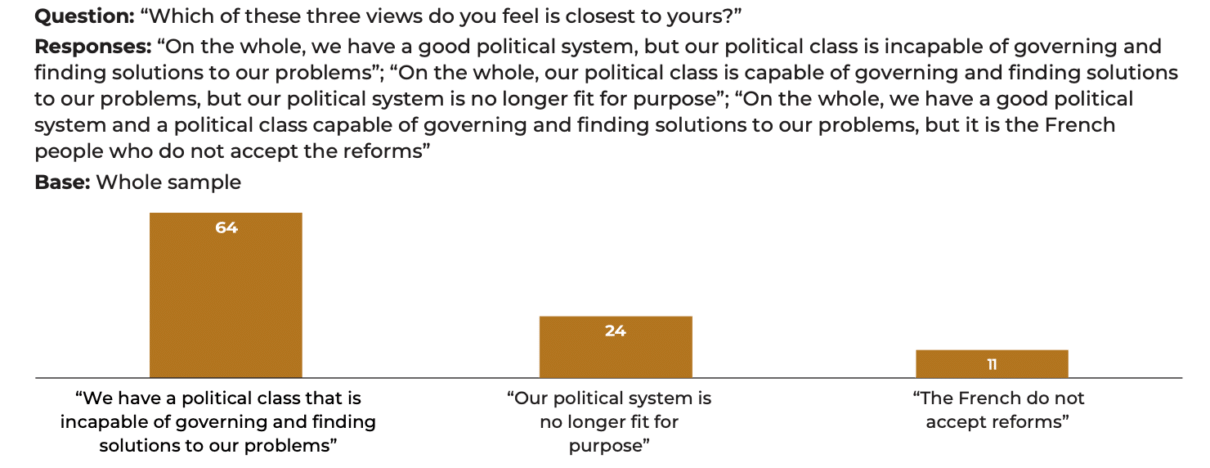
25. The French believe that their problem lies not with their institutions but with the political class. 64% of those surveyed replied: “On the whole, we have a good political system, but our political class is incapable of governing and finding solutions to our problems”; 24% believe that “our political class is capable of governing and finding solutions to our problems, but our political system is no longer fit for purpose”. Finally, 11% believe the root of the problem lies in the fact that “it is the French who do not accept the reforms”.
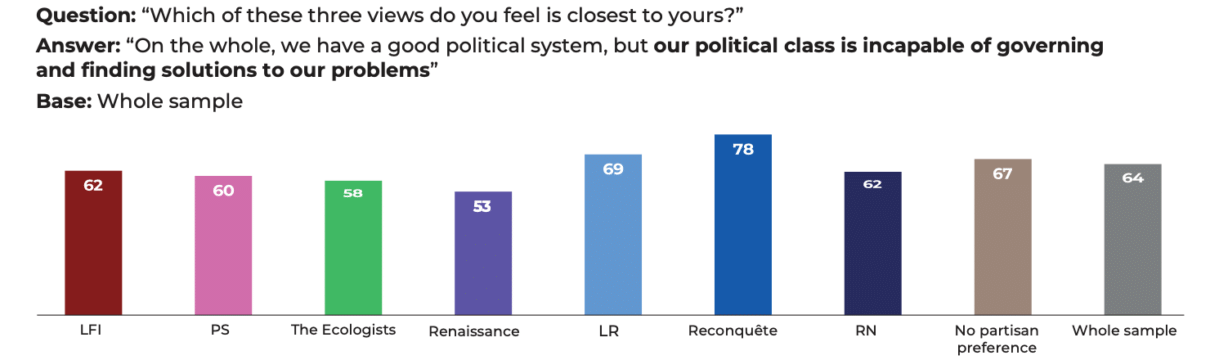
26. A majority of people are critical of the political class, regardless of their political affiliation: this is evident among supporters of Reconquête (78%), LR (69%), LFI (62%), the RN (62%), the PS (60%), the Ecologists (58%), and Renaissance (53%). Criticism of a “political class that is incapable of governing and finding solutions to our problems” is also more widespread among voters with no party affiliation (67%) than among the electorate as a whole (64%).
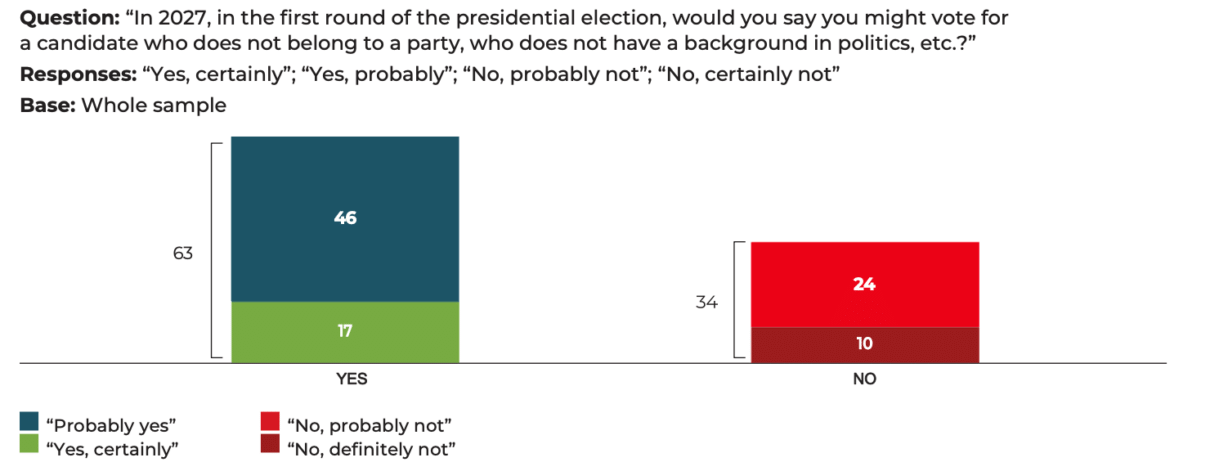
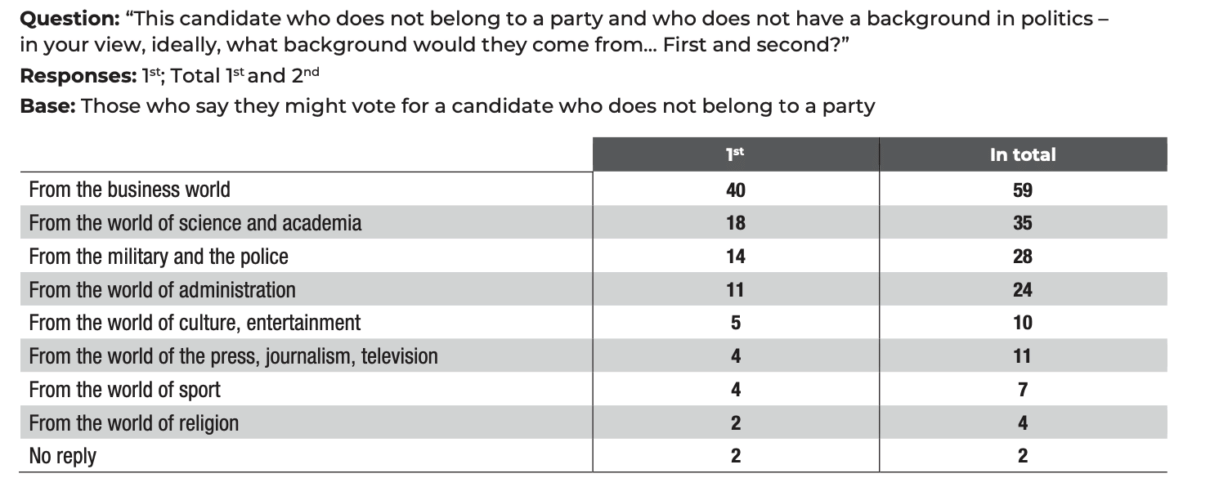
27. The idea of a “candidate who does not belong to a party and who does not have a background in politics” is one of the signs of the loss of credibility in our politicians and those in power. The figure of a candidate from civil society should be seen as a manifestation of anti-political sentiment. It has the support of 63% of voters. According to 59% of the voters surveyed, this candidate should come from the business world, whilst 35% believe they should come from the world of science and academia.
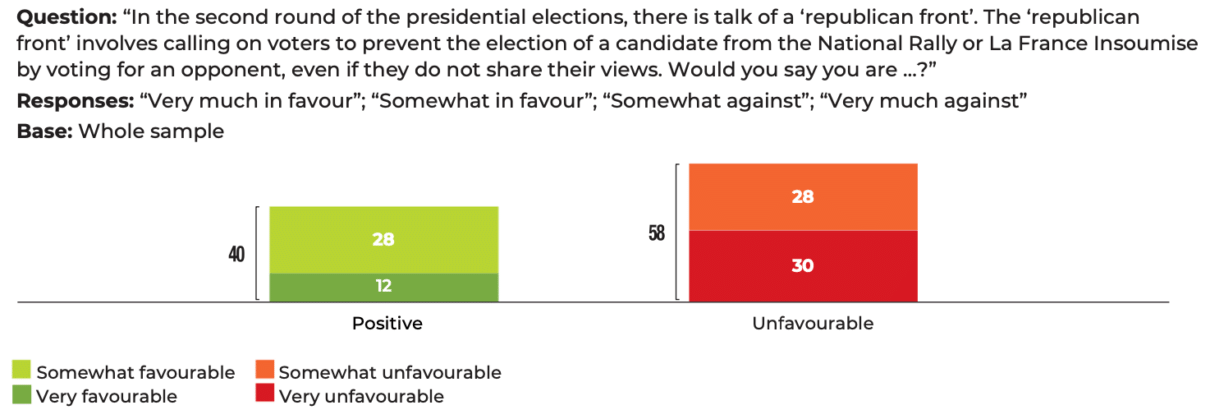
28. Defined in our survey as “an appeal to voters to prevent the election of a candidate from the National Rally or La France Insoumise by voting for an opponent, even when one does not share their views”, the “republican front” is largely rejected by the public (58%).
29. Whether the “republican front” is accepted or rejected is determined by political logic: 62% of voters who identify as left-wing are in favour of it, whilst 65% of voters who identify as right-wing are opposed to it.
30. On the left, supporters of the Ecologists are the most in favour (79%) of the “republican front”, ahead of supporters of the PS (71%). Among supporters of Jean-Luc Mélenchon’s party, support is less pronounced (52%). LFI voters seem to sense that the appeal to this electoral discipline will no longer automatically work in their favour.
31. On the right, the “republican front” is widely rejected, whether by supporters of the RN (82%), by voters who voted for Marine Le Pen in the second round of the 2022 presidential election (84%), or by supporters of LR (60%).
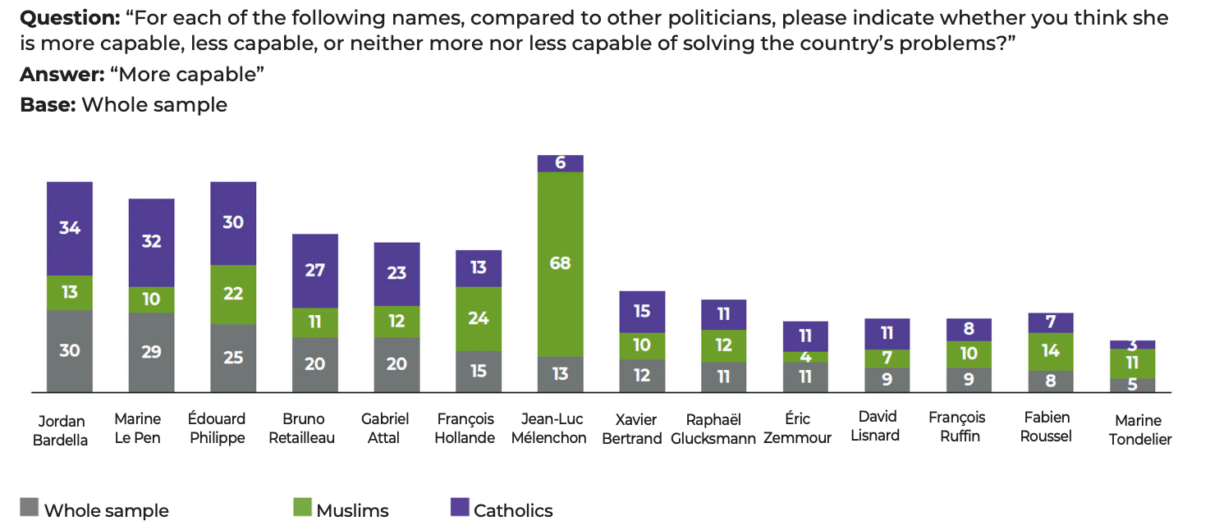
32. In the public eye, the two populist candidates are not considered to pose an equivalent level of danger. When it comes to Marine Le Pen, 29% of those surveyed consider her ability to find solutions to our problems to be greater than that of other politicians, whilst 13% hold the same view of Jean-Luc Mélenchon. The RN candidate’s electoral potential (33%) is significantly higher than that of LFI (15%). Finally, whilst 51% of voters rule out voting for Marine Le Pen, 71% rule out voting for Jean-Luc Mélenchon. The LFI candidate is rejected by more voters than Marine Le Pen.
33. Feeling anxious and despondent, voters hope to restore institutional and political order in 2027. They might not succeed. Disgruntled and determined to punish the governing parties, they might elect a protest candidate as president, which would lead them to use the general election to oppose him with a counter-power. The French could therefore confer presidential powers on the elected candidate on 2 May 2027, only to strip them of any ability to govern, thereby prolonging – just as everyone is seeking to move beyond it – the serious upheaval caused by the dissolution of 9 June 2024. Such is France’s turmoil.
34. In reality, the rise in support for populist parties is undeniable. The data from the Fondapol opinion polls mirrors the results of the first round of the three previous presidential elections. The total number of votes cast for populist, rightwing and left-wing candidates accounted for 32.8% of the votes cast in 2012, 48.4% in 2017 and 58% in 2022.
President Emmanuel Macron is coming to the end of his second term in office amidst a climate characterised by a mixture of anxiety, dismay, disappointment, despondency and rejection. It will be up to his successor to dispel this gloomy atmosphere and restore the country’s vitality. But the French now doubt that the presidential election will be able to provide a solution to their problems. They have come to wonder whether this election might not be one of the main causes of their difficulties. Perhaps they are beginning to have doubts about democracy, or even about politics.
Indeed, today, in the summer of 2026, the French have every reason to wonder what to expect from an election. Between the first round of the last presidential election, on 10 April 2022, and the second round of the general election following the dissolution of Parliament, on 7 July 2024, voters went to the polls seven times without ever managing to find a political solution, without managing to establish a government programme – that is to say, a programme put forward by candidates and endorsed by their election.
Indeed, Emmanuel Macron’s re-election in 2022, like his election in 2017, owed much, if not everything, to the fact that voters were faced with an impossible choice. However, through its very repetition, the lack of choice ultimately undermines the legitimacy of the electoral process, even though it lies at the heart of the democratic system. The presidential election must not become a poll in which voters are subject to an implicit obligation to choose a candidate. In 2017, the second round was the result of such a vote, although Emmanuel Macron’s election was also down to the enthusiastic support of voters who were won over by the candidate and his programme.
In 2022, voters are faced with the same kind of call to action. It is even more distressing because it is an exact repeat of what they went through five years earlier. The repetition demonstrates a major failure on the part of the President. But it is also more of a struggle because, this time, it requires voters to re-elect the incumbent President, as was the case with Jacques Chirac in 2002. However, it is essential that a president whose re-election is the result of conditions that are so restrictive for voters should not act as though he regarded his re-election as a sign of approval or an expression of satisfaction. This is what the French people intended to convey through their vote in the general election that followed in June 2022, which produced a result unfavourable to the President. The French people did not want to give him a stable majority in the National Assembly. It is not without reason that they only gave him a relative majority. The re-elected President’s late campaign could be seen as a particularly unwelcome display of self-assurance. It has not been pointed out that, during the 2022 presidential election, voters did not have the opportunity to express their views on Emmanuel Macron’s five-year term, just as François Hollande’s voters did not in 2017, since the Socialist President had ultimately decided not to stand for re-election.
In the case of François Hollande, deciding not to stand for re-election, or, in the case of Emmanuel Macron, being re-elected under constraints that do not give voters a genuine choice, are two ways of avoiding the verdict of the people. In the case of François Hollande, the outgoing President chose to avoid the issue.
For Emmanuel Macron, the avoidance of sanction resulted from the very limited options available to those who did not vote for him. Two situations which have given rise to further causes of frustration and exasperation among the electorate. All the more so because, in the case of Emmanuel Macron, the constitutional limit of two consecutive terms once again deprives voters of the opportunity to express their verdict at the end of a presidential term. Following 2017 and 2022, 2027 will be the third consecutive occasion on which the presidential election no longer allows the French people to exercise their right to hold politicians to account through the ballot box.
Consequently, firstly, because he had failed to take into account the very specific circumstances surrounding his re-election, the President lost his absolute majority in the 2022 general election. Subsequently, having governed as if the elections had gone entirely in its favour – or indeed as if they had not taken place at all – the Macronist slate suffered a clear setback in the 2024 European elections. Voters handed victory to the RN, led by Jordan Bardella, two years after the presidential election in which Marine Le Pen was defeated by Emmanuel Macron. The decision to dissolve parliament, taken on the day the results of the European elections were announced, had no chance of restoring the presidential majority. On the contrary, it could only serve to confirm the voters’ resolve – which had grown even stronger – to make the RN an even more powerful party. Haphazard, adventurous and enigmatic, President Macron’s latest resort to the ballot box will deprive the country of any majority and any chance of recovery before the general election in June 2027.
The final three years of President Macron’s second five-year term are further fuelling the French people’s deep political disarray. The unbridled pace of a world that we no longer seem able to keep up with, the challenges the country must face on its own – challenges which grow more daunting with every passing year – stand in stark contrast to the spectacle of a political class deemed incapable of governing, yet which is embarking on a twelfth presidential election, arguably the most perilous of all for the country.
| Please note The questionnaire for the Fondapol survey, conducted in partnership with OpinionWay, was administered between 1 and 8 June 2026. The uncertainty surrounding Marine Le Pen’s candidacy for the 2027 presidential election could not be resolved before 7 July. This unprecedented situation led us to submit a questionnaire that included the names of Jordan Bardella and Marine Le Pen. Incidentally, this precaution gave us the opportunity to observe differences in the responses to the same question, depending on whether the National Rally’s presidential candidate was Marine Le Pen or Jordan Bardella. Although this is not the focus of this work, we have included some of this data for the reader’s information; it can be found in the following pages. |
What might the post-Macron era look like ?
The end of macronism under Macron
Question: “To what extent are you satisfied or dissatisfied with Emmanuel Macron’s performance as President of the Republic?”
Emmanuel Macron came to power in a France that was already deep in crisis. In fact, it was because of a decline that had been evident since the early 1980s that he was able to stand as a candidate and then be elected. Emmanuel Macron has benefited from a “mild anti-establishment sentiment” through which voters have punished the governing parties on the left, in the centre and on the right, without having to run the risk of a populist shift. But after ten years of Macronism, who should we turn to? We cannot simply return to the parties of the left, centre and right, all of which were sidelined in one fell swoop in 2017. In the minds of the French, these parties have often governed and been deeply disappointing. What’s more, they haven’t really disappeared since 2017; they have simply moved on and changed their name, but they have, in one way or another and to varying degrees, been involved in a “Macronism” that needed them, their senior figures and their elected representatives, as it was starting out without a following.
One of the harmful effects of the Macron era has been to blur the dividing lines between the left, the centre and the right, as well as between the government and the opposition. As a result, today, when it comes to any alternative to Macronism, the French may feel that their only option is to elect one of its more or less direct heirs – whether they acknowledge this or not – or to opt for a populist rejection of the status quo.
Electing one of its heirs implies partly continuing Macronism, or at least not sanctioning it. Is it possible to envisage a successor to Emmanuel Macron who embodies the spirit of “Macronism” without running the risk of making them bear the brunt of criticism levelled at “Macronism”? The French public’s opinion of their political class has deteriorated to such an extent that this poses a significant risk to any candidate from the governing parties, regardless of how closely aligned they may have been with Macronism. Is it possible to prevent a populist candidate from being elected? Should we, once again, be preparing to put up a “republican front” – or even two? It may also be to express their desire to escape the repetition of this pitiful plea that the French dream of a businessman as president.
1. The dissolution of 9 June 2024 and the break with Macronism
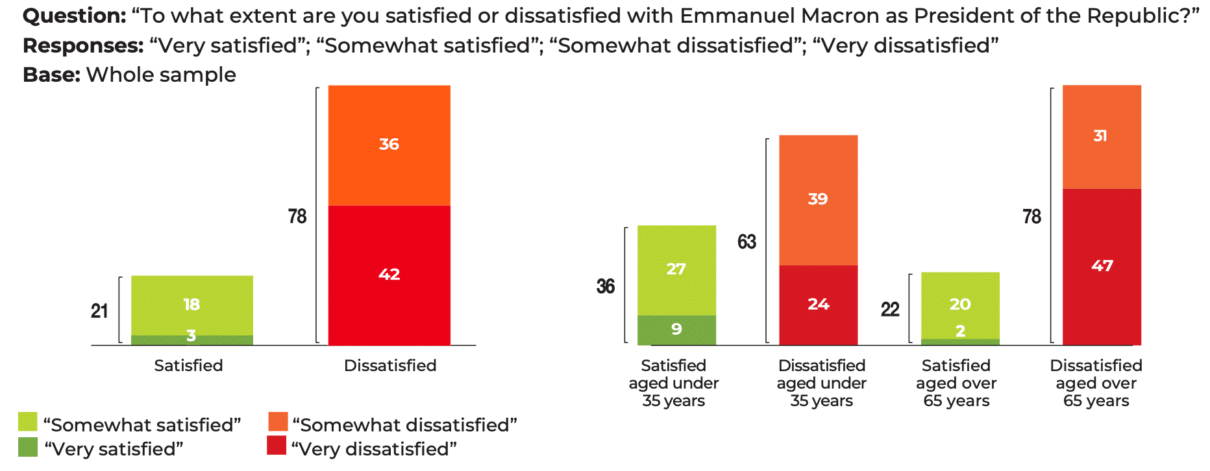
At the end of the outgoing President’s two terms of office, his record has been harshly criticised1. It is not just the high level of dissatisfaction (78%) that is worth noting here, but also the high proportion of those who say they are “very dissatisfied” (42%).
French people’s satisfaction with Emmanuel Macron’s presidency (%)
Copyright :
Fondapol – June 2026
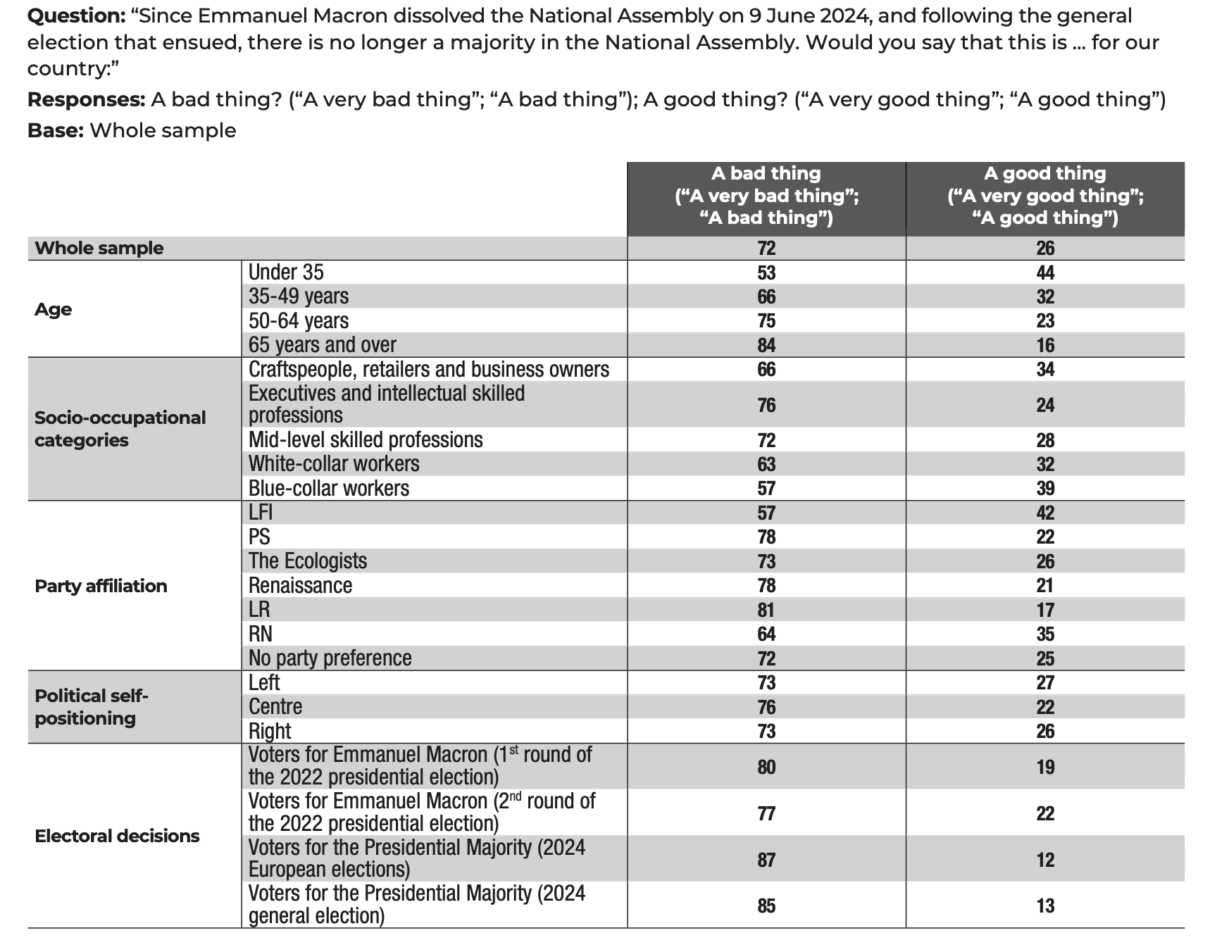
Voters’ view on the dissolution (%)
Copyright :
Fondapol – June 2026
Public opinion and the Macron presidency (%)
Copyright :
Fondapol – June 2026
Interpretation guide: across the entire sample, 21% of those surveyed say they are “satisfied with Emmanuel Macron as President of the Republic”; 78% are not satisfied.
Whilst many voters may recognise the extreme difficulty of governing, and even acknowledge failures, most do not accept reckless decisions that have catastrophic consequences for the whole country. The dissolution of 9 June 2024 is Emmanuel Macron’s major mistake. In 1997, Jacques Chirac had also failed in his attempt to shore up his majority in this way, but to say the least, his failure enabled the public authorities to function, thanks to an established opposition capable of taking the reins of a new government and steering policy. In 2024, the outcome is quite different. The newly elected National Assembly is unprecedented, informal and chaotic. It has neither a majority nor an opposition, and remains incapable of forming either.
Furthermore, in 2026, three-quarters (72%) of those surveyed considered dissolution to be a “bad thing” (26% saw it as a “good thing”). A widely held view logically implies that it is held by a majority across most social, professional and political groups. But the details highlight the considerable damage this decision has caused among Emmanuel Macron’s supporters.
It is the very heart of Macronism that has been hit. The view that the dissolution was a bad thing is all the more widespread among older voters. Compared with the overall average (72%), this is evident from the age of 35 and over (75%), followed by those aged 50 and over (80%) and those aged 65 and over (84%). The dissolution met with relatively less opposition among LFI supporters and among RN supporters. Conversely, opposition to the dissolution is soaring among supporters of the PS (78%), Renaissance (78%) and LR (81%).
The dissolution is opposed by 80% of voters who voted for Emmanuel Macron in the first round of the 2022 presidential election, by 77% of those who voted for him in the second round, and by 87% of those who voted for the Renaissance slate in the European elections on 9 June 2024, and by 85% of those who voted for his presidential majority coalition in the 2024 general election. Finally, disapproval is most prevalent among those on the left (73%), those on the right (73%), and those who declare no party preference (72%) – a group that accounts for more than 40% of the sample.
2. In the summer of 2026, 41% of his voters regret having voted for Macron
41% of voters who say they voted for Emmanuel Macron in the first round of the 2022 presidential election now say they regret it. A majority (57%) do not regret it. It is the youngest people who regret voting for Macron the most. Excluding those who were ineligible to vote at the time due to their age, 61% of voters under the age of 35 who voted for the President’s re-election in 2022 now regret doing so (39% do not regret it). Conversely, it is among the oldest age group – those aged 65 and over – that the proportion of those who do not regret it (61%) is highest (compared with 35% who say they do regret it).
But saying that one does not regret voting for Emmanuel Macron in 2022 does not necessarily mean that one views his presidency favourably. In fact, the 50-plus age group, who voted overwhelmingly for Emmanuel Macron at the time, are the most likely (62%) not to regret that choice. However, they are also the group most likely (82%) to say they are dissatisfied with Emmanuel Macron as President of the Republic; indeed, half of them (48%) say they are “very dissatisfied”, while 80% consider the dissolution as a “bad thing”. Macron’s voter base was shattered on 9 June 2024.
The fact remains that if the figures on regret do not entirely match the high level of dissatisfaction recorded, it is no doubt, at least in part, because, in the run-up to both the 2017 and 2022 presidential elections, a vote for Macron was seen as the way to prevent Marine Le Pen from being elected. One can imagine that these voters still believe, with the benefit of hindsight, that Emmanuel Macron was the best candidate, both in 2017 and in 2022. If we were to accept this latter interpretation, it would shed light on the national mindset. The French are struggling with a shortage of candidates deemed capable of protecting them from an anti-establishment president, be it Marine Le Pen or Jean-Luc Mélenchon.
Regret at having voted for Emmanuel Macron, by age (%)
Copyright :
Fondapol – June 2026
3. The double failure of Macronism: the left–right divide has resurfaced, and the populists are gaining ground
The political formula of Macronism rests on two dimensions linked by the centrality of the European reference: firstly, there is the idea of moving beyond the left–right divide through a synthesis, the “at the same time” approach; secondly, the “at the same time” approach makes it possible to bring together figures and parties from both the left and the right, uniting them in a common political endeavour characterised by their openness to a federal evolution of the European Union. Thirdly, this coalition was intended to replace the traditional left–right divide with a divide pitting, on the one hand, pro-European parties on the right and left against, on the other, Eurosceptic populist parties on the right and left.
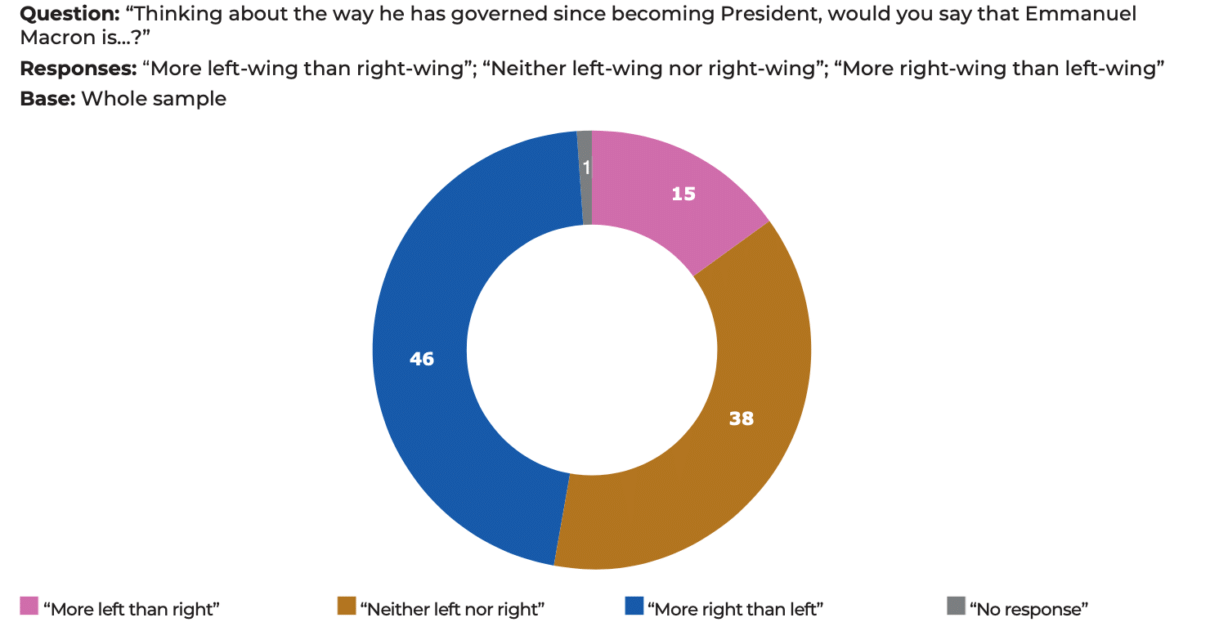
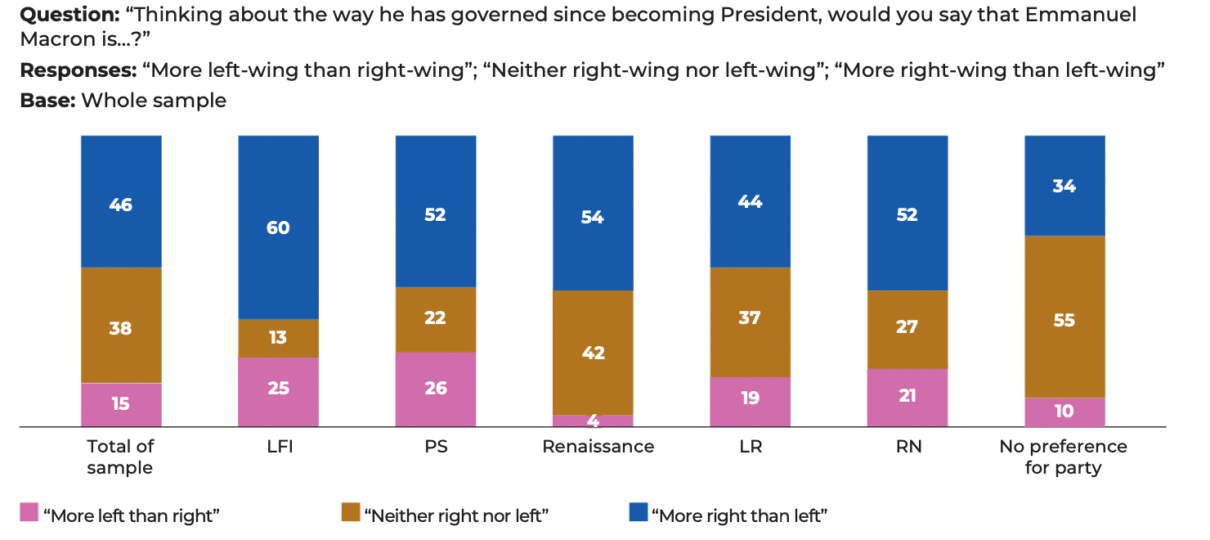
Fundamentally, voters have not sufficiently recognised that the left–right divide has been overcome. Nearly half of the French population believe that the President of the Republic has pursued right-wing policies (46%); conversely, a minority (15%) see his policies as left-wing. A third (38%) believe that this policy is “neither right-wing nor left-wing”. As a result, overall, a majority of voters (61%) place Emmanuel Macron on the right or the left – that is to say, on the traditional political spectrum from which the outgoing president sought to break free.
As regards the move to replace the traditional left–right divide with a divide between moderate pro-European parties and Eurosceptic populist parties, it is not opinion polls but election results that speak for themselves; one cannot help but note the rise of populist parties, on the right with the RN, and on the left with LFI. This was evident right from the first round of the 2022 presidential election, in a spectacular and entirely unprecedented manner in our electoral history; it was also evident, of course, in the second round. We saw the same thing in the 2022 general election and, even more so, in 2024, during the European elections and the general election.
Opinions on Emmanuel Macron’s political stance (%)
Copyright :
Fondapol – June 2026
Was Emmanuel Macron a left-wing or a right-wing president, or neither? (%)
Copyright :
Fondapol – June 2026
Note: Among supporters of Renaissance, 42% believe that Emmanuel Macron is neither right-wing nor left-wing.
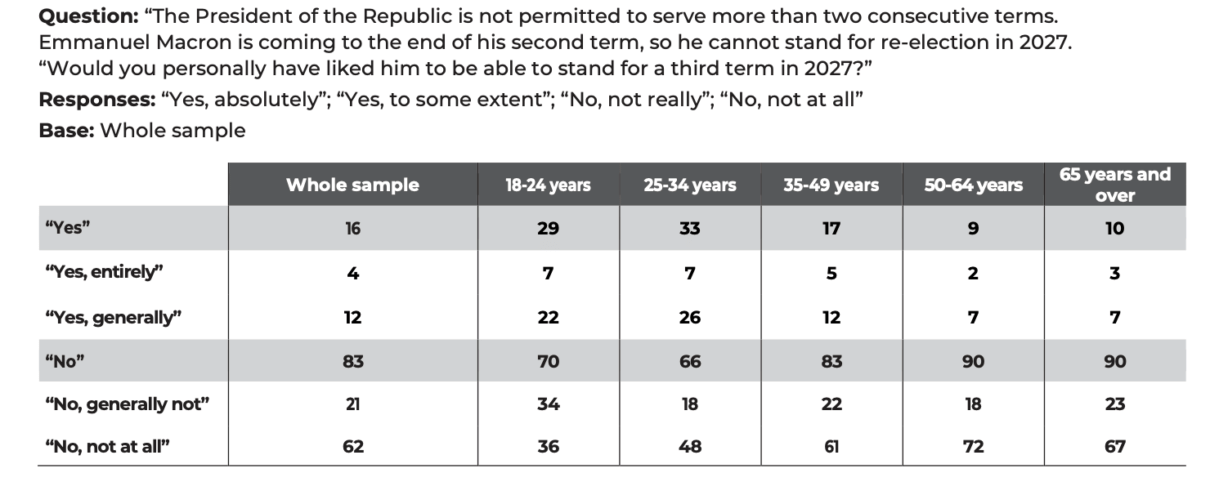
To gain a clearer picture of voters’ views on Emmanuel Macron’s presidency and his popularity, we took into account the constitutional prohibition on a third consecutive term by phrasing the question as follows: “The President of the Republic is not permitted to serve more than two consecutive terms of office. Emmanuel Macron is coming to the end of his second term, so he cannot stand for re-election in 2027. Would you personally have liked him to stand for a third term in 2027?”.
Fewer than one-fifth (16%) of those surveyed said they would have liked Emmanuel Macron to be able to stand for a third consecutive term, compared with 83% who would not have wanted him to ; nearly two-thirds (62%) of those surveyed even say they would “not have wanted it at all”.
Would you have liked Emmanuel Macron to be able to stand for a third term in 2027? (%)
Copyright :
Fondapol – June 2026
A political class deemed incapable of governing
In a previous Fondapol study2, we noted the erosion in public opinion of what we termed the “privilege of competence” accorded to governing parties; namely the notion that, compared with populist parties, moderate parties were better able to manage the affairs of state. This privilege of competence reflects a difference between the various political leaders and the ideological orientation of their parties, but also establishes a hierarchy according to which parties and political leaders are more or less capable of governing. The hierarchy is established pontaneously by the people we interviewed here. It is conceivable that collective perceptions of this aptitude are based on a range of factors of varying degrees of objectivity, including public profile, background, qualifications, political affiliation, the nature of their public statements, their style, experience in government, etc.
1. The governing parties have lost their reputation of competence
The reputation for competence enjoyed by the governing parties has been eroding for some time. This process stems from the increasingly worrying developments in the country and the inability of those in power to reverse them. This inability was made all the more apparent by the frequent changes in government that became more common from the 1980s onwards. The practical result has been to reduce the stigma attached to populist parties, which have long been seen as the epitome of incompetent and dangerous parties, unfit to hold office. We had previously observed, in June 2021, that this phenomenon was particularly favourable to Marine Le Pen: at the time, 21% of those surveyed considered her “more capable of responding to the concerns of the French than other politicians”3. The proportion of respondents who attributed this competence to her had become the same as that of those who gave a favourable response regarding the President of the Republic, Emmanuel Macron (20%). We then noted that it was not the perception of populist party competence that had grown in public opinion, but rather the opposite: the perceived competence of the governing parties had declined to such an extent that they were ultimately placed on a par with the populist parties, in this case the RN.
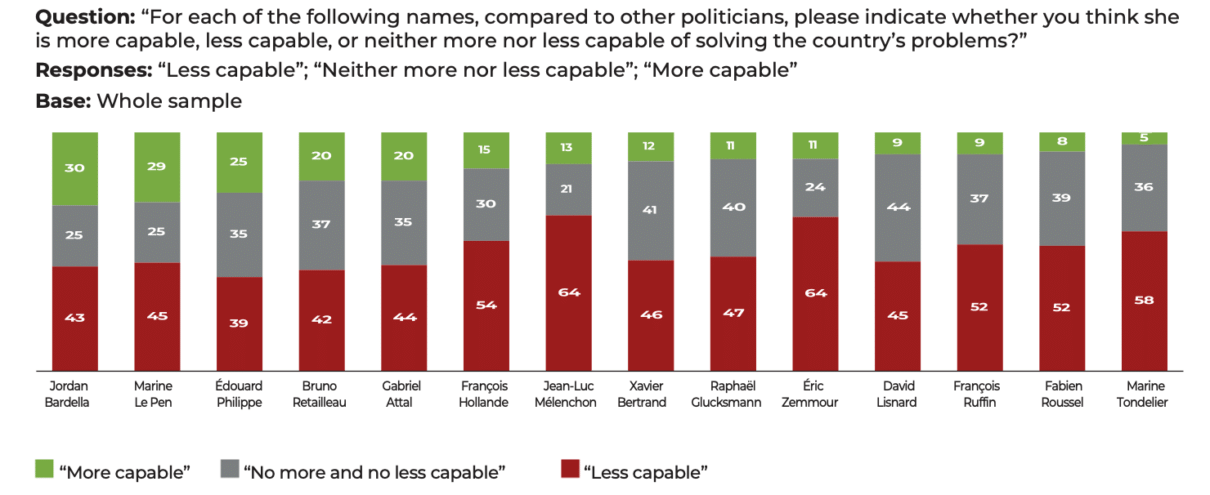
In June 2026, the turnaround appears to be complete. Voters consider Marine Le Pen (29%) and Jordan Bardella (30%) to be “more capable” of governing than the representatives of the governing parties, ahead of Édouard Philippe (25%), Gabriel Attal (20%) and Bruno Retailleau (20%). All three of them have held government posts. The same goes for François Hollande. Only 15% of those surveyed consider the former President of the Republic to be more capable of governing than other politicians. Finally, it should be noted that, with 13%, Jean-Luc Mélenchon does not get this same recognition. It is tending to become more favourable towards populist parties in general than towards governing parties. Finally, it should be noted that, with 13%, Jean-Luc Mélenchon does not get this same recognition, which is tending to become less favourable to governing parties than to populist parties in general, and right-wing parties in particular.
On the whole, we have a good political system, but our political class is incapable of governing (%)
Copyright :
Fondapol – June 2026
The political class is criticised regardless of the respondents’ political affiliations (%)
Copyright :
Fondapol – June 2026
Is the political class still capable of solving the country’s problems? (%)
Copyright :
Fondapol – June 2026
2. The lack of public confidence in those in power is reflected in the assessment of their performance
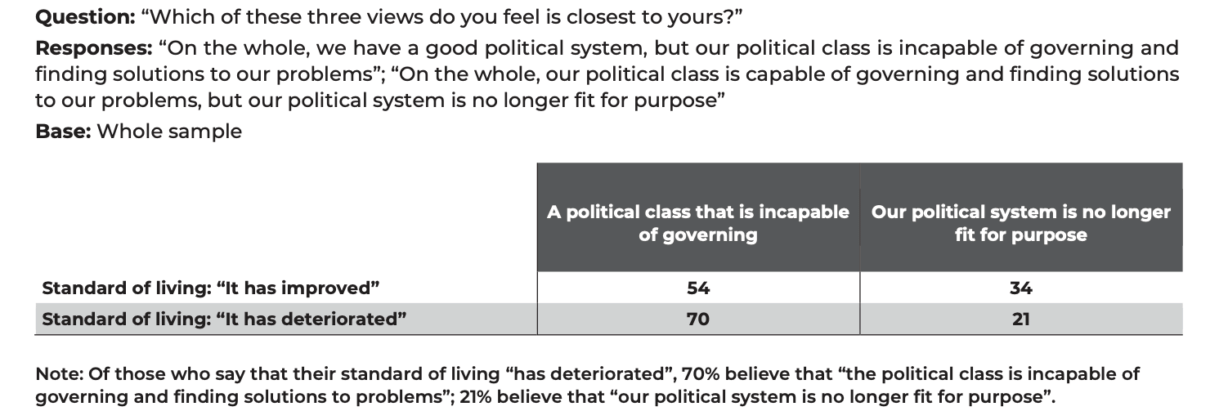
The survey reveals that the public has passed a very harsh judgement on the government’s record. A majority (53%) believe that their standard of living has declined in recent years, whilst only a small minority (6%) report an improvement (compared with 39% who say it has remained stable). More than three-quarters of voters believe that the France way of life, its traditions and its customs are under threat today; conversely, only 21% believe that this intangible heritage is being preserved. Nearly two-thirds (64%), based on what they know about “global trends in terms of economic growth and technological innovation”, conclude that “France is now lagging behind”. Finally, an even larger majority (88%) believe that France’s level of debt could lead to a major financial crisis in the coming years. Whatever the issues put to the public for consideration, a majority of respondents consistently express dissatisfaction.
Rejection of the political class is much more pronounced among voters who feel that their standard of living has deteriorated … (%)
Copyright :
Fondapol – June 2026
Note: Of those who say that their standard of living “has deteriorated”, 70% believe that “the political class is incapable of governing and finding solutions to problems”; 21% believe that “our political system is no longer fit for purpose”.
What are the priority issues in the presidential election (%)
Copyright :
Fondapol – June 2026
Note:
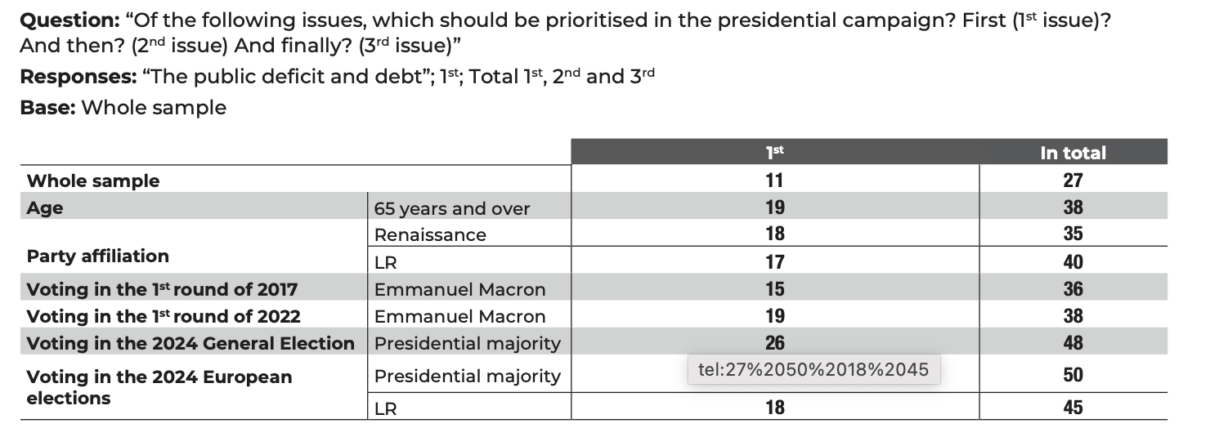
11% of French people believe that the issue of the public deficit and debt should be the priority in the 2027 presidential campaign.
27% of French people believe that the issue of the public deficit and debt should be one of the three priorities of the 2027 presidential campaign, out of the sixteen topics proposed.
Perception of financial risk in France (%)
Copyright :
Fondapol – June 2026
Note: Of those who voted for the presidential majority in the 2024 general election, 26% believe that the issue of the public deficit and debt should be the priority in the 2027 presidential campaign.
3. No more politicians? The idea of a candidate from civil society
The conflict between French society and its political class is also reflected in the idea of a candidate who would be popular precisely because he or she does not come from the political class. It’s not a new idea. In 2026, when the time comes to elect a new president, the idea has not gone away. It is precisely since Emmanuel Macron’s emergence in 2016 and his election in 2017 that the prospect of a candidate from civil society seems to have become a reality. Admittedly, Emmanuel Macron was not entirely outside the sphere of state power before his election, but he had never been elected to any office whatsoever, which is a first. He therefore held the promise of a new approach to governance. Emmanuel Macron was responding to the expectations of the French people, who, exasperated yet cautious, wanted to engage in a “vote of protest” that was as lowrisk as possible. In 2017, the French wanted to punish the entire political class without risking punishment for themselves. He was first elected as an “outsider” candidate, defeating a rival who was even more “anti-establishment”.
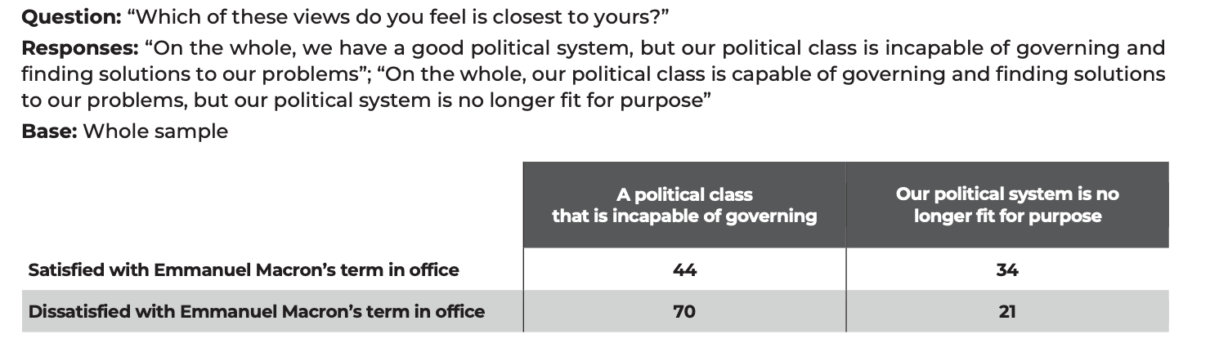
The hope for a new approach to politics and to governance is undoubtedly difficult to fulfil. The disappointment ultimately caused by Macron’s two five-year terms is fuelling increasingly harsh criticism of the political class as a whole. The state of the National Assembly and parliamentary proceedings since its dissolution in 2024 is weighing heavily on a country that is already disoriented, concerned and angry. We can see the link between the disappointment with Emmanuel Macron and the growing rejection of the ruling class: those who believe that “on the whole, we have a good political system,but our political class is incapable of governing and finding solutions to our problems” account for an average of 64% of respondents; but this proportion rises to 75% among those who say they are “very dissatisfied” with Macron’s presidency, to 70% among those who are “dissatisfied”, falling to 44% among those who are “satisfied” and to 38% among those who are “very satisfied”.
The idea of a “candidate who does not belong to a party and who does not have a background in politics” is supported by 63% of voters (compared with 34%). At the very least, this should be seen as a desire to see candidates emerge who are more in tune with the world as it is, as suggested by the stronger support among managers and highly educated professionals for the idea of a candidate from outside politics (70%). It is young people who are the least likely to vote for such a candidate (45% of 18–24-year-olds and 56% of those under 35).
The desire for such a renewal is strongest among supporters of Renaissance (75%) or Les Républicains (75%); it is as strong on the left (68%) as it is on the right (62%). The reason may lie in the fact that the idea of a candidate who does not come from a political background usually conjures up the image of someone with a talent for organisation and leadership. Thoughts quickly turn to the military or businessmen. In fact, the question is what background would this candidate, who has no political background, come from. In our survey, the background that received the most favourable responses was “business” (40%).
Finally, the fact that such a perspective meets with overwhelming approval (71%) among respondents who say they have a “very positive image” of the Gilets Jaunes could suggest that a figure from a world outside politics is one manifestation of criticism of the system.
A president from the business world (%)
Copyright :
Fondapol – June 2026
A president from the business world (%)
Copyright :
Fondapol – June 2026
Opinions of the political class are more critical among those who are dissatisfied with Emmanuel Macron’s term in office (%)
Copyright :
Fondapol – June 2026
Note: Among those who are satisfied with Emmanuel Macron’s term in office, 44% believe that “the political class is incapable of governing and finding solutions to our problems”.
Who in 2027?
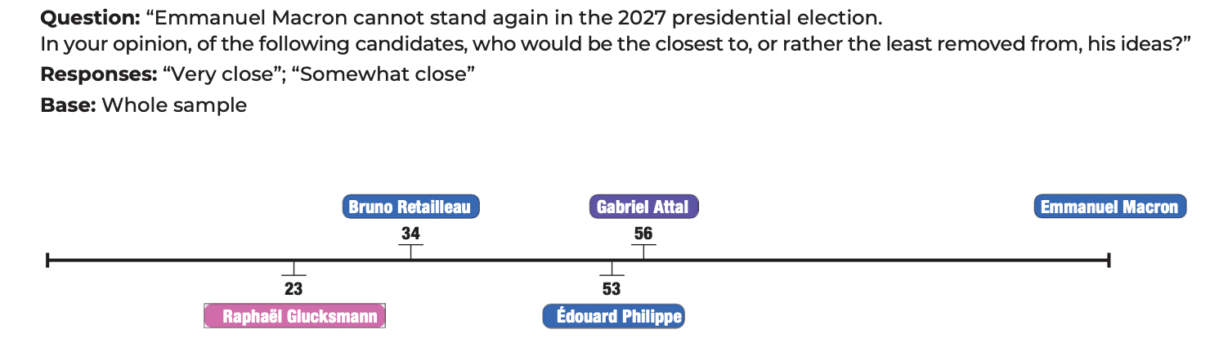
Question asked: “Emmanuel Macron cannot stand again in the 2027 presidential election. In your opinion, of the following candidates, who would be the closest to, or rather the least removed from, his ideas?”
1. Where might Emmanuel Macron’s voters turn?
Now back in the running, Macron’s supporters are a valuable asset for the contenders for his succession, insofar as the key battle is being fought in the space between Jean-Luc Mélenchon and Marine Le Pen – that is, as things stand with the current field of candidates, Gabriel Attal, Raphaël Glucksmann, Édouard Philippe and Bruno Retailleau. They are concerned about the potential impact on their candidacy of any association with Macronism – either for having worked alongside him in the running of the country, or for espousing a political style that corresponds, at least in part, to that of the outgoing president. It is logical that Gabriel Attal should be seen as the closest to President Macron (56%, whilst 42% see him as very different); next comes Édouard Philippe (53%, compared with 45% who consider him as very different), followed by Bruno Retailleau (34%, compared with 64%) and finally Raphaël Glucksmann (23%, compared with 75%).
It is understandable that, for a candidate, referring to their affiliation with Macron’s camp in a positive light is also an obstacle to reaching the second round of the presidential election4. When staking a claim to a presidential legacy, taking into account the outgoing president’s popularity is a question that generally arises, but it is particularly relevant in the case of Emmanuel Macron, given that his two five-year terms have been associated with a series of crises, leading in particular to a situation of political and financial deadlock.
Who is considered to be close to Emmanuel Macron? (%)
Copyright :
Fondapol – June 2026
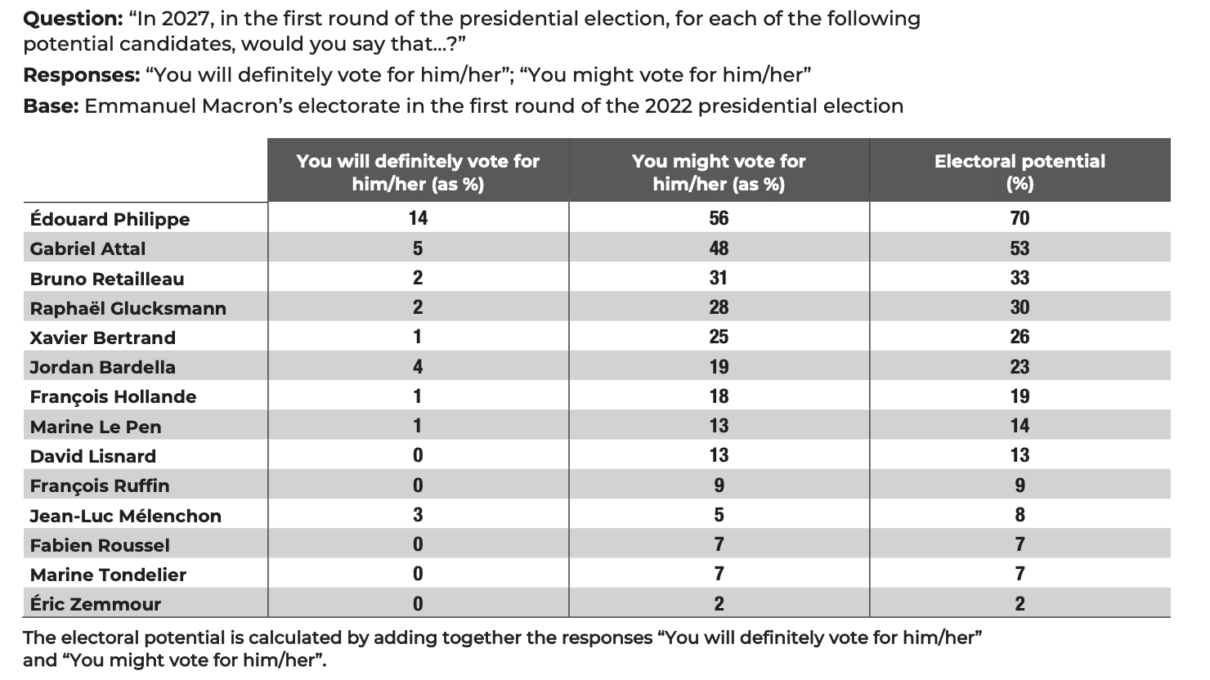
Where might Macron’s supporters turn? (%)
Copyright :
Fondapol – June 2026
Note: Among those who voted for Emmanuel Macron in the first round of the 2022 presidential election, 14% say they will definitely vote for Édouard Philippe in 2027 and 56% might vote for him, representing an electoral potential of 70% for this candidate.
Reading notes: Respondents have the option of selecting the response “you might vote for him/her” for different candidates they are undecided between. The response “I’ll definitely vote for him/her” can only be used for one candidate.
Gabriel Attal, Jordan Bardella, Xavier Bertrand, Raphaël Glucksmann, François Hollande, Sarah Knafo, Marine Le Pen, David Lisnard, Jean-Luc Mélenchon, Édouard Philippe, Bruno Retailleau, Fabien Roussel, François Ruffin, Marine Tondelier, Éric Zemmour.
Thus, 56% of Emmanuel Macron’s voters in the first round of the 2022 election say they would be prepared to vote for Édouard Philippe in 2027; 48% say they could vote for Gabriel Attal, 31% for Bruno Retailleau and 28% for Raphaël Glucksmann. However, one-fifth of his voters say they might vote for François Hollande (18%) or Marine Le Pen (13%). A further 5% of Macron’s 2022 voters are likely to vote for Jean-Luc Mélenchon.
2. The electoral potential of the candidates in the leadership contest
In June 2026, whilst the French may be dissatisfied with Emmanuel Macron, they do not show any significant interest in the other candidates, subject to three caveats: firstly, only fifteen names were included in this survey; secondly, the data is opinion poll data from early summer 2026; finally, the lack of interest or low level of interest in the candidacies is notable, with the exception of Jean-Luc Mélenchon, Marine Le Pen and Jordan Bardella.
To gauge the state of electoral preferences, we did not use a measure of voting intentions but, given the uncertainty surrounding the actual candidates and the time remaining before the election, we have instead assessed voters’ stated willingness to vote for a particular candidate. The question was put as follows:
“In 2027, in the first round of the presidential election, for each of the following potential candidates, would you say that… you will definitely vote for [NAME] / you might vote for [NAME] / you probably won’t vote for [NAME] / you will not vote for [NAME]”. The names of fifteen political figures were tested5. When respondents select the response “I will definitely vote for him/her”, they are indicating the firmness of their preference for a candidate on the list; the interface that collects their responses does not subsequently allow them to make the same choice (“I will definitely vote for him/her”) for another candidate, which is consistent with the expression of certainty about their vote.
However, when people select the response “you might vote for”, they retain the option of giving the same answer in favour of other candidates between whom they are undecided. By combining the “definitely” responses with the “might” responses, we obtain the electoral potential of each of the names tested.
The candidates’ electoral potential (%)
Copyright :
Fondapol – June 2026
Reading notes: The electoral potential is calculated from the total number of responses: “You will definitely vote for him/her” and “You might vote for him/her”; Respondents have the option to choose the response “You might vote for him/her” for the different candidates they are considering voting for. The response “I’ll definitely vote for him/her” can only be used for one candidate.
The core of the potential electorate for 2027 (%)
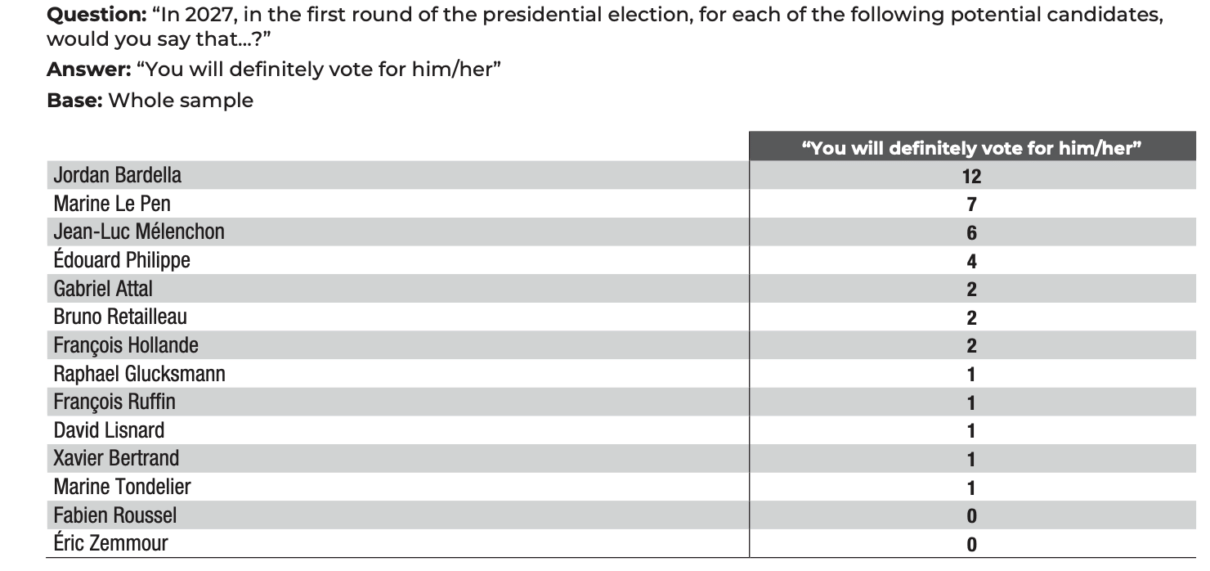
Copyright :
Fondapol – June 2026
3. Can we go back to the way things were? François Hollande and the narcissistic injury of his voters
The prospect of François Hollande standing for election is seen as “a bad thing” by 72% of all voters. Even more strikingly, a majority (59%) of those who voted for him in 2012 believe that another bid for the presidency in 2027 would be a “bad thing”. Admittedly, a majority (54%) of Socialist Party (PS) supporters say that its return would be a “good thing”, but the PS’s voter base has fallen from 28.6% of votes cast in the first round of 2012 to 6.36% in 2017 and to 1.75% in 2022. Whilst there is currently some support for the former president’s candidacy among supporters of the Socialist Party, the current influence of this historic party has been reduced by a factor of four or twenty, depending on whether the comparison is made with the first round of 2017 or that of 2022, but, in any case, the 54% who view a candidacy by François Hollande in 2027 as a “good thing” carry little weight given what has become of the PS and its electorate, which faces competition both from the right, from Macronism, and from the left, from Mélenchonism.
Among supporters of the Ecologists, the majority (58%) see this as a “bad thing”, whilst 40% see it as a “good thing”. If we take a broader view of the response from voters who, on the left–right political spectrum, identify as left-wing, a majority (61%) would still describe the former President’s candidacy as a “bad thing” should it go ahead. A similarly high level of disapproval (61%) persists among those who voted for the NFP left-wing coalition in the 2024 general election.
Voters who lived through François Hollande’s fiveyear term and who, for the most part, voted for him in the second round in 2012, are even more hostile to his candidacy: more than three-quarters (78%) of those aged over 50 view another bid for the presidency as a “bad thing”. This disapproval rises to 80% among those aged 65 and over.
François Hollande’s candidacy presents a unique challenge, and it will be interesting to see whether and how it can be overcome. At the end of his fiveyear term, in 2017, the Socialist President decided not to stand for re-election. He was therefore not held to account for the conduct of his term of office, either by his constituents or by the French people in general. That is why the French people may have seen his departure in 2017 as a form of evasion, a way of shirking his responsibilities, a sort of modern-day flight to Varennes – this time by the President of the Fifth Republic. One might think that this decision played no small part in the immediate subsequent rise of a protest movement against the political class; perhaps one might even see the Gilets Jaunes movement as one of the consequences of this failure to be held to account; perhaps this is also why the Gilets Jaunes, as we recall, made frequent references to the French Revolution, the Sans-culottes and even the guillotine, in a sort of narcissistic rage. Because in 2017, voters would have wanted to decide whether or not to re-elect François Hollande. They were entitled to this power by right, as it was the voters who had elected him President. The narcissistic injury felt by those who had made him President would have been less acute had François Hollande decided to leave politics.
That is why it is undoubtedly more difficult for François Hollande to be elected again ten years later than to be re-elected at the end of his first term in 2017. It was as though President Hollande, who was inevitably unpopular towards the end of his term of office, had thought it possible – and sufficient – to punish himself, to undo singlehandedly what the people had achieved. He left office without formally handing over the power to hold him to account to the electorate, unlike Nicolas Sarkozy in 2012. Judging by the opinion polls, it seems likely that voters would not hesitate to exercise their power to punish the government ten years on, should a new candidate provide them with the opportunity to do so.
François Hollande: a comeback would be difficult (%)
Copyright :
Fondapol – June 2026
2017–2027 a persistent political crisis
The deepening of divisions and the rise of religion
See Pascal Perrineau, D‘un parti de protestation à un parti dominant. La dynamique électorale du Rassemblement national (2017–2026), Fondapol, July 2026 [online].
There is a populist political phenomenon. It is now more widely recognised and better known. Populism has been on the rise since the 1980s. Its expansion is particularly favoured by the presidential election. Since 1988, the FN has, on the whole, continued to grow in strength. It has now become a dominant party6. Its rise is not based on asserting opposition to a political majority, but on calling for a challenge to “the system”. In 2026, the populist movement in France includes a figure traditionally associated with the right, Marine Le Pen; since 2012, it has also included a figure associated with the left, namely Jean-Luc Mélenchon. Together, over ten years, from the first round of the 2012 presidential election to the first round of the 2022 presidential election, their combined share of the vote rose from 29% to 45.1% of the votes cast. Populism promises radical change. Its growth inevitably comes at the expense of the moderate parties, on both the right and the left; these have lost as many voters as those parties have gained. The rise of populism at the polls is a sign of a fundamental political crisis.
The 2012, 2017 and 2022 presidential elections: the rise of two populist movements

Copyright :
Fondapol – June 2026
Caught in these formidable jaws, the moderate parties – on both the right and the left – which once dominated and ensured the parliamentary stability of the Fifth Republic, are seeing their support erode; on the right, to the benefit of the RN, which is deploying a strategy of moderation and realignment, which has been commented on time and again; on the left, this has benefited Mélenchon’s party, which, far from moderating its stance, is becoming more radical – yet the end result is the same: diversion of the electoral left towards LFI.
1. On the left and on the right, moderate parties are under pressure from populists
Both because it is taking voters away from the governing left and because it is radicalising the electorate that remains loyal to it, the governing left is under pressure from LFI, which, for the time being, appears set to consolidate its dominance across the entire left: 36% of PS supporters and 62% of supporters of the Ecologists say they have already voted for LFI.
Three-quarters (74%) of Jean-Luc Mélenchon’s voters in 2017 had voted for François Hollande in the second round in 2012. Five years later, in 2022, a large proportion (64%) of those who had voted for the Socialist candidate in the first round had chosen him in 2012. The presidential election has become a mechanism for siphoning off the Socialist vote to the benefit of LFI.
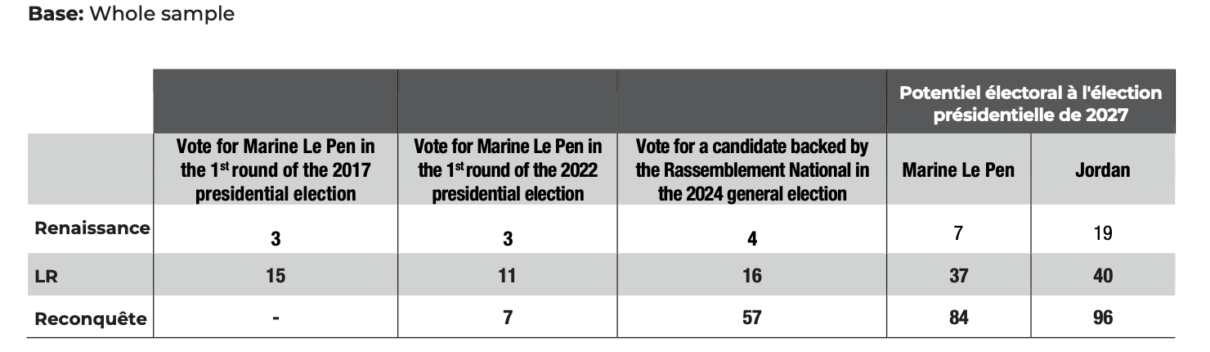
The ruling right-wing party, for its part, is under pressure from the RN. Thus, just as the governing left is undermined by the populist left, the governing right faces competition from the populist right: 37% of people who say they support LR have already voted for the RN.
From votes for Renaissance, LR or Reconquête to votes for RN (%)
Copyright :
Fondapol – June 2026
Note: Among supporters of Renaissance, 3% voted for Marine Le Pen in the first round of the 2017 and 2022 presidential elections. 4% of them voted for a candidate backed by the RN in the general election. 7% said they would “definitely vote” for or “might vote” for Marine Le Pen in the 2027 presidential election, and 19% said they were definitely going to vote or might vote for Jordan Bardella in the 2027 presidential election.
From votes for the Ecologists and PS to votes for LFI (%)
Copyright :
Fondapol – June 2026
Note: Among supporters of the Socialist Party, 22% of them voted for Jean-Luc Mélenchon in the first round of the 2017 presidential election and 28% in the first round of the 2022 presidential election. 49% of them voted for a candidate backed by the New Popular Front in the 2024 parliamentary elections. 13% said they would definitely vote or might vote for Jean-Luc Mélenchon in the 2027 presidential election.
2. On the right, an authoritarian temptation and Catholics open to voting for the RN
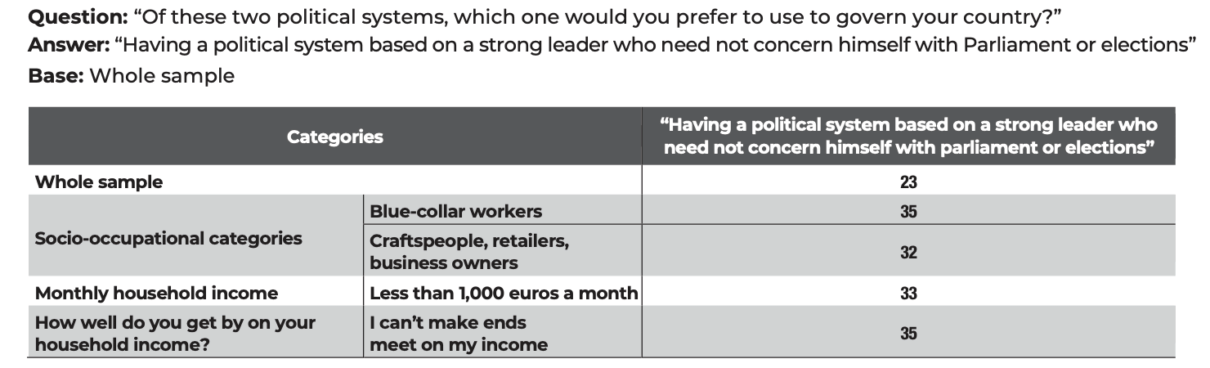
The extent to which there is a tendency towards authoritarianism can be gauged by asking the following question: “Of these two political systems, which would you prefer to govern your country?: “Having a political system based on a strong leader who need not concern himself with Parliament or elections” or “Having a democratic political system with an elected Parliament that oversees the Government”. A quarter (23%) of those surveyed favour an authoritarian system. Conversely, 74% say they are committed to “a democratic political system with an elected Parliament that oversees the Government”.
Preference for what we shall refer to here as an “authoritarian regime” stands at roughly the same level – between one-fifth and one-quarter – regardless of the age group considered, averaging 24% among those under 35 and 23% among those aged 35 and over. This mindset could become firmly established. The tendency towards authoritarianism is more pronounced among people with no qualifications or few qualifications (29%), among manual workers (35%), among those who replied “I can’t manage on my income” (35%), and more generally among the working classes (28%).
Social science research has shown that the working classes have a greater than average inclination towards authoritarian regimes; conversely, it is often argued that the left is less supportive of such regimes than the average population.
This divergence can be seen as a further sign that the left has lost touch with the working classes. The shift to the right among these working-class groups can be verified, noting that support for an authoritarian regime stands at 29% among voters on the right (31% among LR supporters, 35% among RN supporters and 56% among supporters of Reconquête), compared with 13% among voters on the left.
The analysis shows that 28% of those who voted for Marine Le Pen in the first round of the 2022 presidential election want “a political system based on a strong leader who need not concern himself with Parliament or elections”, 37% of those who voted for the list led by Jordan Bardella in the European elections on 9 June 2024, and a further 34% of those who voted for the RN in the 2024 general election, following the dissolution announced that day.
Finally, there is a link between hostility towards the European project and a preference for an authoritarian regime, as broadly defined in our questionnaire. Among those who express this preference, a third (35%) are in favour of France no longer being part of the European Union, and 39% are in favour of leaving the euro and returning to the franc.
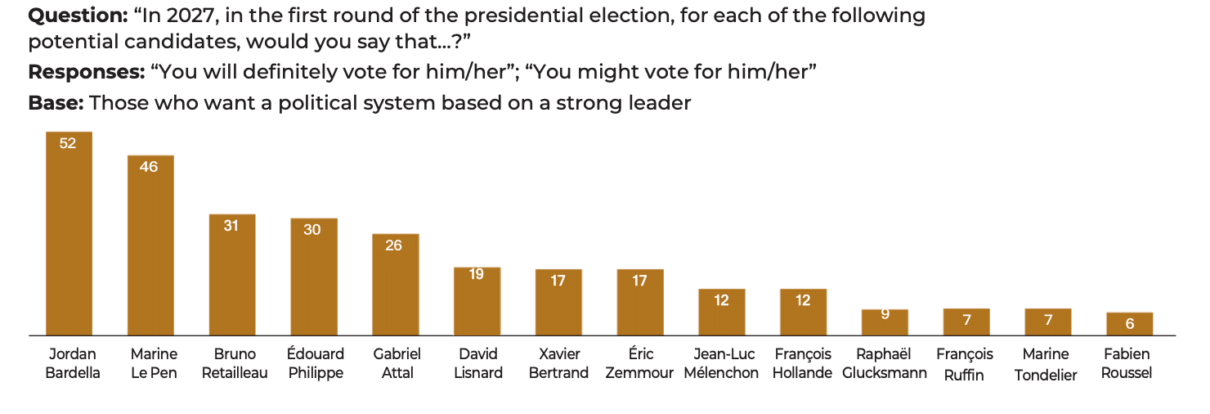
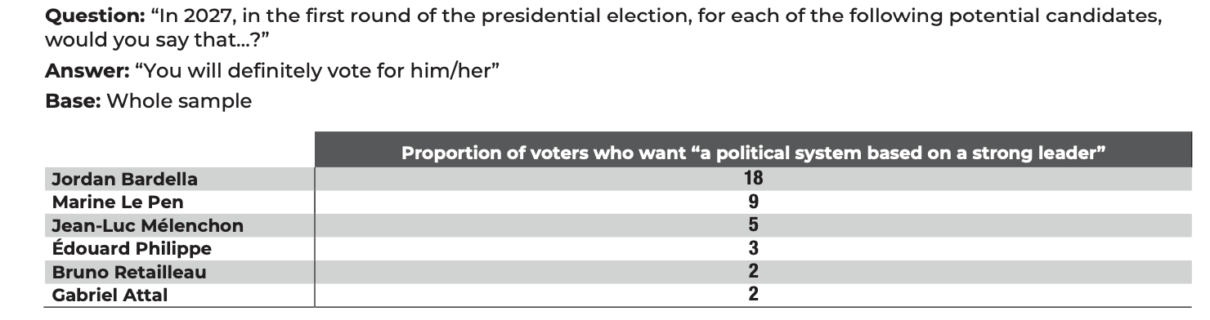
Following on from this observation, we can see that 9% of those who prefer a political system based on a strong leader will “definitely vote” for Marine Le Pen. This proportion stands at 18% among voters who say they will definitely vote for Jordan Bardella, 3% among those who say they will definitely vote for Édouard Philippe, and 2% among those who say they will definitely vote for Bruno Retailleau or Gabriel Attal. It is worth noting that 5% of those who say they will definitely vote for Jean-Luc Mélenchon favour a political system based on a strong leader. LFI represents the section of the left-wing electorate most susceptible to authoritarian tendencies.
Authoritarian tendencies among the working classes (%)
Copyright :
Fondapol – June 2026
The trend towards authoritarianism on the right (%)
Copyright :
Fondapol – June 2026
Note: 32% of those who have previously voted for the RN would prefer “a political system based on a strong leader who need not concern himself with Parliament or elections”.
Authoritarian tendencies among potential voters (%)
Copyright :
Fondapol – June 2026
Note: 46% of those who want “a political system based on a strong leader” say they will definitely vote for, or might vote for, Marine Le Pen.
Reading notes: Respondents have the option of selecting the response “you might vote for him/her” for different candidates they are undecided between. The response “I’ll definitely vote for him/her” can only be used for one candidate.
Support for “a political system based on a strong leader” among potential voters (%)
Copyright :
Fondapol – June 2026
Note: Of those who want “a political system based on a strong leader”, 9% say they will definitely vote for Marine Le Pen.
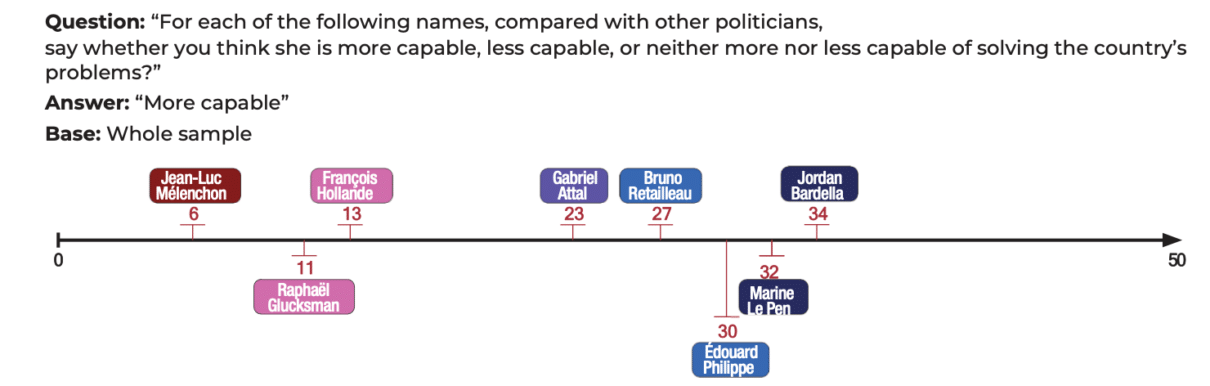
Catholics’ assessment of the ability to govern (%)
Copyright :
Fondapol – June 2026
The rise of right-wing parties, and in particular the RN, is finding significant support among Catholic voters. When asked who they consider best placed to solve the country’s problems, Catholics cited Jordan Bardella (34%) first, followed by Marine Le Pen (32%). They are also more likely than the average French person to regard Bruno Retailleau as the person best placed to tackle the country’s challenges (27%, compared with 20% of the electorate as a whole).
This trend is reflected in electoral intentions for 2027. Among Catholics, 42% say they will definitely (14%) or might (28%) vote for Jordan Bardella. The figure stands at 36% for Marine Le Pen (7% say they will “definitely vote for her” and 29% say they “might”).
This closeness is also reflected in the desire to see the RN obtain a parliamentary majority in the event of a victory should Jordan Bardella or Marine Le Pen be elected President of the Republic: 54% of Catholics would like him or her to have a majority of MPs in the National Assembly, which is higher than the national average (49%).
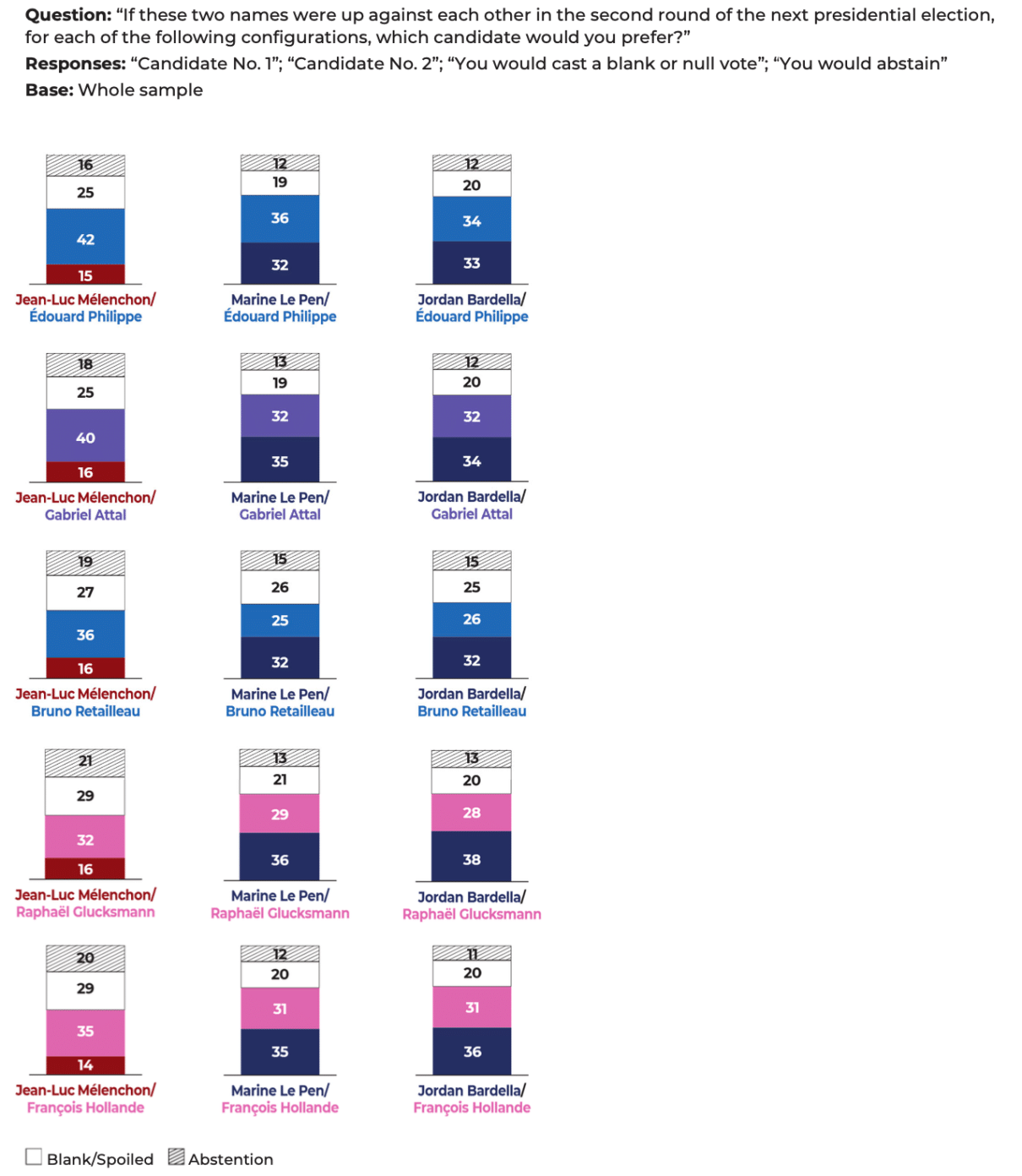
Finally, in a second round pitting Jordan Bardella against Jean-Luc Mélenchon, 49% of Catholics would vote for Jordan Bardella, 8% would vote for Jean-Luc Mélenchon, whilst 26% would cast a blank ballot and 15% would abstain. This trend is accompanied by a particularly strong rejection of Jean-Luc Mélenchon: in the first round of the 2027 presidential election, 82% of Catholics ruled out voting for him.
Taken together, these results highlight the strong support for the right among Catholic voters, a high level of electoral support for the National Rally, and very strong opposition to Jean-Luc Mélenchon.
3. On the left: insurrectionary tendencies and mobilisation of the Muslim vote
On the left, the temptation to revolt is a kind of counterpart to the authoritarian temptation on the right. In comments made by MP Mathilde Panot in February and by the mayor of Saint-Denis, Bally Bagayoko, in May, the two LFI politicians appeared prepared to refuse to recognise the result of the presidential election in the event of an RN candidate’s victory, and referred to an insurrection-style reaction.
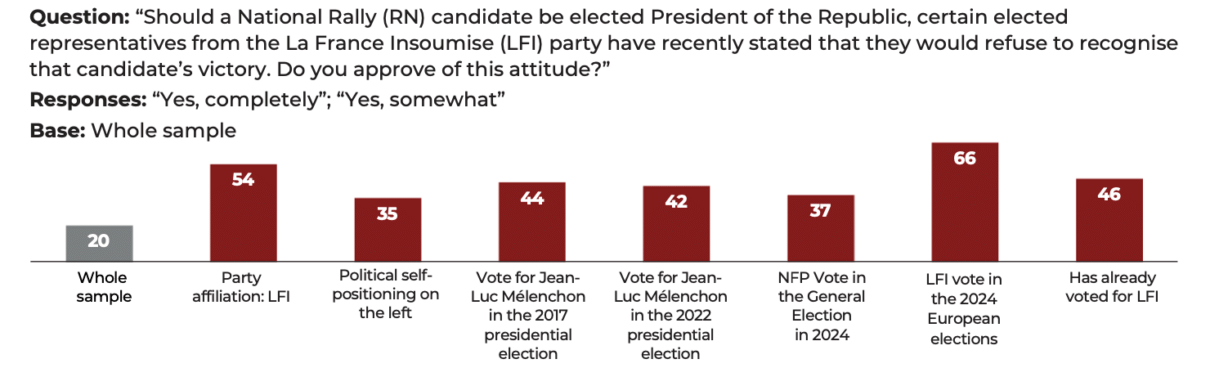
We wanted to gauge public opinion on this idea by asking the following question: “Should a National Rally (RN) candidate be elected President of the Republic, certain elected representatives from the La France Insoumise (LFI) party have recently stated that they would refuse to recognise that candidate’s victory. Do you approve of this attitude?”.
| LFI and the temptation of insurrection Mathilde Panot, LFI MP, 20 February 2026:“I say thank you to the antifas, the anti-fascists – and that includes us, La France Insoumise – we are anti-fascists. Anti-fascism is first and foremost about resisting fascism and saying that we will never accept fascism coming to power legally through the ballot box in our country – which is precisely what Marine Le Pen, flanked by all these far-right splinter groups swarming around her, is seeking to do.”1Bally Bagayoko, LFI mayor of Saint-Denis (93), 7 May 2026: “I am firmly convinced that the people are capable of rising up. And this form of popular uprising will only be possible if power is, in fact, returned to the grassroots […]. Of course, a popular uprising – in the sense, of course, of mobilising the population on a large scale – because, unfortunately, all the major reforms in this country have come about through a popular uprising. I mean, the storming of the Bastille – these are events that are, in fact, linked to the history of France. “And that’s precisely because, at some point, there’s a kind of public outcry that leads to mass mobilisation, and that means that, at some point, we manage to achieve something.”2 “People are both aware of the issue and, in fact, don’t need to be called upon. They will decide. The Gilets Jaunes didn’t need to be called upon; they took the initiative themselves. What I’m saying is that if this happens, it’s precisely because, at some point, there will be those who take responsibility – because the people no longer expect anything from the State, and they expect nothing from the political parties, and they want to take their destiny into their own hands […]”. Bally Bagayoko, LFI mayor of Saint-Denis (93), 11 May 2026: 1. Link to the original video (transcribed excerpt: 23’15”) (Siamo tutti antifascisti ! – Panorama #80). |
On the left, the temptation to revolt (%)
Copyright :
Fondapol – June 2026
The refusal to recognise the victory of a National Rally candidate in the presidential election is supported by 20% of those surveyed. It is among young people that this refusal meets with the widest approval: among secondary school pupils and university students (31%), 18–24-year-olds (33%) and 25–34-year-olds (40%). Apart from the younger generations, support for this refusal has a social dimension: it concerns a third of the unemployed (32%) and a third (32%) of those whose monthly income is less than €1,000.
But it is in the political sphere that the temptation to revolt is felt most strongly. Statements promising to refuse to recognise the election of an RN candidate as President of the Republic are supported by 35% of those on the left, compared with 16% of those on the right. It is LFI supporters who are most likely (54%) to approve of this refusal, ahead of supporters of the Ecologists (36%) and supporters of the Socialist Party (26%). In electoral terms, 44% of voters who supported Jean-Luc Mélenchon in 2017 agree with these comments, as do 42% of those who supported him in 2022. However, this spirit of insurrection was also widely shared by LFI voters (66%) in the European elections on 9 June 2024, and among NFP voters (37%) in the first round of the general election that followed the dissolution of Parliament.
These twin temptations – authoritarianism on the right and insurrection on the left – are part of a period characterised by the expansion and diversification of forms of political dissent. The 2027 presidential election will also be the result of the rise of anti-politics and protests of all kinds, which have increasingly dominated the news over the past thirty years or so.
Increase in dissent (%)
Copyright :
Fondapol – June 2026
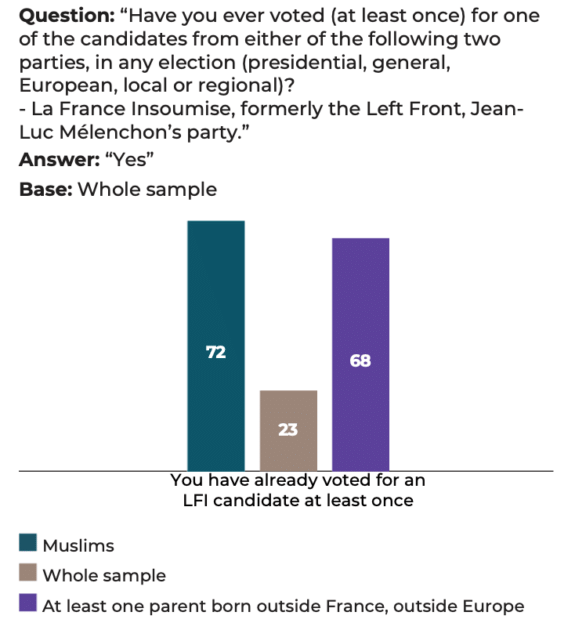
Voters who identify as Muslim, as well as those with at least one parent born outside France and outside Europe, stand out clearly from the rest of the electorate. Firstly, there is a very close alignment with LFI. 72% of Muslims surveyed say they have already voted for LFI, compared with 23% of the French population as a whole.
This proportion is only 15% among Catholics and 27% among those with no religious affiliation. This sense of connection is also particularly strong among French people with at least one parent born outside France and outside Europe, 68% of whom say they have already voted for LFI.
Jean-Luc Mélenchon’s dominance among the Muslim electorate is assured in the first round. He is also their undisputed frontrunner should there be a second round. Voters with at least one parent born outside France and outside Europe show a stronger preference for Jean-Luc Mélenchon than the French population as a whole, although this preference is less pronounced than among Muslim voters as a whole.
Whilst, among the electorate as a whole, Jean-Luc Mélenchon’s potential share of the vote in the second round stands at between 14% and 17%, depending on the hypothetical head-to-head scenarios, it stands at between 62% and 74% among Muslims and between 49% and 64% among people with at least one parent born outside France and outside Europe.
LFI’s success among its “new France” (%)
Fondapol – June 2026
In every head-to-head contest between Jean-Luc Mélenchon and another candidate in the poll, Muslim voters consistently express a preference for him, and by a very large majority. This preference is also particularly pronounced among voters who have at least one parent born outside France and outside Europe. It is significantly less pronounced among the electorate as a whole.
The survey reveals a deep divide between the electorate as a whole and certain sections of it. Across the entire electorate, Jean-Luc Mélenchon is defeated in every second-round scenario tested here. On the other hand, he consistently wins the vote among Muslim voters, as well as among people with at least one parent born outside France and outside Europe.
Assessment of candidates’ competence by religious affiliation (%)
Copyright :
Fondapol – June 2026
Note: 68% of Muslims say that Jean‑Luc Mélenchon is capable of solving the country’s problems, compared with 13% of the whole sample.
These results illustrate the success of the political strategy pursued by Jean-Luc Mélenchon. It involved reaching out to emerging social groups that were undergoing significant demographic change and growing in influence. This strategy has been a success, judging by the support LFI has received from Muslim voters and, more broadly, from French people of non-European immigrant background. Furthermore, the campaign launched by LFI to encourage its potential supporters to register on the electoral roll is likely to further boost turnout among these voters. Whilst it may not, at this stage, enable it to secure a majority among the electorate as a whole, it does ensure a level of support well above the average within these groups and may play a decisive role in securing its place in the second round.
Disobedience on the horizon: rejection of the “republican front”
In the search for a successor to Emmanuel Macron, the RN’s candidate is gaining particular traction in public opinion. We do not give enough thought to the fact that the prospect of voting for Marine Le Pen is also the result of the disappointment and anger that have been fuelled, for many years, by the ineffectiveness of public policy and the behaviour of the political establishment. The situation becomes problematic when this same political class – which is in power but has been rejected by the people – appears to be seeking to cling to power, despite its poor track record, by mobilising a “republican front” against the political organisations that have become the most recognisable and popular opposition groups.
1. The exploitation of the “republican front” has led to its downfall
A new dissenting movement could emerge in 2027. The “republican front” is presented as a means of blocking or restricting access to power for a political group deemed dangerous to democracy … yet which is permitted to stand for election, which is a fundamental contradiction in the way the mechanism is understood. The concept of the “republican front” and its use have played an important role since the 1980s. The aim was to contain the surge in support for the National Front seen in the 1983 local elections, the 1984 European elections, the 1986 general election and the 1988 presidential election. However, the rise in support for the FN and the decline of the governing parties, on both the right and the left, were so rapid that in 2002, during the presidential election, the “republican front” was called upon for the first time in the context of the second round of a presidential election. Voters on the left were urged to join forces with those on the right to vote for Jacques Chirac in order to block Jean-Marie Le Pen, the National Front’s long-standing candidate.
The mechanism was intended to be used only in exceptional circumstances, particularly in the case of the presidential election. But it was then applied to the second round of the 2017 presidential election and that of 2022, then to the 2024 general election. It is understood that this issue is likely to come up again during the 2027 presidential election. In ten years, on three, and perhaps four, occasions, our major national elections have been placed under the extreme pressure of the “republican front”. What was once an exceptional occurrence – the “republican front” – has become a recurring practice that leads voters to believe that political parties that fail to govern ask voters to re-elect them regardless.
Support for the “republican front” is now in the minority (%)
Copyright :
Fondapol – June 2026
Furthermore, the dissatisfaction caused by the centrist candidate – in this case, Macron – for whom voters are casting their votes in order to prevent an RN candidate from coming to power, can only serve to encourage rejection of the “republican front”. Indeed, among those who are satisfied with Emmanuel Macron, 68% support the “republican front”, compared with 33% of those who say they are not satisfied with the President. Paradoxically, Macron – the candidate who galvanised the “republican” vote and promised to curb the extremes – must now, after his two terms in office, fear leaving office only to be succeeded by a second round pitting Marine Le Pen against Jean-Luc Mélenchon.
In response to the question “in the second round of the presidential elections, there is talk of a ‘republican front’. The “republican front” involves calling on voters to prevent the election of a candidate from the RN or LFI by voting for an opponent, even if they do not share their views. Would you say you are… Very much in favour; Somewhat in favour; Somewhat against; Very much against?”, rejection of the “republican front” is clearly in the majority (58%), but 40% of those surveyed are in favour of it. The dividing line is political: 62% of voters who identify as left-wing are in favour of the “republican front”, whilst 65% of voters who identify as right-wing are opposed to it. On the left, supporters of the Ecologists are the most in favour (79%), ahead of supporters of the Socialist Party (71%). Among LFI supporters, support is less widespread (52%). This is the consequence of the emergence of new reasons to put up this front, that is to say, now also against Jean-Luc Mélenchon’s party. However, another finding is worth highlighting: the very high level of support among Renaissance supporters (78%), but also among Emmanuel Macron’s voters in the second round in 2022 (66%) – a figure that is, of course, logical but, it should be noted, somewhat more moderate. Voters who helped ensure the incumbent president remained in office may have felt a sense of disappointment at having to vote for the second time in a row out of a sense of obligation.
On the right, the proposal is rejected, primarily by supporters of the RN, the vast majority of whom (82%) are opposed to it, as are Marine Le Pen’s voters from the second round of the 2022 election (84%). A clear majority of LR supporters (60%) are opposed to the “republican front”.
The “republican front” is regarded by public opinion as a political tool. Whilst it is based on grand principles and claims to be motivated by noble causes, it is always beneficial to the left and disastrous for the right. A mechanism or ploy devised by the left, which has been overused and is now worn out, the “republican front” cannot withstand being applied systematically, nor the necessity of now having to deploy it against a leftwing party – something the left is less inclined to do. But it is the prospect of a second round pitting the candidate of a far-right party against the candidate of a far-left party which, were it to materialise in 2027, would spell the end of this practice of extending the scope of electoral discipline.
The politicisation of the republican front (%)
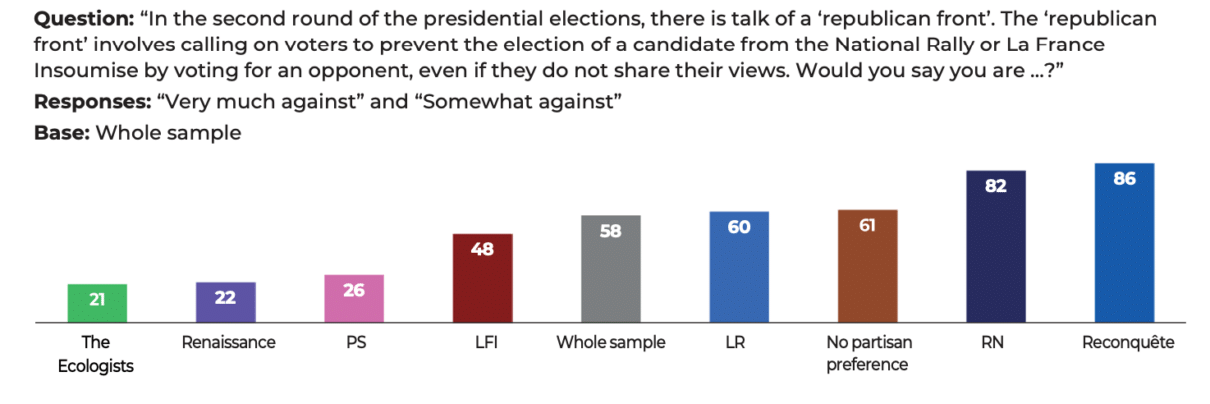
Copyright :
Fondapol – June 2026
2. We must now also put up a “republican front” against the left
On the left, given the uncertainty surrounding the Socialist Party’s candidacy, it is Jean-Luc Mélenchon who appears to be the most popular. This should be seen as the result of a long-term campaign conducted according to a strategy that appears to tick all the boxes of a well-executed endeavour: unquestionable strategic rigour, absolute determination, and a programme set out in terms that are clearly inspiring to its audience, “The New France”, a harbinger of the future and of justice, with revolutionary overtones, whilst still leaving ample room for resentment and dark thoughts, class hatred, anti-Semitism, racialisation and a taste for violence … Politically speaking, it is also a cultural revolution, representing a complete break with the republican consensus that had been established since the beginning of the Third Republic. Hence his ability to rally support, whether from voters – particularly French people of Muslim faith or culture – supporters attending his rallies, or the media, which are drawn to his speeches. But this second populist candidate, from the left, is also the one against whom the “republican front” was extended.
For some time now – at least since 2024 – the idea of a “republican front” has been used against LFI. Its anti-Semitism, the vitriol of its rhetoric, and indeed the behaviour of its activists and elected representatives – who are often threatening towards groups of people or even individuals – its communitarian and separatist approach to the nation, and its links with representatives of the Islamist movement or despotic regimes are grounds for classifying LFI as a party that poses a threat to our democracy.
The 2027 presidential campaign has not yet got under way, and the field of candidates remains highly uncertain, but there is already talk of the “republican front” strategy. An obscure area of law, made all the more difficult to understand by the fact that, since 2024, it has not prevented the National Assembly from forming ad hoc majorities including LFI or the RN, or even members of LFI and the RN, for example on the “end-of-life” bill adopted by a majority comprising members of LFI and the RN. After forty years of campaigning, which has become increasingly frequent, the effectiveness of the “republican front” has waned considerably.
If the call for a “republican front” were to be made during the 2027 presidential election, it would be the third consecutive presidential election, and the fourth consecutive national election (including the 2024 general election), to result in this political manoeuvre, which is not provided for in any legislation and is not monitored by any authority. If this were to happen for the fifth time, it might no longer be accepted by a majority of voters. The “republican front” could even backfire on its instigators. The low regard in which most French people hold their political class, their leaders, many of their elected representatives and party leaders is not unrelated to this sad reality: by 2027, there will have been ten years of strong hostility from the political class towards the RN, and now towards LFI; a political class which, at the same time, has failed to reduce the reasons for voting for these parties and their candidates, whose electoral influence has continued to grow, particularly in the case of the RN.
3. Le Pen, Mélenchon: public opinion does not accept that the two pose an equal threat
The French political debate often tends to portray the RN as a more dangerous party than LFI. However, the results of our survey show that the French do not accept this hierarchy.
It is clear that voters determined to vote for Marine Le Pen or Jean-Luc Mélenchon – the core of their respective support base – do not regard their chosen candidate as a threat to democracy, but rather as the champion of genuine democracy. Conversely, Jean-Luc Mélenchon’s supporters view Marine Le Pen’s supporters as an extreme political threat, and vice versa. Generally speaking, the results of our survey show that whilst most voters regard Marine Le Pen or Jean- Luc Mélenchon as a threat to the country, the majority do not share the view that Marine Le Pen and Jean-Luc Mélenchon represent two sides of the same threat, or two equivalent threats. This is evident from the assessment of electoral potential and from the judgement as to whether she is better able to “solve the country’s problems than other politicians”. This is evident once again in the voting preferences of voters faced with a series of “head-to-head contests”, in the form of hypothetical second-round run-offs presented to them as part of our survey.
Marine Le Pen’s electoral potential is greater than that of Jean-Luc Mélenchon. The LFI candidate is significantly less popular than the RN candidate. Jean-Luc Mélenchon is met with widespread rejection. This is evident, first of all, from a comparison of their respective electoral potential: 33% for Marine Le Pen, compared with 15% for Jean-Luc Mélenchon. The core support base of the LFI leader (6% of voters who say they will definitely vote for him) is comparable to that of his RN rival (7%). By contrast, the proportion of voters who say they would not vote for the LFI candidate (71%) is twenty percentage points higher than the proportion of those surveyed who say they would not vote for Marine Le Pen (51%).
Marine Le Pen wins four out of the five head-to- head match-ups; Jean-Luc Mélenchon wins none. These results also reflect the fact that, in public opinion, the two forms of populism are not regarded as equivalent. These head-to-head matches simulate second-round contests. They pit either the RN candidate or the LFI candidate against their main rivals. When Marine Le Pen’s candidacy is put to the test, she is beaten only by Édouard Philippe; the margin is then 4 points in favour of the former Prime Minister, and 1 point in the event of Jordan Bardella standing as a candidate.
Marine Le Pen is regarded as having greater competence in government affairs than Jean- Luc Mélenchon. When asked who, compared with “other politicians”, is best or least capable of solving the country’s problems, Marine Le Pen is regarded as “more capable” by a higher proportion of respondents (29%) than any of the other candidates surveyed, with the exception of Jordan Bardella (30%), and well ahead of Jean-Luc Mélenchon (13%). Of all the candidates, the leader of LFI is the one whose ability to govern is viewed most unfavourably. Nearly two-thirds (64%) of the entire sample consider Jean-Luc Mélenchon to be “less capable” than “other politicians”; this is the highest level of unfavourable opinions, on a par with Éric Zemmour (64%). This gap once again highlights the difference in how Marine Le Pen and Jean-Luc Mélenchon are perceived by the public.
Marine Le Pen is considered more capable than Jean-Luc Mélenchon by a higher proportion of LFI supporters than the proportion of RN supporters who consider Jean-Luc Mélenchon more capable than Marine Le Pen. In fact, 14% of LFI supporters regard Marine Le Pen as “more capable” (compared with 10% who replied “neither more nor less capable” and 76% who replied “less capable”). Conversely, 9% of RN supporters regard Jean-Luc Mélenchon as “more capable” (compared with 13% who replied “neither more nor less capable” and 78% who replied “less capable”). This could prove a useful lesson in the event of a second round pitting Marine Le Pen against a mainstream candidate.
Jean-Luc Mélenchon’s strength lies in the religious vote. He is the only candidate to benefit from this. We have seen that the leader of La France Insoumise is, alongside Marine Le Pen, the candidate who attracts the highest proportion of respondents who answered: “I will definitely vote for…”, in this case for Jean-Luc Mélenchon. This is what we refer to here as the “core electoral base”. The largest core support base is that of Marine Le Pen (7%), followed by that of Jean-Luc Mélenchon (6%). It is clear, however, that the LFI candidate is performing significantly worse in terms of electoral potential (which corresponds to the total number of “you will definitely vote for” and “you might vote for” responses). He is also rejected by a much larger proportion of the electorate than Marine Le Pen. On the other hand, his position is once again looking favourable – and this time to an exceptional degree – when viewed through a religious lens, specifically in terms of the voting preferences of French people of Muslim culture or faith. Jean-Luc Mélenchon reigns supreme. As the heir to a Marxist-Leninist and Trotskyist left – and, as such, to an anti- religious political movement – the LFI candidate nevertheless achieves much higher support among Muslims than any of his rivals, whilst he achieves results far lower than those of Marine Le Pen among people who declare no religious affiliation (those “with no religion”).
Let there be no doubt: if the gap between the vote for Le Pen and the vote for Mélenchon is so wide, it is just as much because Jean-Luc Mélenchon was able to deliver a rallying message to Muslim voters as it is due to the concern felt among Muslims at the prospect of a victory for the RN candidate. In the run-up to the 2027 presidential election, Marine Le Pen and Jean-Luc Mélenchon are encouraging and supporting one another.
Muslims’ views on the potential candidacies of Jean-Luc Mélenchon, Marine Le Pen and Jordan Bardella in the 2027 presidential election (%)
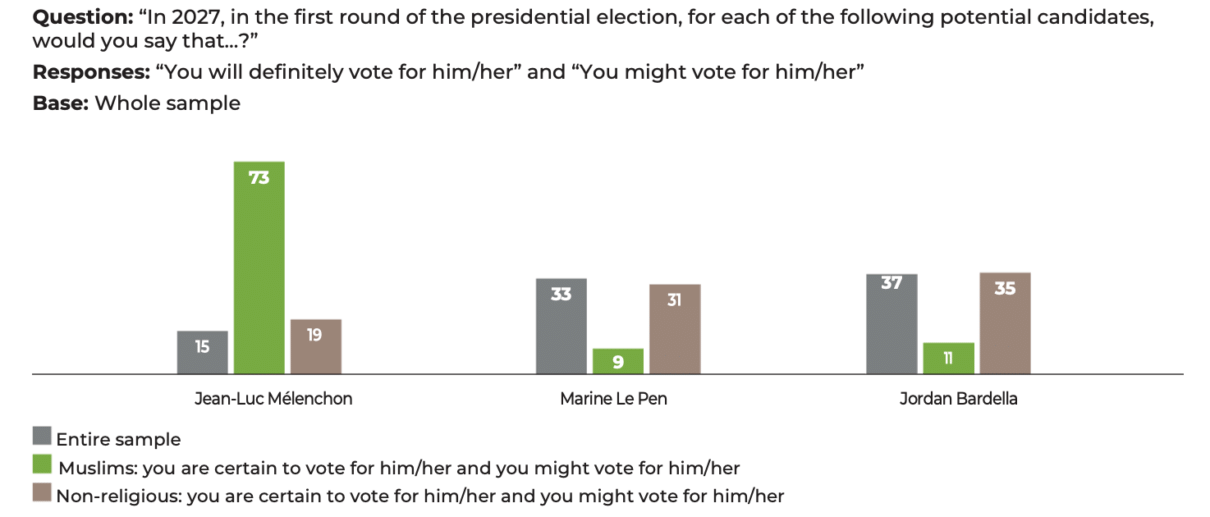
Copyright :
Fondapol – June 2026
Candidate competence (%)
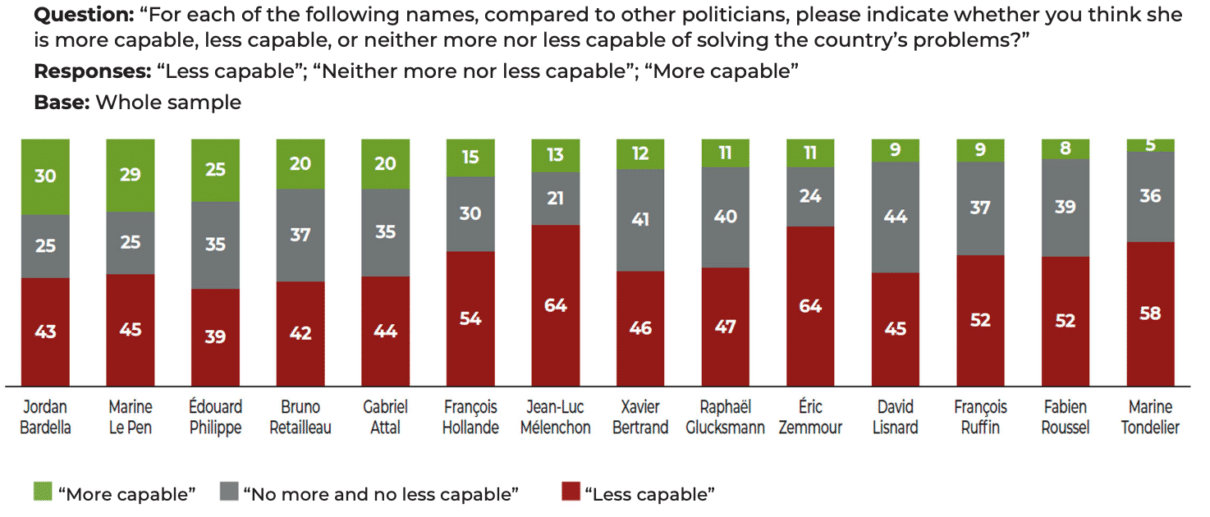
Copyright :
Fondapol – June 2026
These opinions are reflected in the electoral potential for the second round. Jean-Luc Mélenchon does not win in any of the scenarios examined in the survey. Conversely, the RN comes out on top in almost all the configurations tested. Édouard Philippe does indeed appear to be the only one capable of beating the RN candidate, but his lead is too narrow to be certain of victory.
Second-round run-offs (%)
Copyright :
Fondapol – June 2026
Electoral support for Jean-Luc Mélenchon, Marine Le Pen and Jordan Bardella (%)
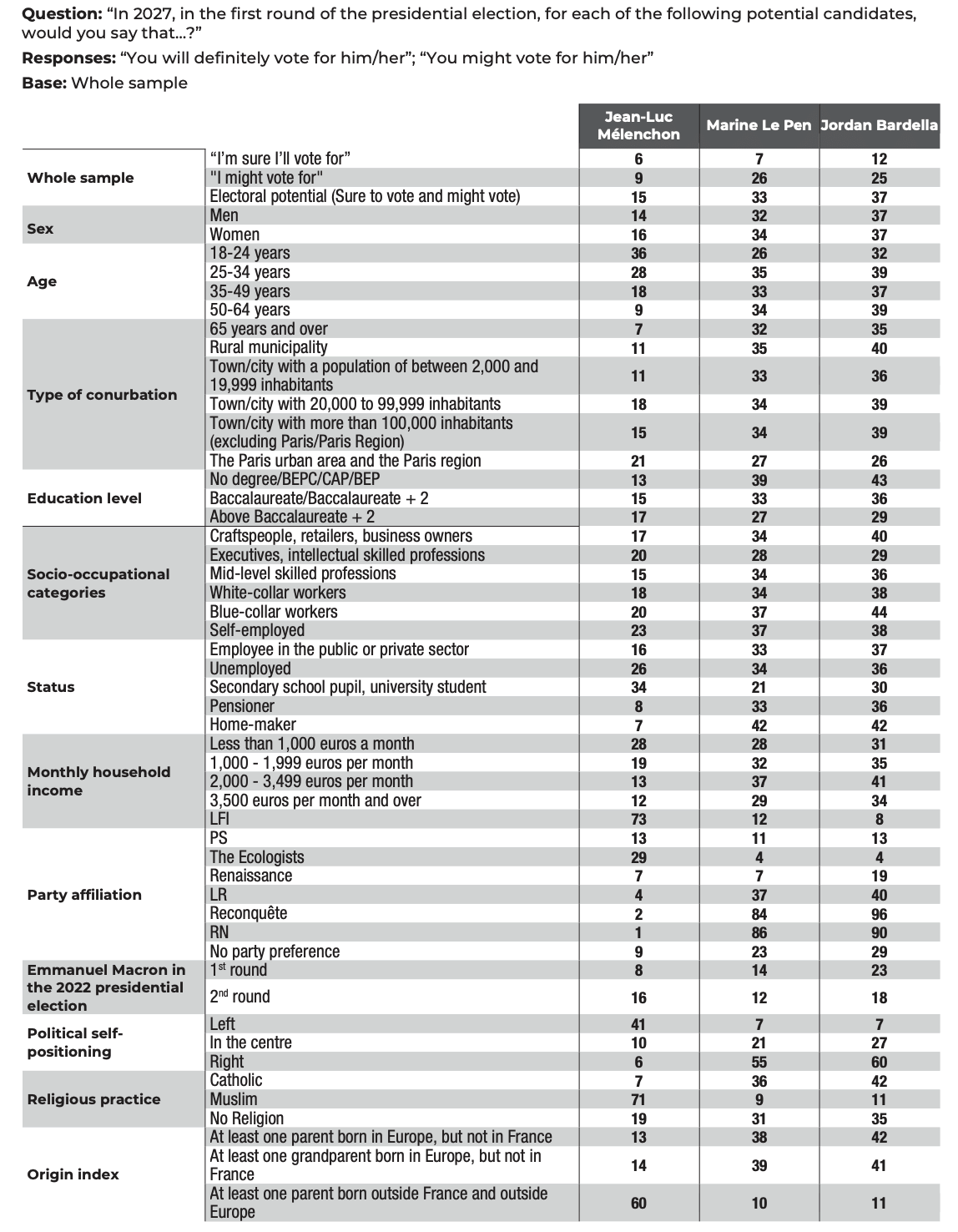
Copyright :
Fondapol – June 2026
Electoral support for Jean-Luc Mélenchon, Marine Le Pen and Jordan Bardella (%) – continued
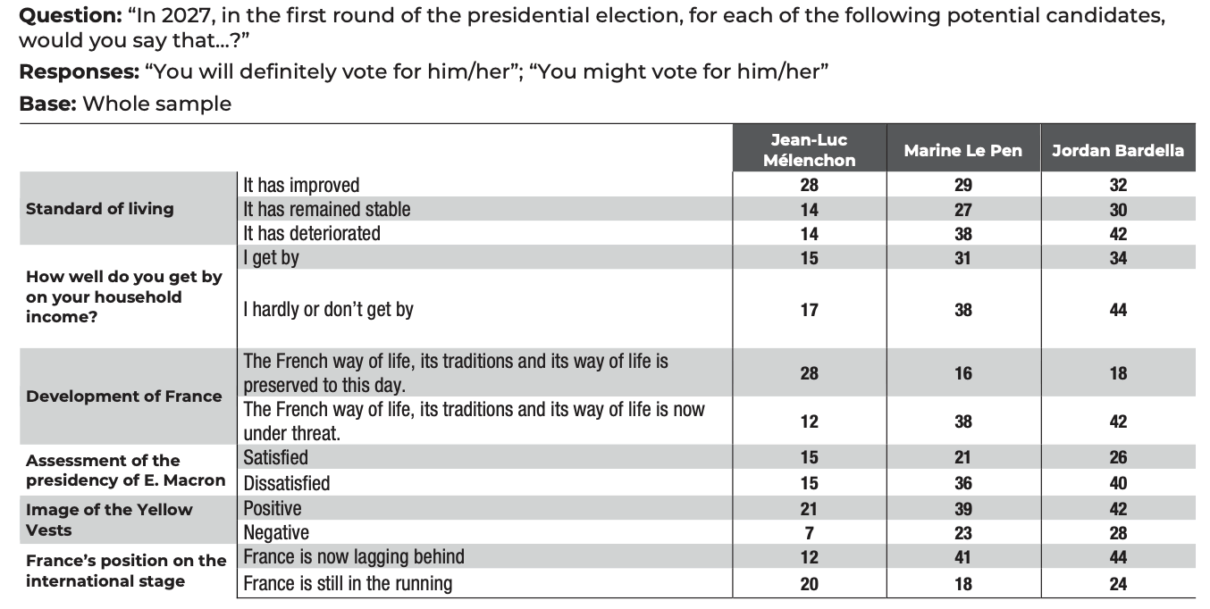
Copyright :
Fondapol – June 2026
To solve the country’s problems, who is best placed to do so: Marine Le Pen or Jean-Luc Mélenchon? (%)
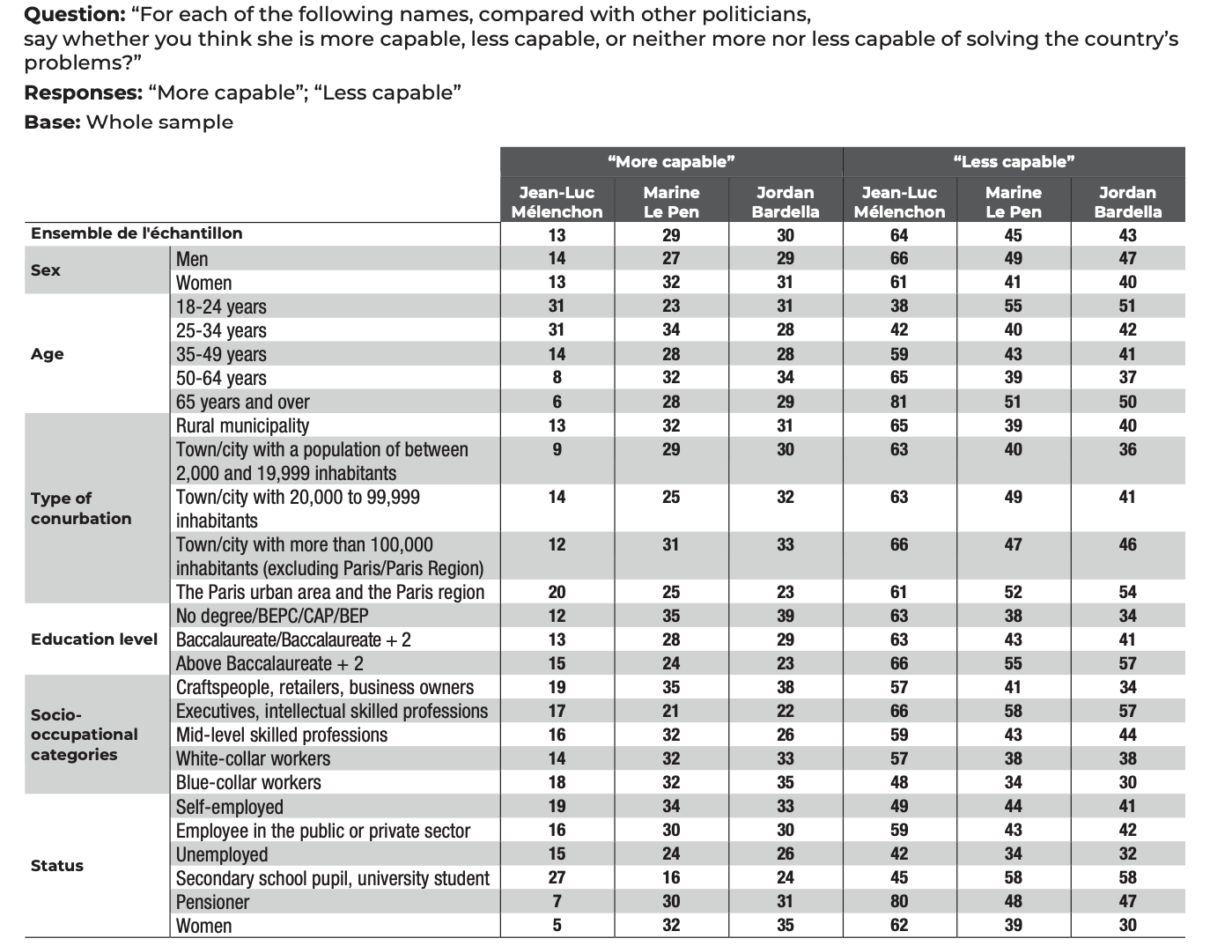
Copyright :
Fondapol – June 2026
To solve the country’s problems, who is best placed to do so: Marine Le Pen or Jean-Luc Mélenchon? (%) – continued
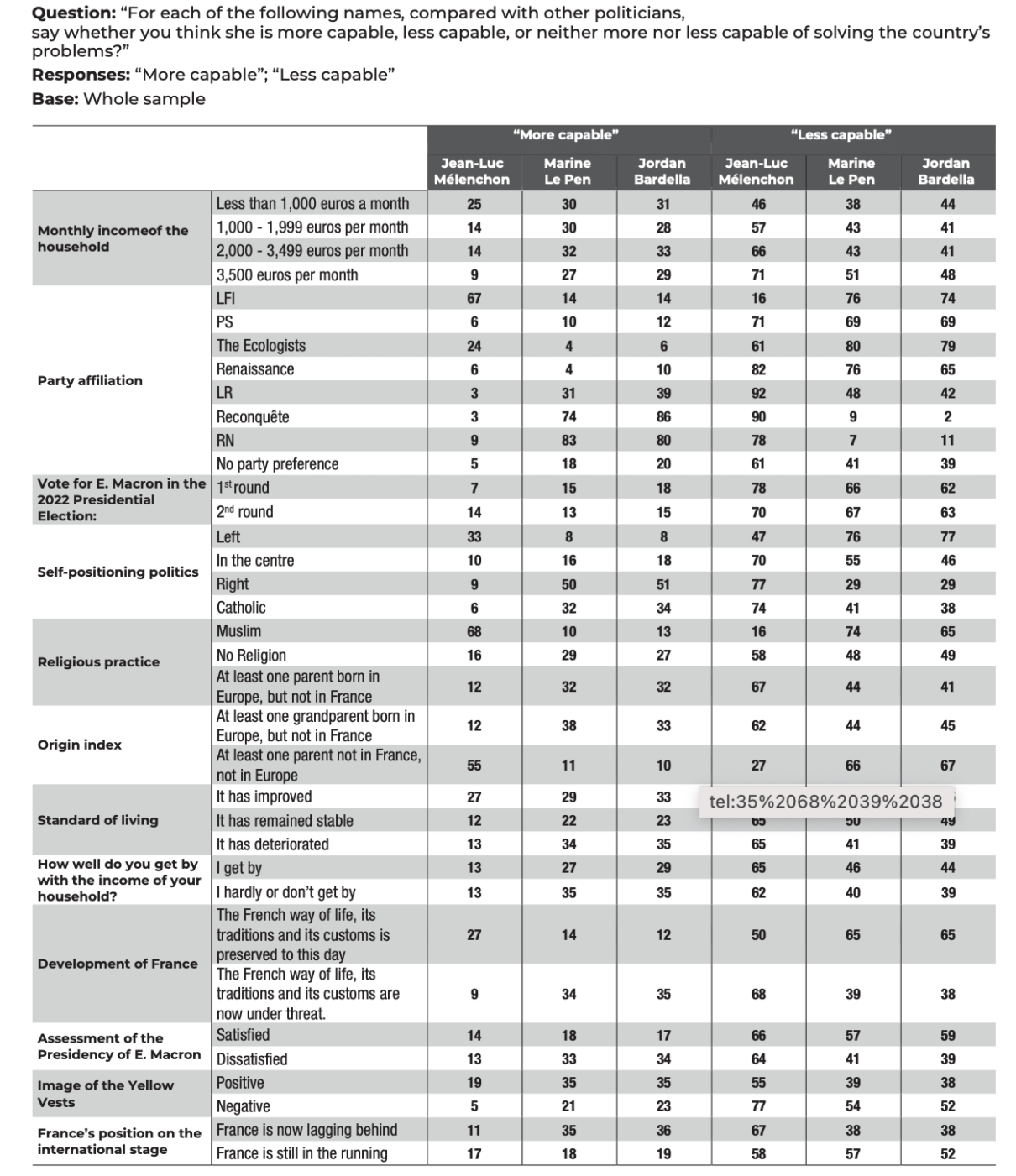
Copyright :
Fondapol – June 2026
Note:
“At least one parent born in Europe, outside France” means that respondents have at least one foreign-born parent who was born in Europe
“At least one grandparent born in Europe, outside France” means that respondents have at least one foreign-born grandparent who was born in Europe
“At least one grandparent born outside France, outside Europe” means that respondents have at least one foreign-born grandparent who was born outside Europe
A nation and its sovereign election in crisis
1. For the majority of voters (64%), France is “now lagging behind”
There is a link between political affiliation and the perception of national decline. This can be seen by providing context and offering a choice between two statements: “Given what you know about global trends in economic growth and technological innovation, do you agree with those who say that France is now lagging behind, or do you agree with those who say that France is still in the running?”
The results reveal a dividing line between the right and the left.
On the right, the view that people are being left behind is virtually unanimous; it is highest among supporters of Reconquête (87%) and the RN (81%); it remains the view of the majority among LR supporters (68%) as well as among voters with no party preference (64%).
Generally speaking, the view that “France is now lagging behind” is held by a majority on the left (52%), within LFI (54%) and within the PS (56%). However, this view is held by a minority within the Ecologists (42%), many of whom, on the contrary, believe that France “is still in the running” (57%). The unusual distribution of views observed among the Ecologists is broadly reflected among the Renaissance electorate, where the view that France is in decline is less widely held (44%), whilst the view that France is “still in the running” is held by a majority (55%).
These two perspectives – which are both opinions and sentiments – therefore dominated the national consciousness in June 2026. On the one hand, as we have seen, 78% of those surveyed share the feeling that the French way of life, its traditions and its customs are now under threat; on the other hand, 64% feel that, in the light of global developments, economic growth and technological innovation, France is now lagging behind.
Given the state of the world, France is now lagging behind (%)
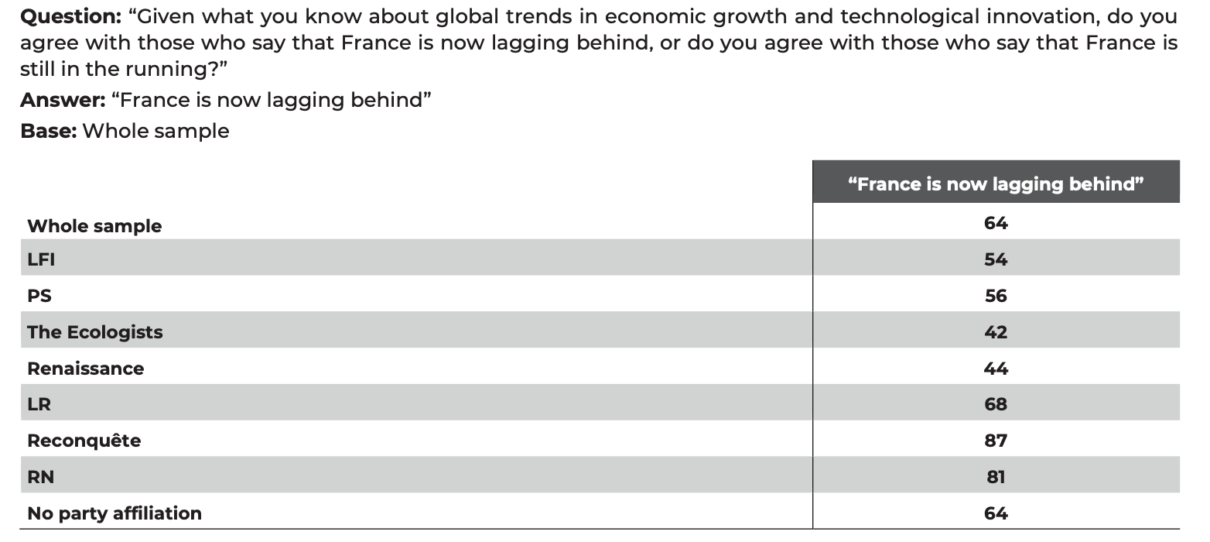
Copyright :
Fondapol – June 2026
Globalisation and protest (%)
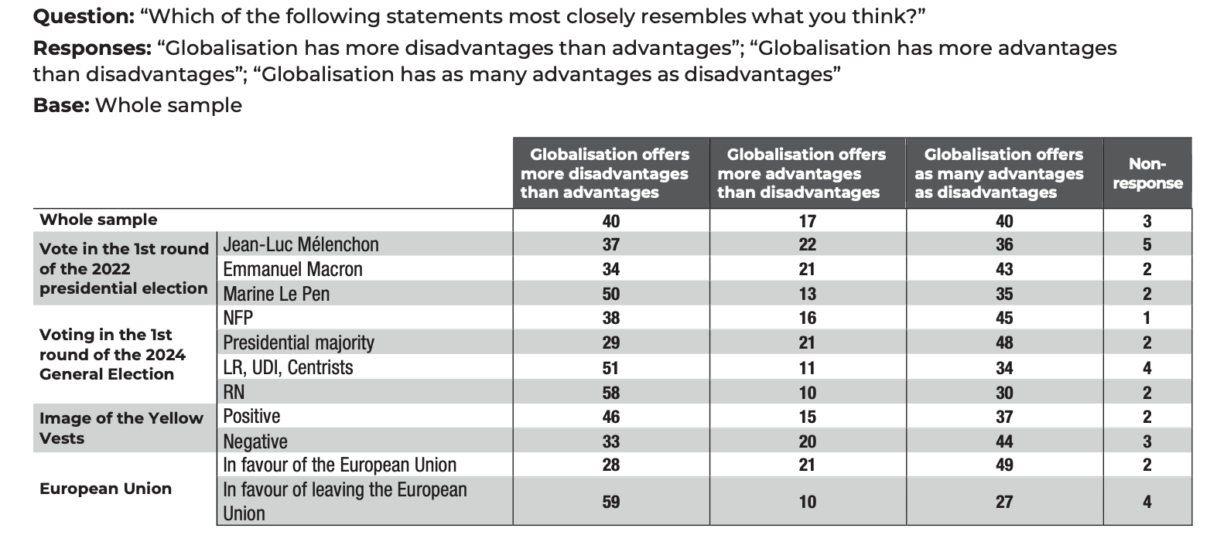
Copyright :
Fondapol – June 2026
Note: Among those who have a positive view of the Gilets Jaunes, 46% believe that “globalisation has more disadvantages than advantages”.
Perceptions of globalisation are a good indicator of collective confidence. However, the French have long been characterised by a negative or lukewarm view. The French now fear the way the world is going. In our survey, only 17% believe that “Globalisation offers more advantages than disadvantages”. Perhaps even more telling of our national disarray is the fact that the younger generations are only slightly less pessimistic; just 28% of 18–24-year-olds and 25% of 25–34-year-olds believe that globalisation offers more advantages than disadvantages. These percentages decrease as the age of the respondents increases, with only 12% among those aged 65 and over. This figure reflects the fact that secondary school pupils and university students are the group most likely (34%) to consider globalisation to be beneficial.
In the run-up to the presidential election, it is clear that a pessimistic view of globalisation is more prevalent among right-wing voters. Nearly half (46%) of LR supporters believe that globalisation has more disadvantages than advantages; the proportion is a majority (52%) among RN supporters.
This well-known fear of globalisation is fuelling a protest movement. This is expressed electorally, with an over-representation of Marine Le Pen’s voters, but it is also expressed in the over- representation of respondents who say they have “a very positive image” of the Gilets Jaunes (59%).
In the face of globalisation, pessimism prevails (%)
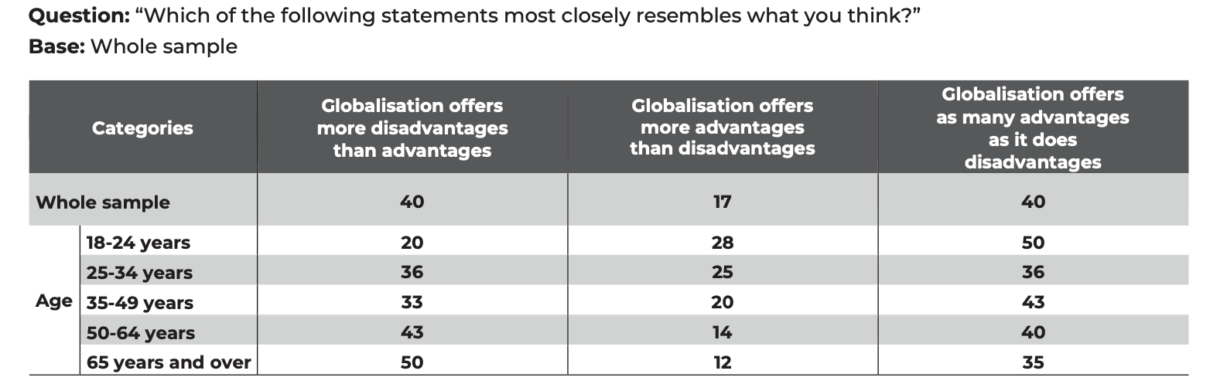
Copyright :
Fondapol – June 2026
In the face of globalisation, pessimism prevails (%) – continued
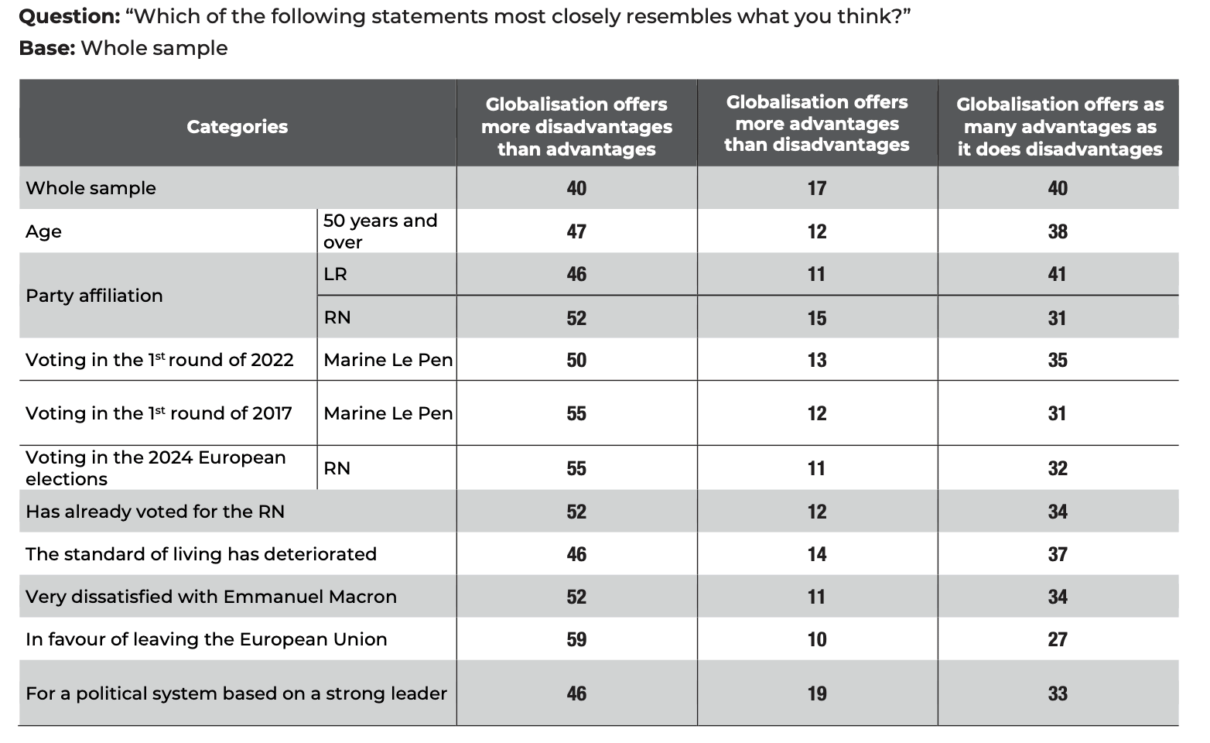
Copyright :
Fondapol – June 2026
Note: 52% of RN supporters believe that “globalisation has more disadvantages than advantages”.
Opinions on globalisation by political affiliation (%)
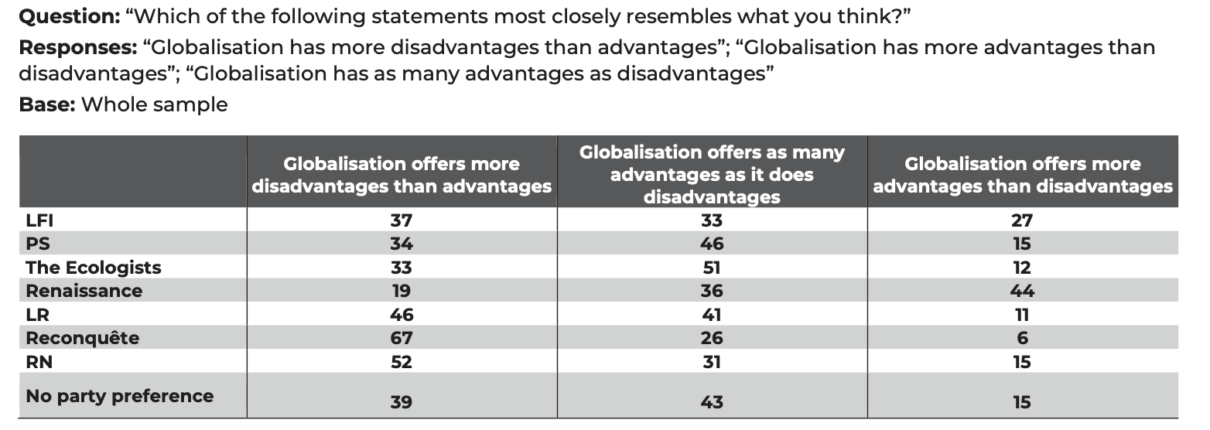
Copyright :
Fondapol – June 2026
2. Is it the voters who should fear a “major financial crisis” (88%), or their leaders?
For the majority of French people (88%), a “major financial crisis” threatens the country. It should be emphasised that it is with this legitimate concern in mind that they are approaching the presidential election. It is therefore up to the political class to address a concern that is as widespread as it is justified. How could we possibly fail to address this urgent and crucial issue during an election campaign to elect the head of state? Tragically, it is commonly regarded as naïve to expect a candidate to take this approach. This fatalism leads to the recognition of a de facto incompatibility between political responsibility and the conduct of the presidential election, given that a candidate for the Presidency of the Republic cannot take the most serious issues seriously without jeopardising any chance of being elected.
Yet we know that failing to address the issue before the election serves to discredit politicians and the government, leaving the field open to populists, abstention and blank votes. We know this for a fact, as this is what we have observed in presidential elections since at least 1981. Candidates who, through a display of ordinary skill or prudence, choose to challenge, ignore or postpone addressing the extreme gravity of the economic and financial problems and the responses they require will have to face up to them if they are elected. According to the general view, it is certain that they will seek to delay the initial measures that are required, at least until the general election has taken place.
Given that it involves the direct election of a candidate by fifty million voters, and given its system of two-round majority voting, the presidential election is ill-suited to the difficult period we are entering. It places state power within the reach of demagogues and simplistic thinking, and exposes us to the risk of allowing our most dangerous passions to influence it. Given the issue of debt and the risk of a major financial crisis, it appears that the presidential election has become at odds with the national interest. It is therefore tragic that the French people are being offered nothing more than a presidential election as a way of rescuing the country from economic collapse and political turmoil.
It is worth noting that a minority (11%) of those surveyed do not believe that a major financial risk is imminent. Among those voters who do not believe there is a financial crisis or who believe it can be tackled, the majority are supporters of La France Insoumise (23%), the Ecologists (20%) and the Socialist Party (16%). They are predominantly left-wing, although such confidence is also widely held among supporters of Renaissance (21%). It is worth noting in this regard that this convergence of views on this crucial issue between, on the one hand, supporters of LFI, the Ecologists and the Socialist Party, and, on the other, supporters of Renaissance, highlights the left-wing element within the Macronist electorate. By comparison, only 6% of RN supporters do not consider this financial risk to be significant. Incidentally, this gives us an indication of the influence of left-wing views among the potential electorate of Renaissance and Gabriel Attal. These opinion- shaping forces will influence the candidates’ campaign messages in the presidential election. One might think that no one would want to risk losing even a fraction of their electorate by making a firm commitment to restoring public accounts.
Should we be worried about a major financial crisis? (%)
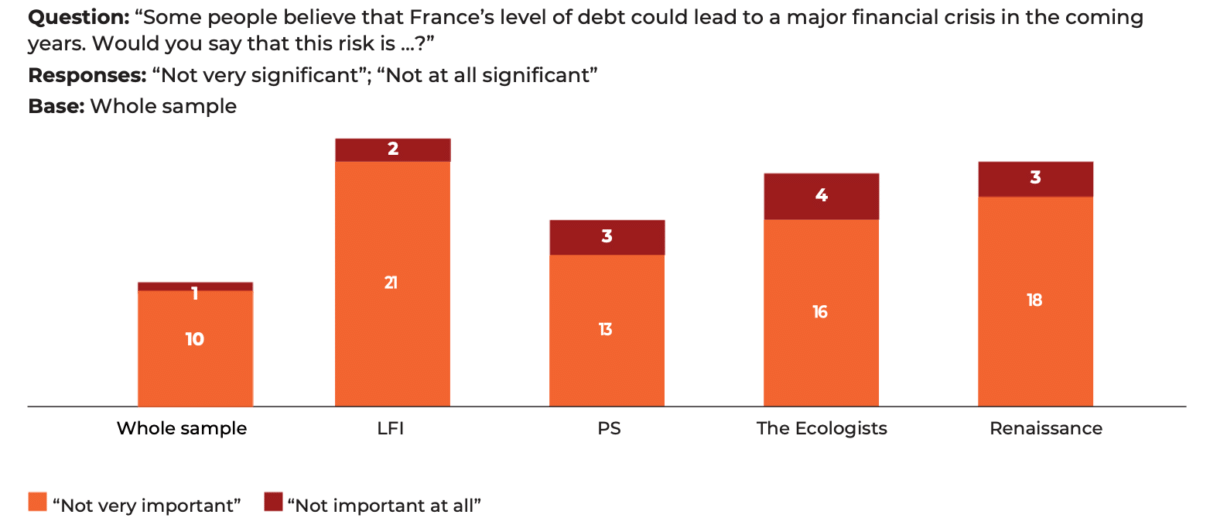
Copyright :
Fondapol – June 2026
Note: 13% of PS supporters believe that the risk of a financial crisis is not very significant.
See Piero Ignazi, “The silent counter-revolution”, European Journal of Political Research, 1992, 22: p. 3–34; Daniel Oesch, “Explaining Workers’ Support for Right-Wing Populist Parties in Western Europe: Evidence from Austria, Belgium, France, Norway and Switzerland”, International Political Science Review, vol. 29, no. 3, June 2008; Dominique Reynié, Populismes. La pente fatale, Paris Plon, 2011; Les nouveaux populismes, Paris, Pluriel/Fayard, 2013; Pippa Norris and Ronald Inglehart, Cultural Backclash. Trump, Brexit and Authoritarian Populism, 2019, Cambridge University Press; Dominique Reynié, Les Européens abandonnés au populisme, Fondapol, May 2024 [online].
Saying nothing to get elected and doing nothing once elected, or saying nothing to get elected and trying to do something once elected, are two different ways of achieving the same result: incomprehension, rejection and the dismissing of the elites, who are accused of having concealed the truth, of having lied, of being incompetent and corrupt, to the point of ultimately calling the democratic system itself into question.
3. The political impact of the heritage crisis
The hypothesis of a “heritage crisis” is based on the idea that the destabilisation of the democratic world, which has been evident for some thirty years, owes one of its main causes to a historical phenomenon of dispossession. This means material dispossession – the loss of tangible assets, prosperity or a standard of living – and, at the same time, the loss of an intangible, cultural heritage and a way of life.
For the past thirty years or so, research has shown that this intangible dimension plays a major role in the electoral and public-opinion success of populist parties; the importance of this factor even outweighs the economic, material dimension, including among the working classes7. The hypothesis of a heritage crisis goes a long way towards explaining the rise of populist parties in the democratic world, which has been evident since the late 1980s.
In our survey, to take this hypothesis into account, we asked two questions, one of which concerned respondents’ assessment of changes in their standard of living, which relates to material heritage. The question was phrased as follows: “Do you feel that, in recent years, your standard of living has improved or deteriorated?” In short, it is a question of assessing how one’s standard of living has changed. A majority (53%) of those surveyed believe that their standard of living has declined in recent years, whilst 39% say it has remained stable and 6% say it has improved.
Has your standard of living improved, deteriorated or remained the same? (%)
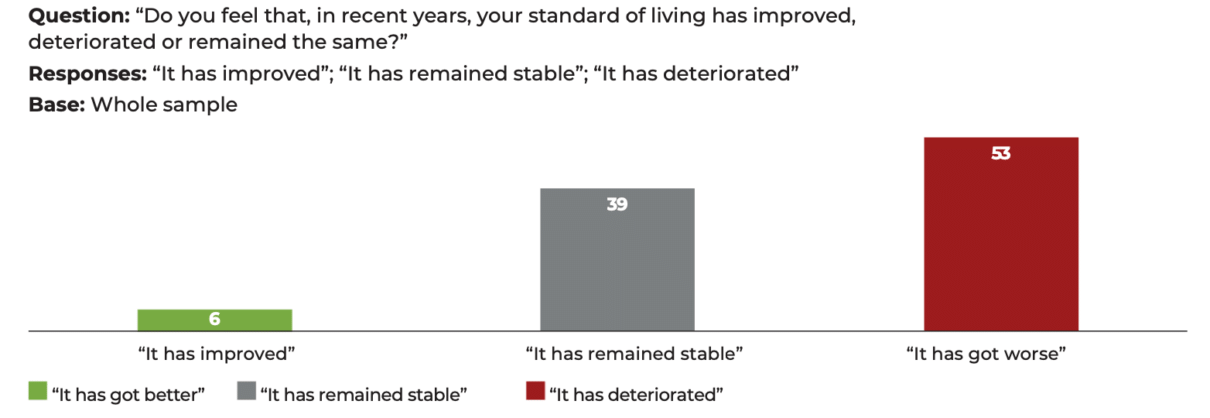
Copyright :
Fondapol – June 2026
A political crisis centred on heritage issues can be observed in most European countries. But it might just as well be recorded anywhere in the world, at least as far as intangible cultural heritage is concerned. This would be a logical consequence of globalisation, both as a process of worldwide integration and as a technological revolution. The term “political heritage crisis” refers to a twofold concern that is causing unease in Western democratic societies. A growing number of citizens are concerned not only about the future of their material heritage, their standard of living and, more generally, the material conditions of their lives, but also about the future of their intangible heritage, their history, their way of life, their culture, and how this is passed on and sustained.
It should be noted that, contrary to public discourse, the perception that living standards have declined is all the more pronounced among older respondents. This is particularly true of those aged 50–64, among whom a clear majority (62%) believe that their standard of living has “deteriorated”. By contrast, the youngest age group, those aged 18–24, take a more relaxed view of the issue: only 42% of them say their standard of living has declined, and they are in fact the only age group for whom a sense of stability (45%) outweighs a feeling of decline. The result is consistent with what is observed by employment status: the unemployed are the most pessimistic group, with 68% feeling that their standard of living has deteriorated, whilst students and secondary school pupils, like younger people in general, remain the only group in which a sense of stability (45%) holds up in the face of perceived decline (42%).
The perception that living standards have declined increases with age (%)
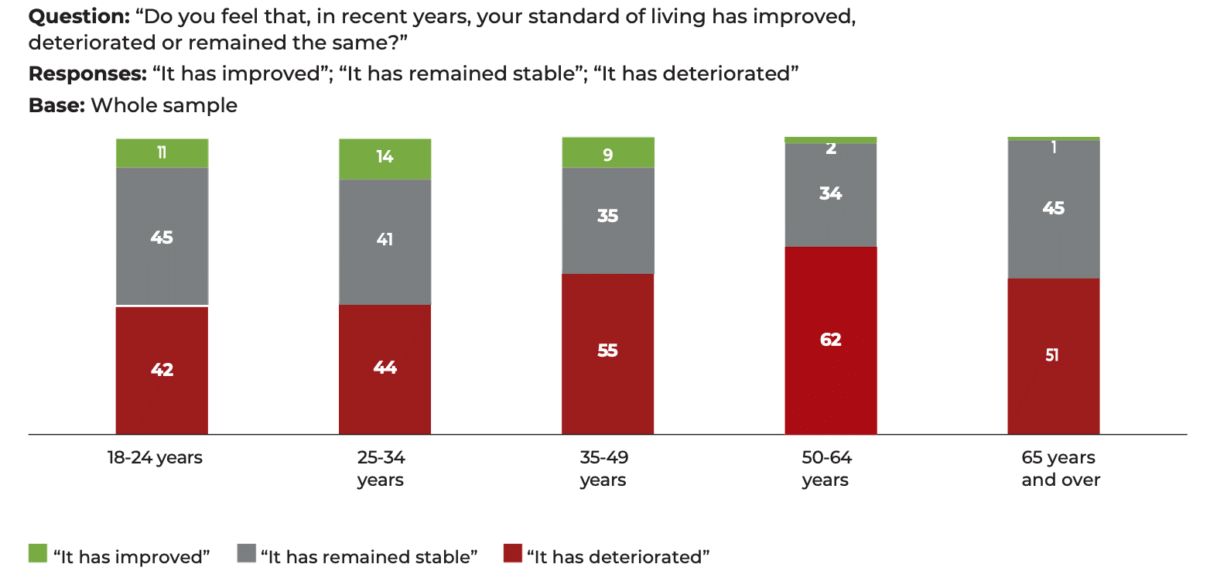
Copyright :
Fondapol – June 2026
The question designed to assess changes in intangible heritage was phrased as follows: “In recent years, have you felt that the French way of life, its traditions and its customs are now being preserved or, on the contrary, are they under threat?”. More than three-quarters (78%) of those surveyed say that their way of life, as defined, is now under threat.
This sense of loss, the nature of which is difficult to pinpoint – a feeling that evokes grief and nostalgia – is felt even more keenly by the older generations: 83% of people aged 50 and over experience this sense of existential unease. However, there is no significant generational divide when it comes to intangible heritage. Indeed, whilst the youngest age group (18–24 years) are relatively the least concerned – with nearly a third (30%) believing that traditions and ways of life are being preserved – a very large majority (70%) consider them to be “under threat”.
For most French people, the French way of life and the country’s traditions are now under threat (%)
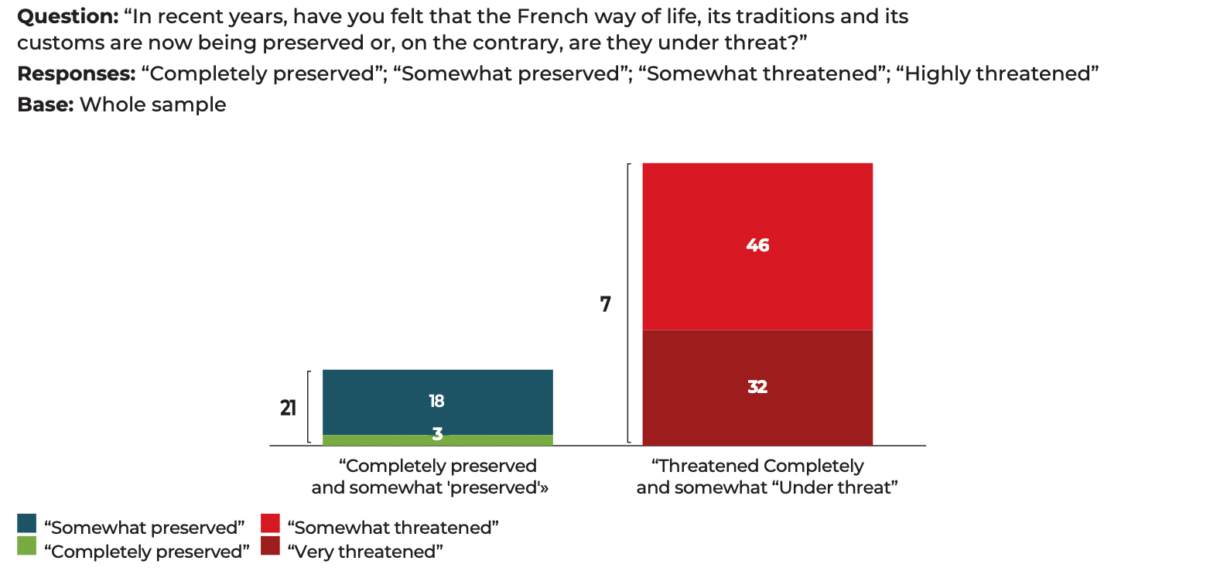
Copyright :
Fondapol – June 2026
The French way of life, its traditions and its customs are now under threat (%)
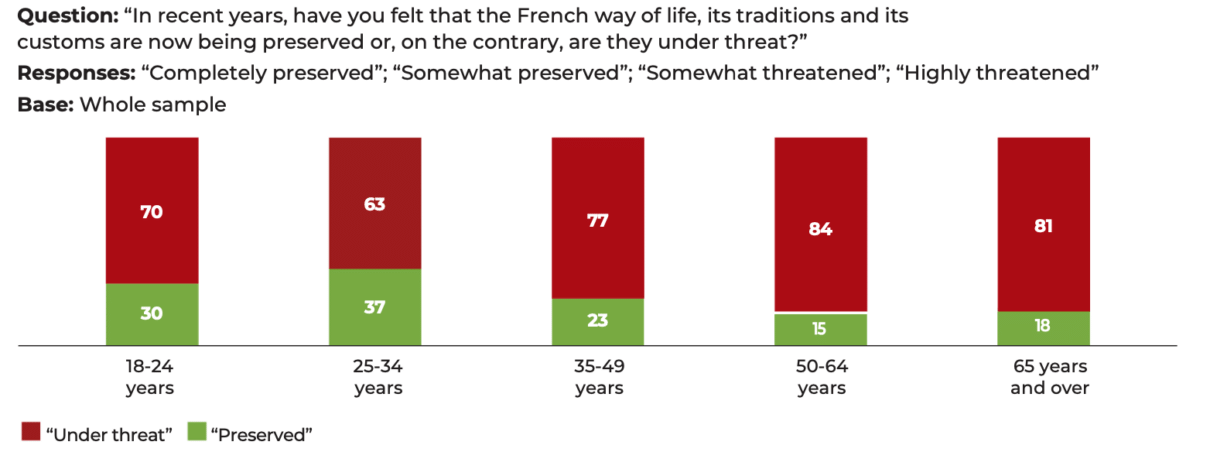
Copyright :
Fondapol – June 2026
The perception of a threat to traditions and ways of life in France is worth examining in the light of the religious affiliation of the respondent, as a convergence between Muslims and Catholics is becoming apparent. A majority (59%) of French Muslims also believe that “the French way of life, its traditions and its customs are now under threat.” A similar majority is found among Catholics, though to a greater extent (83%).
The feeling that the French way of life and traditions are “under threat” is so widely shared that it undoubtedly reflects realities and points of reference that are, in part, different; yet it nonetheless reflects a sense of loss collectively felt by the French people, regardless of generation, political views, religious beliefs or standard of living. The issue of heritage must be understood as a matter of great significance, a symptom of a people’s disorientation within a history that they no longer shape, no longer understand, and which seems to no longer need them.
Traditions under threat (%)
Copyright :
Fondapol – June 2026
Politically speaking, 83% of those on the right feel this sense of having been dispossessed of their heritage. They account for 81% of LR supporters, 90% of RN supporters and almost all (92%) of Marine Le Pen’s voters in the first round of the 2022 presidential election. They endeavour to express this in various ways, through political parties and candidates who speak on their behalf and stand for election, as well as through their responses to survey questionnaires. But the idea that the French way of life and traditions are “under threat” is also prevalent on the left (64%), among PS supporters (75%) and among voters (71%) who supported Jean-Luc Mélenchon in 2022, and this sense of loss is also shared by 69% of Emmanuel Macron’s 2022 voters.
It is worth noting, however, that the cross-party resonance of this sense of loss – or even dispossession – has not been a topic of discussion in our public debates. Any suggestion of the possibility of such collective unease is automatically dismissed as a right-wing, or even far-right, issue.
The poison of the presidential election
An election against the country
“And when you think about the next presidential election in April–May 2027, what is the first thought that springs to mind: enthusiasm; confidence; concern; despondency; indifference?”
1. Anxiety and despondency among the French as the presidential election looms
For our country, which is facing considerable domestic problems, whose population is deeply troubled and divided, and which lacks a collective vision, in a world in turmoil and beset by major geopolitical crises, the presidential election seems to pale in comparison to the immense scale of the challenges at stake. With the election approaching, only a handful (3%) of those surveyed are enthusiastic about it. Even confidence is marginal (8%). The predominant feelings are anxiety (52%) and despondency (22%). On the whole, three-quarters of voters report feeling negative emotions in the run-up to the presidential election8.
For the French, the presidential election has become a problem (%)
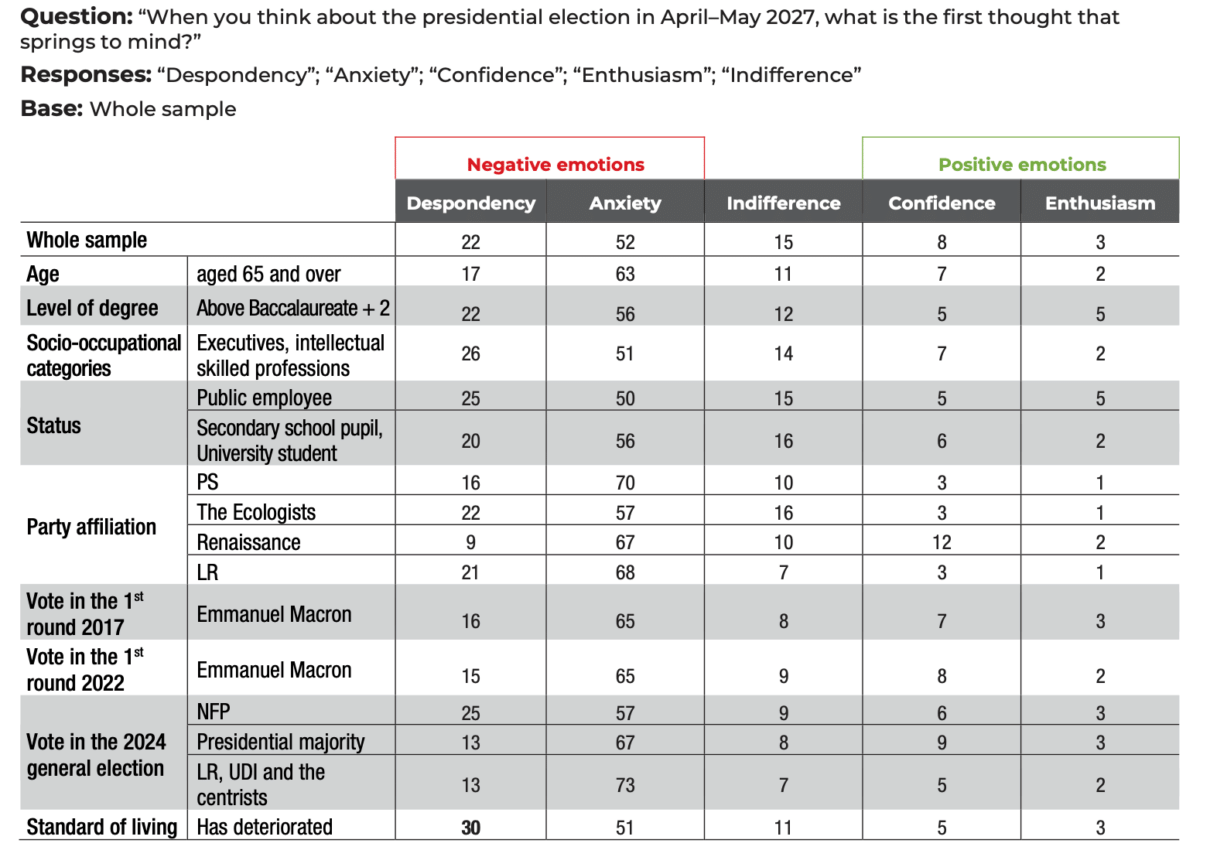
Copyright :
Fondapol – June 2026
The feeling that one’s way of life is under threat and perceptions of the presidential election (%)
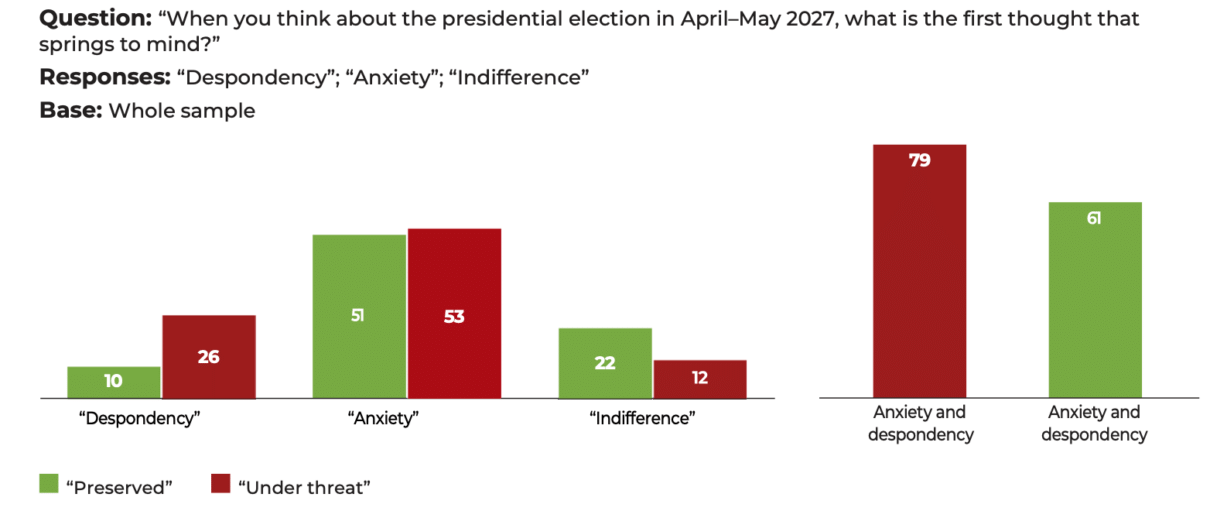
Copyright :
Fondapol – June 2026
Note: Among those who believe that the French way of life, its traditions and its customs are under threat today, 79% feel discouraged and anxious as the 2027 presidential election approaches.
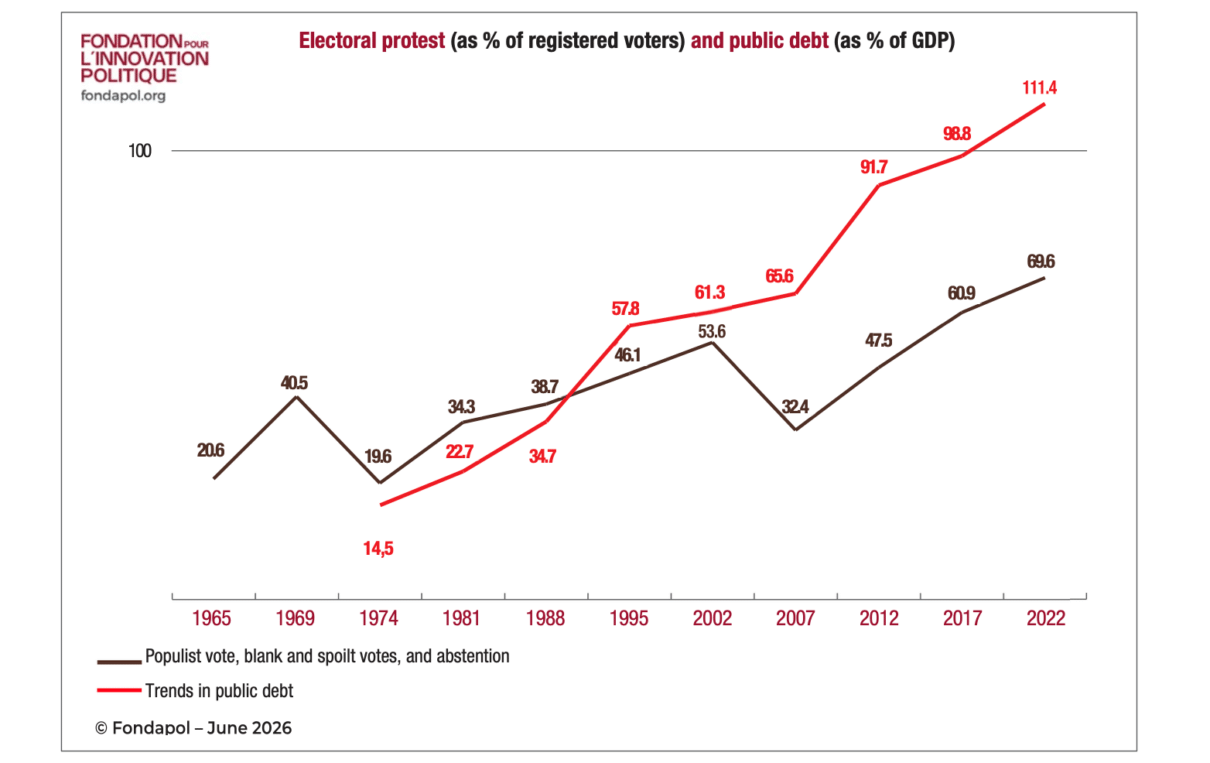
Here I am revisiting the ideas set out in my article, “L’élection présidentielle, une tragédie française”, published on 2 September 2025 in the “Sciences Po Conference” section of the Sciences Po website [online].
As can be seen from an analysis of the 11 previous presidential elections, it was largely through promises and manifestos that showed little regard for their budgetary, economic and political consequences that the crisis was able to take hold in the country and reach such proportions. On the other hand, it is clear that candidates from the governing parties are moving away from economic and budgetary realism in an attempt to rally voters. They pave the way for populist rivals, who will always come out on top in this respect. The presidential election has become structurally favourable to them.
The results of the first round of the 11 presidential elections held since 1965 reveal a massive rise in populism. It first became noticeable in the mid- 1980s. The 1988 presidential election was the first to see a rise in populist support, with Jean-Marie Le Pen, the National Front candidate, securing 14.5% of the vote. At the time, this result could be seen as a vote in anger, hence a temporary discontent. But the surge continued.
During the period 1988–2022, only the 2007 election stood out for a decline in abstention and a rise in turnout in favour of the ruling party’s candidates, to the detriment of the National Front candidate, Jean-Marie Le Pen. But 2007 was merely a blip in the shift towards protest politics in the presidential election. In 2012, support for populist parties rose once again. They accounted for a third of the votes cast, matching the previous record set on 21 April 2002.
In 2017, the total number of populist votes in the first round came close to a majority of the votes cast (48.4%), before far exceeding it in 2022, with 57.8% of the votes cast. Anti-establishment candidates are in the majority.
2. The presidential election and the erosion of accountability
Inevitably, the prospect of the forthcoming presidential election is prompting political leaders and their parties to prioritise competition over cooperation, despite the state of public finances, which is casting the shadow of a major crisis over the country9. The president’s leading role within the institutions should mean that the presidential election is the moment when the major issues that concern and divide the country are resolved. But is it really possible to balance heavily deficit- ridden budgets by entrusting this task to a head of state elected by direct universal suffrage? It is difficult to see how any presidential election campaign could provide useful solutions or allow for debate and negotiation on the appropriate measures needed to turn the financial situation around.
Almost everything about the presidential election runs counter to the minimum requirements for consensus and reform: the excessive personalisation of power, its authoritarian tendencies and its reliance on plebiscitary support.
This is also why the presidential election favours populist candidates more than those who wish to bring about reform for future generations. Under this de facto presidential Fifth Republic, the problem with democracy is not that party leaders and MPs are unable to debate or negotiate, but that they have no incentive to cooperate less than a year and a half before a presidential election. It should be noted here that the shift from a seven- year to a five-year term has only served to exacerbate this institutional disorder. The five- year term increases the frequency of presidential elections, and amplifies the disruptive impact of these pre-election campaigns, which hinder the ability to engage in meaningful debate and prevent the necessary decisions from being taken.
The presidential election strongly influences the types of discourse, government programmes and the form of public debate. By its very nature, the election has played a decisive role in the rise in public spending. It is the root cause of the deficits and the debt. Because of its demiurgic traits, this election could not take economic and financial constraints into account when it became clear that it would be risky not to cut public spending due to a less favourable economic climate. The trend in public debt bears this out. This election is unaffected by economic and financial constraints. It encourages promises of spending – that is to say, tax increases – rather than cost-cutting or State reform.
The presidential election embodies a culture that it has instilled throughout the political sphere and public debate. Its rituals and codes, its symbols, its grandiloquent vocabulary (“the meeting of a man and a people” (in French, la rencontre d’un homme et d’un peuple), “the queen of elections”, the “highest office”, “master of clocks” (le maître des horloges), “the state of grace”, etc.) – all of this suggests that somewhere there exists a miraculous solution, a magic formula of which the president is the custodian, and which would give the French people the power to ignore the scarcity of wealth and the need to produce it.
As we can see, electoral protest is insatiable once it is recognised, as evidenced by the rise in public spending; the explosion in debt demonstrates just how effective electoral protest can be in a political system organised around a presidential election, such as our own. It encourages candidates to promise spending and discourage them from announcing cost-cutting measures. The continuing rise in public deficits and compulsory levies is weighing heavily on the economy; similarly, far from strengthening democracy, rising deficits are dangerously destabilising it by legitimising demagoguery and populism. It is an economic and political failure.
3. A shrinking electorate in the first round, a “republican front” in the second, protests… Which politician will be able to govern?
We can see the collapse of the electoral base of the governing parties, on both the left and the right. If we take into account not only populist votes but also abstentions, blank and spoiled votes (all of which must necessarily be calculated in relation to the number of registered voters, due to abstention), we arrive at a total of 60.9% in 2017 and 69.6% in 2022. These staggering figures highlight just how much the governing parties have lost ground. Over the past fifteen years, the FN/RN has dominated the traditional right, whilst LFI, led by Jean-Luc Mélenchon, has established its dominance on the left, securing 19.6% of the vote in 2017 and 22% in 2022. But as it is the moderate parties that are in power, their legitimacy is inevitably undermined, called into question almost immediately because of their weak electoral showing, thereby jeopardising the chances of their decisions being endorsed, all the more so if they were to seek to balance the national budget by reducing public spending in general and social spending in particular.
The wave of protest has been so strong that, over the past twenty years, it has propelled a populist candidate into the second round of the presidential election on three occasions: in 2002, 2017 and 2022.
Admittedly, on each occasion, the majority of voters who took part in the election ultimately backed the incumbent president, denying the populist candidates the presidency. But each time, too, this “front” has lost some of its strength. Consequently, the gap between the two candidates in 2017 was halved in 2022, whilst the abstention rate rose by nearly 3 percentage points. Similarly, in the second round in 2022, although Emmanuel Macron was re-elected against Marine Le Pen, it was with only 38.52% of registered voters. In the first such run-off on 5 May 2002, against Jean-Marie Le Pen, Jacques Chirac was re-elected with 62% of the registered voters. In 2022, the “republican front” is on the verge of collapse.
As we have seen, between 1965 and 1981, against a favourable backdrop, the ruling parties dominated the political scene unchallenged, thanks to the presidential election, which provided them with powerful means of persuasion. It is therefore easier for candidates to respond positively to the electorate’s demands, and even to encourage them. But against a backdrop of sluggish growth, economic insecurity, an ageing population and budget deficits – when the need to balance the books and decide on the reforms required to tackle those deficits inevitably arises – populist parties take centre stage. It was the populist presidential election that began to take shape from the mid- 1980s onwards.
The steady rise in populist votes and protest voting threatens to bring our political system to a standstill in 2027 (%)
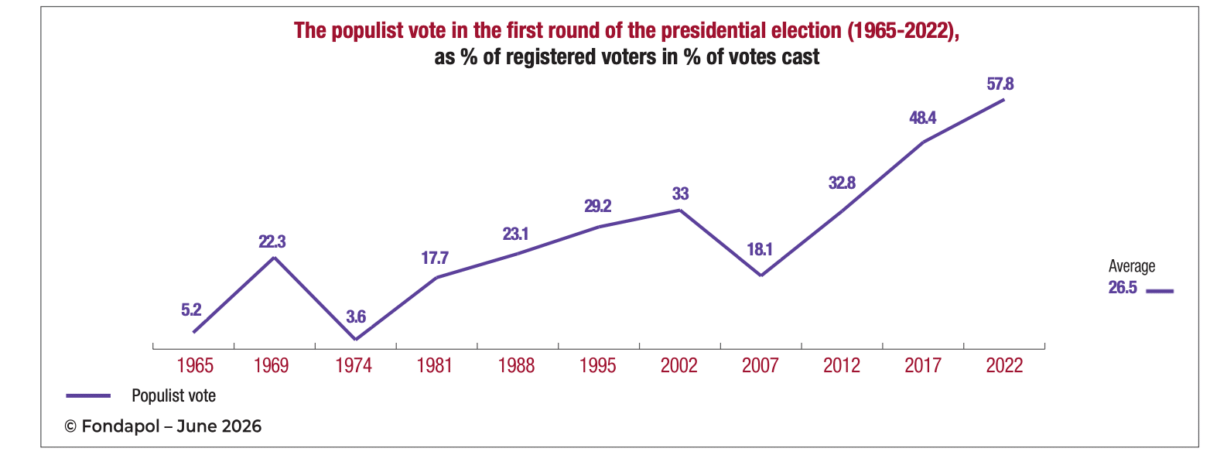
Candidates included: 1965: J.-L. Tixier-Vignancour (Comités Tixier-Vignancour); 1969: J. Duclos (PCF), A. Krivine (LC); 1974: J.-M. Le Pen (FN), B. Renouvin (NAR), A. Laguiller (LO), A. Krivine (FCR); 1981: A. Laguiller (LO), G. Marchais (PCF); 1988: J.-M. Le Pen (FN), A. Laguiller (LO), A. Lajoinie (PCF); 1995: J.-M. Le Pen (FN), A. Laguiller (LO), R. Hue (PCF), J. Cheminade (SP); 2002: B. Mégret (MNR), J.-M. Le Pen (FN), A. Laguiller (LO), O. Besancenot (LCR), R. Hue (PCF), D. Gluckstein (PT); 2007: J.-M. Le Pen (FN), A. Laguiller (LO), O. Besancenot (LCR), M.-G. Buffet (Gauche populaire et antilibérale), G. Schivardi (PT); 2012: M. Le Pen (FN), N. Dupont-Aignan (DLR), J-L. Mélenchon (FdG), P. Poutou (NPA), N. Arthaud (LO), J. Cheminade (SP); 2017: M. Le Pen (FN), N. Dupont-Aignan (DLF), F. Asselineau (UPR), J-L. Mélenchon (LFI), P. Poutou (NPA), N. Arthaud (LO), J.Cheminade (SP); 2022: M. Le Pen (RN), N. Dupont-Aignan (DLF), É.Zemmour (R!), J.-L. Mélenchon (LFI), P. Poutou (NPA), N. Arthaud (LO), F. Roussel (PCF).
* Since the law of 21st February 2014, the census of blank votes has no longer been combined with invalid votes (null votes). The 2017 presidential election was the first during which the new blank vote system was applied. From the 2017 presidential election onwards, we only count blank votes.
French presidential elections — % of registered voters who voted for the candidate elected president
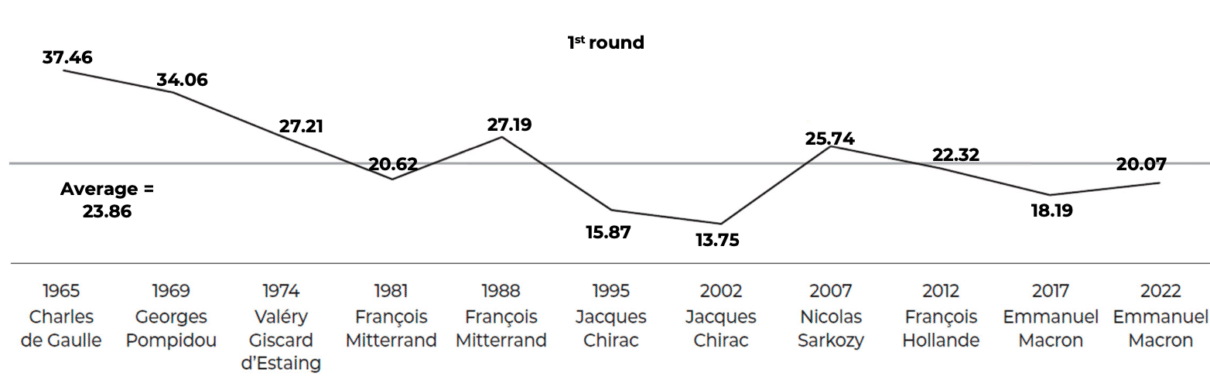
Copyright :
Fondapol – juin 2026
French presidential elections — % of registered voters who voted for the candidate elected president
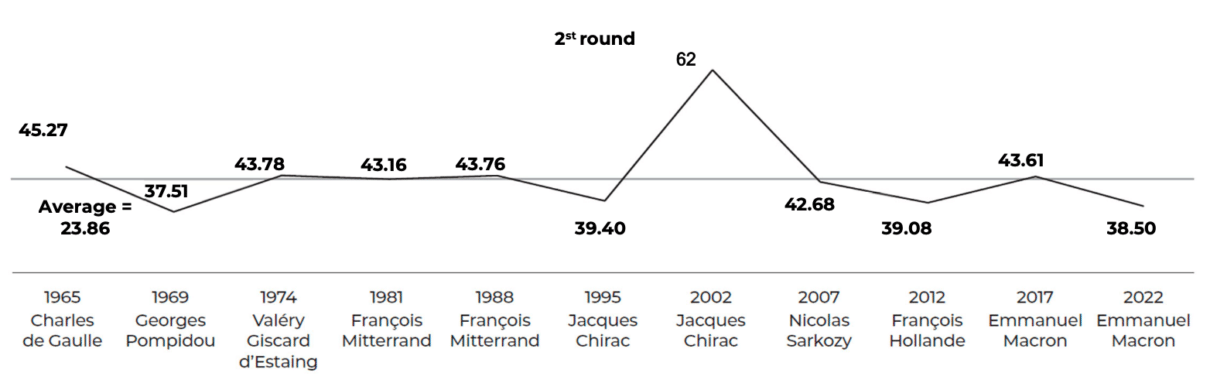
Copyright :
Fondapol – June 2026
Finally, the vote share achieved by the candidate elected as president has never been particularly high relative to the number of registered voters. On average, under the Fifth Republic, the future President of the Republic receives just under a quarter of the votes cast by registered voters (24%) in the first round. In the second round, the average is 43.5%. It should be noted that this average for the 11 second rounds since 1965 includes three second rounds in which a candidate from the FN/RN stood: 2002, 2017 and 2022. Consequently, the results of these three second rounds do not reflect voters’ support for a candidate backing a particular programme, but rather their desire to prevent a candidate from the FN/RN from coming to power. In all three cases, it is difficult to speak of a “government contract”, as it is understood that this is not the issue, as demonstrated by the left-wing voters who voted for Jacques Chirac in 2002, or by voters on both the right and the left who voted for Emmanuel Macron in 2017 and 2022.
Under this type of system, the winner of the presidential election cannot claim to have a mandate for economic and social policy, even though presidents elected in this context tend to forget this.
We can also see that the elected president’s initial first-round support base represents, on average, only a quarter (24%) of registered voters, and that in the second round he manages to secure, on average, 43.5% of the vote, bearing in mind that in three of these eleven elections, in the second round, the winner received more votes than the winner could have hoped for had they not been up against an anti-establishment candidate. Excluding these three elections, the average is 41.8%. In other words, since 1965, around 60% of registered voters have not voted for the elected president.
What else can the presidential election bring?
1. Who should people vote for, and why, if the problem facing the French people is their political class (64%)?
A new president … who immediately finds himself without a majority. Most voters say they want a return to political and institutional order – that is, consistency between the presidential majority and the parliamentary majority – but many are only committed to this in so far as such consistency would align with their own preferences; in particular, that the presidential majority and the parliamentary majority do not converge to the benefit of an RN president. The desire to restore political and institutional order, provided that this does not benefit the RN, implies the possibility of the new president immediately having to govern alongside a fully-fledged parliamentary opposition holding a majority in the National Assembly; however, the determination not to grant a parliamentary majority to an RN president may also lead to a situation comparable to that which we have experienced since the dissolution of 2024, namely the absence of a majority and the impossibility of forming one.
The question asked on this subject was as follows: “After the next presidential election, in 2027, if Jordan Bardella or Marine Le Pen were elected President of the Republic, would you want him or her to secure a majority of MPs in the National Assembly to support their policies, or, on the contrary, would you prefer them not to secure a majority so that members of the National Assembly could act as a counterbalance?”
The country is divided equally. On the one hand, there are voters (49%) who would like the RN, once it has reached the Élysée, to secure a parliamentary majority to support its policies; on the other hand, 48% of voters would prefer the new president not to secure a parliamentary majority, so that members of the National Assembly can act as a counterbalance.
This desire for the presidential majority to align with the parliamentary majority, should a National Rally president be elected, is partly driven by the left–right divide. This desire is particularly prevalent among the working classes (52%) but also among those with a monthly household income of between €2,000 and €3,499 (55%), among French people with few or no qualifications (54%), those who say they “struggle greatly to make ends meet on their income” (56%), those aged 25–34 (52%), those aged 50–64 (53%), private-sector employees (53%), and those who say they are “very dissatisfied” with Macron’s presidency (57%), those who have a positive view of the Gilets Jaunes (53%), voters on the right (71%), those who voted for Marine Le Pen in 2022, in the first round (86%) or in the second round (84%), voters on the right (LR-UDI-Centre) in the 2024 general election (61%), Catholics (54%) and those in favour of a system based on “a strong leader” (65%).
Conversely, however, the hope that the RN candidate will not secure a majority – so that members of the National Assembly can act as a counterbalance – is particularly strong among secondary school pupils and university students (66%), 18–24-year-olds (61%), those under 35 (52%), managers, professionals and those in higher-level occupations (54%), those with a monthly household income of €3,500 or more (53%), higher education graduates (54%), public-sector employees (52%), the unemployed (55%), those who say they are “satisfied” with Macron’s presidency (58%), Jean-Luc Mélenchon’s voters in 2022 (74%), voters who identify as left-wing (80%), supporters of LFI (71%), the PS (74%), the Ecologists (84%) or Renaissance (73%), those with a negative view of the Gilets Jaunes (55%), those who voted for Emmanuel Macron in 2022, in the first round (63%) or in the second round (64%), NFP voters in the 2024 general election (78%), 42% of Catholics – who are deeply divided on this issue – in contrast to Muslims, the vast majority of whom (77%) are in favour of a National Assembly acting as a counterweight to the RN.
Getting elected, perhaps, but what about being able to govern? (%)
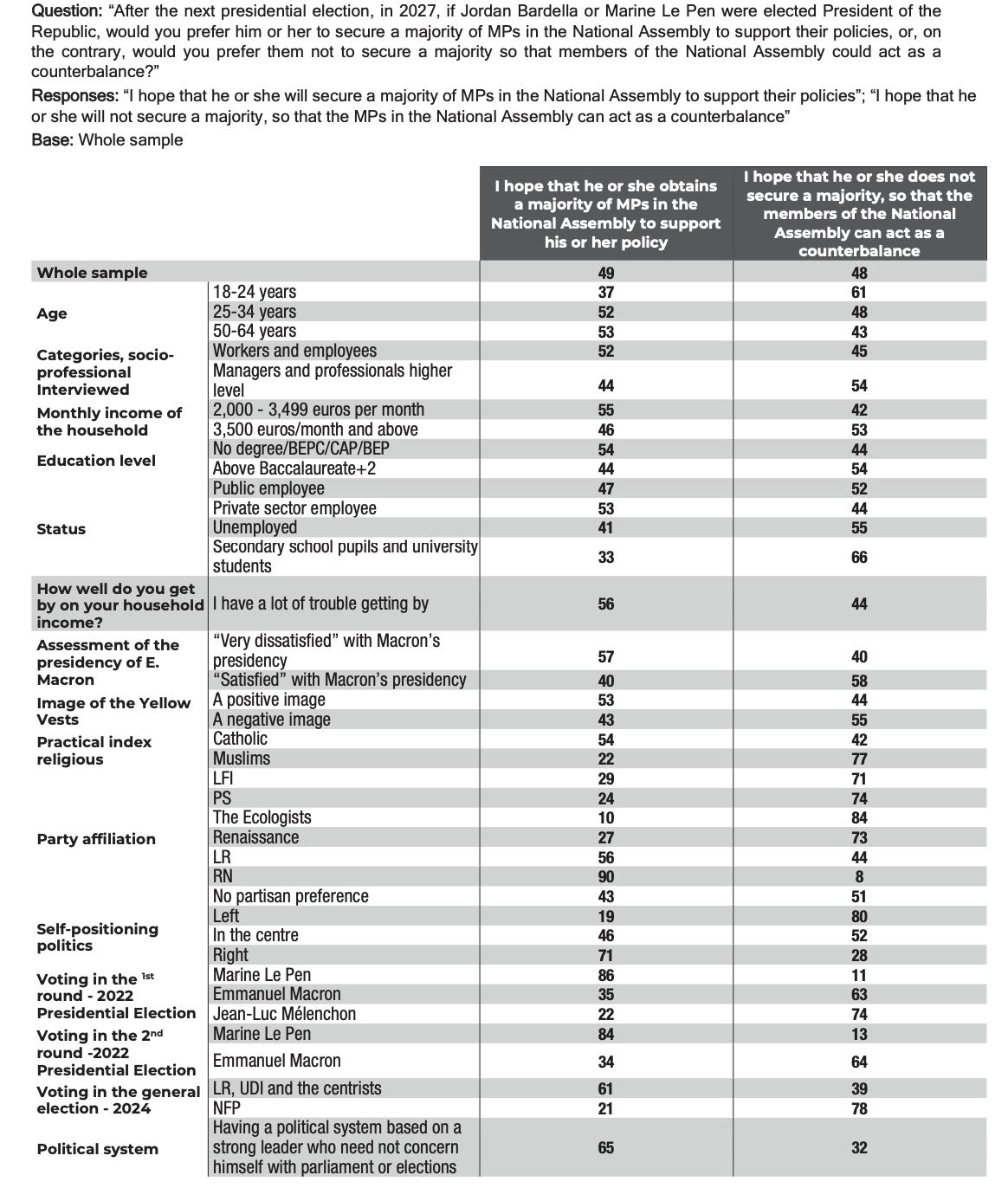
Copyright :
Fondapol – June 2026
2. General election: 3rd round of a protracted presidential election (April– May–June–July 2027)
As we have seen, the French attribute the crisis we are currently experiencing to the political class, not to a failing of our institutions. Two-thirds of those surveyed (64%) believe that, “on the whole, we have a good political system, but our political class is incapable of governing and finding solutions to our problems”.
For anyone who might think that the governed shirk their responsibilities too easily by placing the blame on their leaders, it should be noted that this harsh judgement is held by citizens, the majority of whom (68%) remain committed to the idea that “it is worth voting because it is through elections that we can bring about change”, compared with 30% who conclude that “voting is pointless, politicians do not take the will of the people into account”. These voters also account for three- quarters (74%) of those who express a preference for “a democratic political system with an elected Parliament that oversees the Government”, as opposed to “a political system based on a strong leader who need not concern himself with Parliament or elections” (23%).
Between the election of the head of state and the – highly uncertain – formation of his parliamentary majority, there will be a campaign lasting nearly four months: a fierce, perhaps even furious contest, saturated with demagogic rhetoric. What room will be left for the aspirations of French society? Will they even have a say in the matter? Will they break through the thick veil of media and political oversimplification? Will the election campaign draw inspiration from the major questions, core convictions, intuitions and political, economic and social preferences of the French people, despite the dogmas imposed by ideological machines upon a collective mindset that is otherwise pluralistic, inventive, well- informed and vibrant? Our political system shows that the French people may be asked to vote, but without having had the opportunity to discuss matters, without really having been heard, or even listened to.
The election period and the ongoing political crisis will lead public commentary to place greater emphasis on French sentiments and passions, which are, unfortunately, more negative than positive given the country’s current situation and the election campaign. Nevertheless, in many respects, the aspirations of the people must be regarded as very encouraging, even if it is regrettable that they are not given greater consideration by the media or even taken on board by politicians. Thus, nearly two-thirds (64%) of those surveyed believe that “given global developments, economic growth and technological innovation, France is now lagging behind”, compared with 35% who, on the contrary, believe that France is still in the running.
When those who believe France is now lagging behind were asked “what should France’s priority be in order to make up lost ground and regain its prosperity, power and influence”, the top three priorities were overwhelming: “re-industrialising the regions” (43%), “cutting taxes and easing the regulatory burden on our businesses” (43%), “restoring a competitive and export-oriented agricultural sector” (35%).
For those who, on the contrary, believe that “France is still in the running”, the top three priority issues that the campaign should address remain the same. This time, it is no longer a question of France making up lost ground, but of “maintaining its prosperity, power and influence”; the agenda is barely any different and is just as strongly characterised by a proactive approach: “re-industrialising the regions” (40%), “cutting taxes and easing the regulatory burden on our businesses” (35%) and, finally, “restoring a competitive and export-oriented agricultural sector” (31%).
For those who think France is now lagging behind, what should the priority be to make up lost ground? (%)
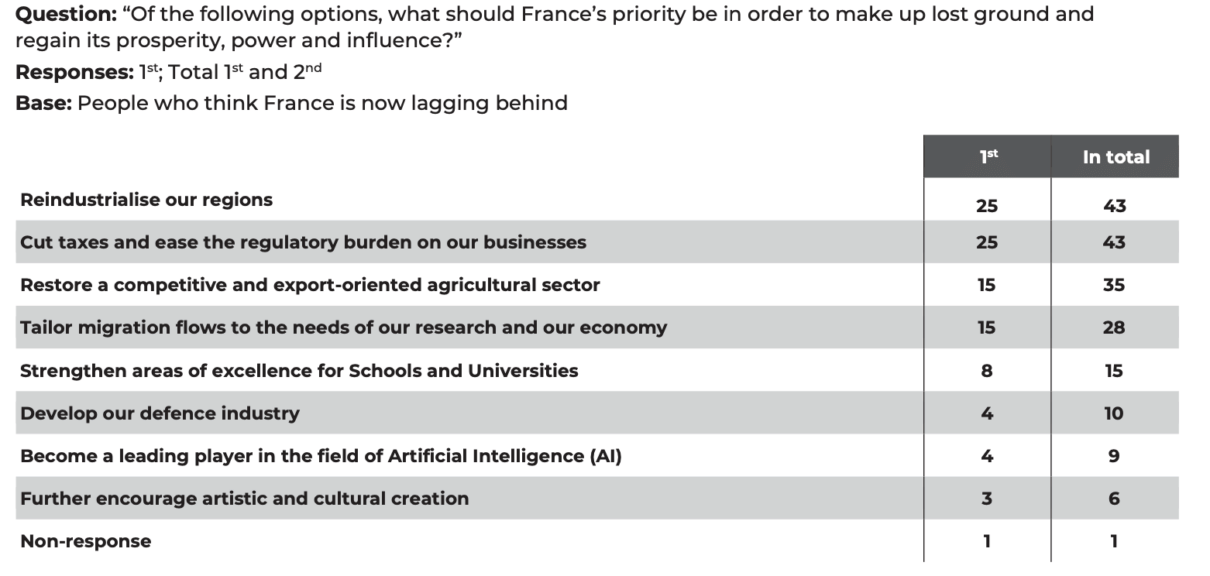
Copyright :
Fondapol – June 2026
For those who believe that France is still in the running, what should the priority be to maintain its position? (%)
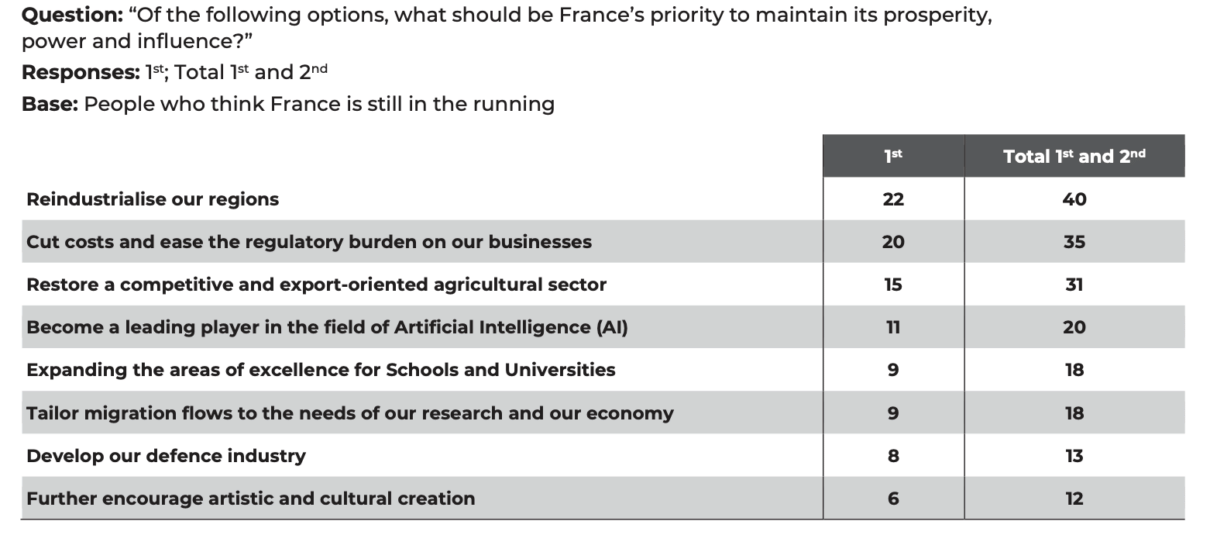
Copyright :
Fondapol – June 2026
Those French people who believe that the issue of “the public deficit and debt” should be the priority in the presidential campaign (%)
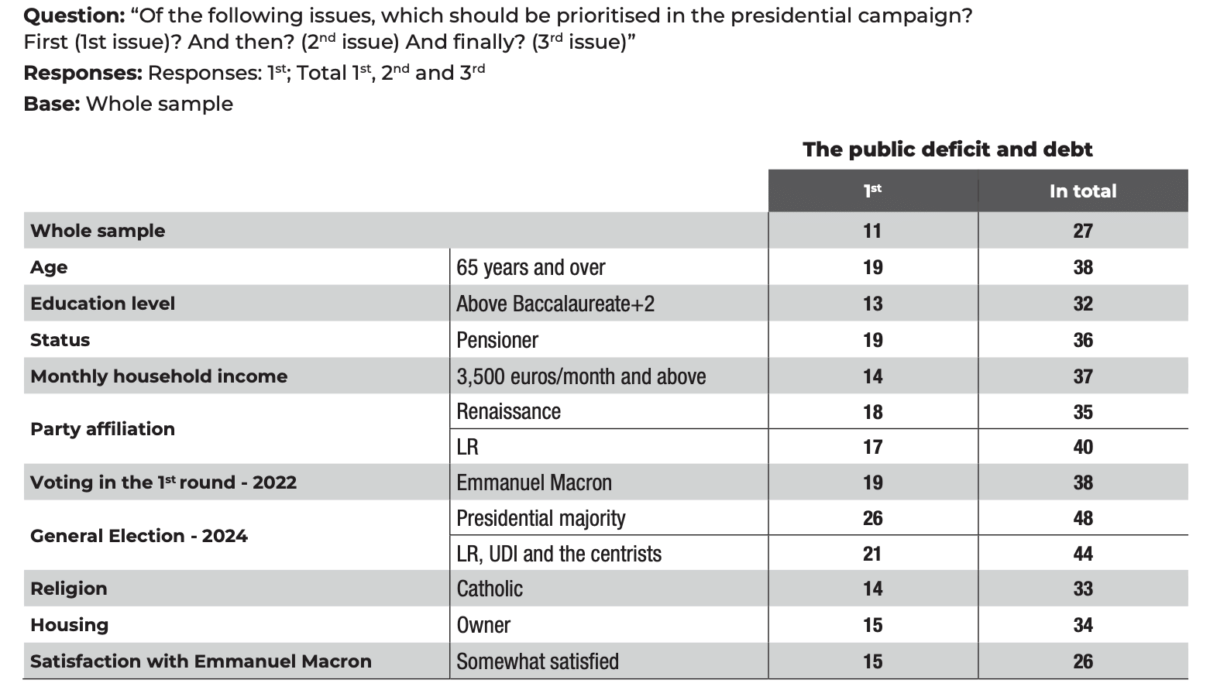
Copyright :
Fondapol – June 2026
The question was phrased as follows: “Of the following issues, which should be prioritised in the presidential campaign? First (1st issue)? And then? (2nd issue) And finally? (3rd issue)”.
We have seen that 88% of those surveyed fear that a serious financial crisis is imminent, due to the country’s large deficits and debt. Despite this widespread awareness of the financial risk facing France, when voters are asked about the issues that should be prioritised in the presidential campaign10, “the public deficit and debt”, one of the sixteen topics suggested, is cited as the top priority by 11% of those surveyed; this may seem low, but when the total number of mentions is taken into account – that is, first, second and third choices – “the public deficit and debt” ranks among the top three priorities for a quarter (27%) of voters.
The European issue also perfectly illustrates the French people’s seriousness. It should be noted at the outset that, in order to gain a better understanding of public opinion regarding France’s membership of the European Union and the eurozone, it is preferable not to use a binary question (“for” or “against”) so as not to force those who are Eurosceptics at heart to renounce their convictions by accepting a sense of belonging to which they resign themselves out of reason, weariness or resentment, but which they fundamentally do not approve of. To this end, we have devised a question comprising three items:
– “I am in favour of the European Union and of France being a member”;
– “I am not in favour of the European Union, but I do not want France to leave it. What’s done is done”;
– “I am not in favour of the European Union and I hope that France will leave it”.
To gauge support for France’s membership of the European Union, one must therefore add together the responses to the first two options: “I am in favour of the European Union and of France being part of it” (46%) and “I am not in favour of the European Union, but I do not want France to leave it; what’s done is done” (29%), giving a total of 75% of respondents who are in favour of France’s membership of the European Union.
The same applies to the euro. The three options are:
– “I am in favour of the euro” (54%);
– “I am not in favour of the euro, but I do not want us to leave the euro and return to the franc. What’s done is done” (27%);
– “I am not in favour of the euro and I hope that we leave the euro and return to the franc” (15%).
Ultimately, only a minority (22%) want France to leave the European Union, and an even smaller minority (15%) want the country to abandon the euro and return to the franc. These opinion groups naturally constitute an audience and an electorate that must not be overlooked; they could provide support for an anti- European party should circumstances become favourable, particularly in the event of a financial crisis. Nevertheless, the overriding fact is that 75% of those surveyed are in favour of the European Union, in one way or another, under these terms, and 81% are in favour of the euro.
Support for Europe by party affiliation (%)
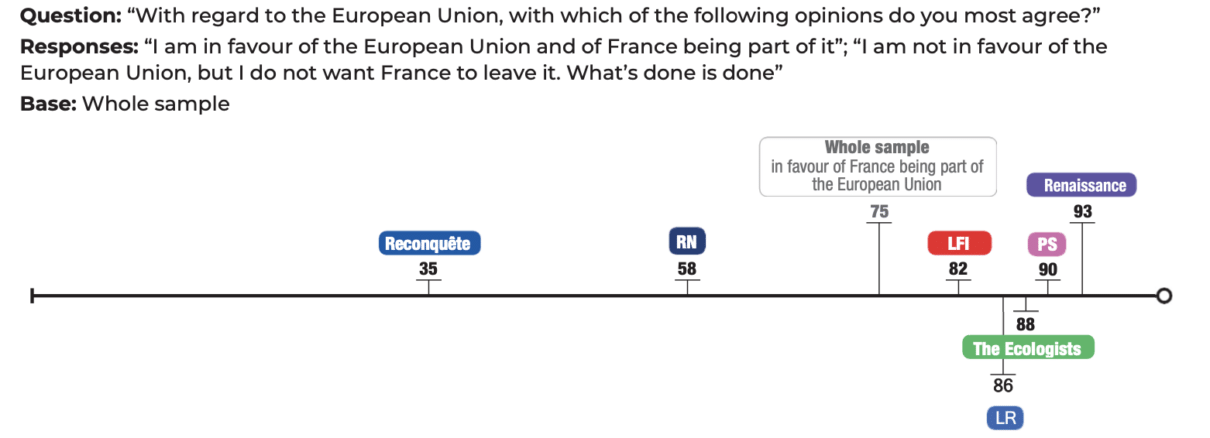
Copyright :
Fondapol – June 2026
Public support for the euro (%)
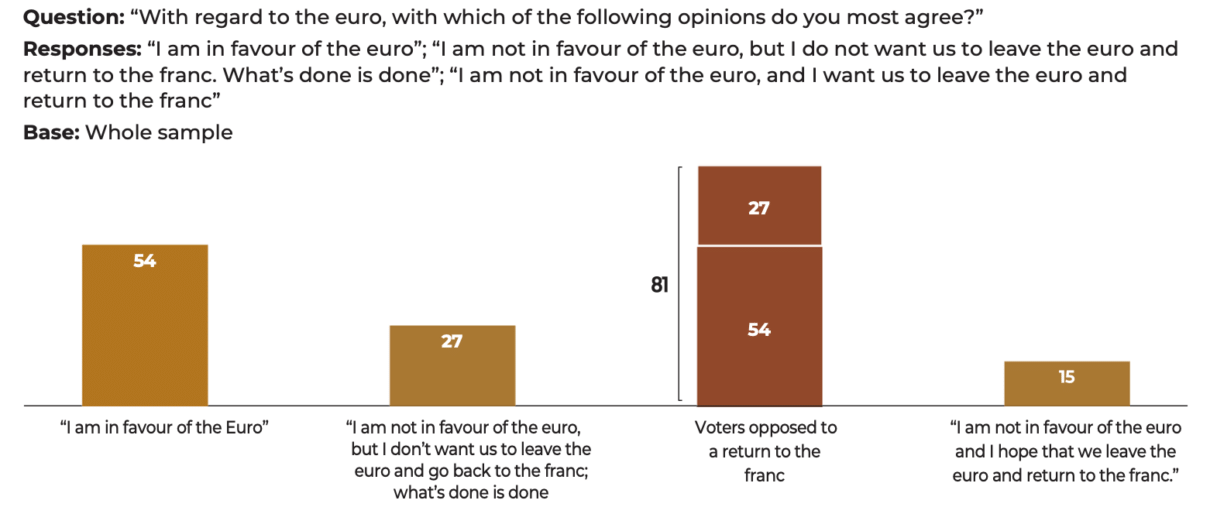
Copyright :
Fondapol – June 2026
Populist expressions of hostility towards the European Union and the euro are perceived by voters as a threat to their interests. Anti-European rhetoric is readily accepted when it is generalised, anti-establishment and provides an outlet for expressing one’s negative views of the elite. It is an expression of protest that costs nothing; but discourse against the euro amounts to asking citizens to put their personal material interests at risk. Such is the limit of populist undertakings. Parties that persist in fighting the euro are finding their electoral base is limited; they can only expand by moderating their criticism of the euro… or by rallying to support the European currency!
In eurozone countries that have seen a sharp rise in support for populist parties, public opinion has remained clearly in favour of the euro, as if citizens were seeking to impose limits on populist government policies. The euro is reaffirming its role as a key guardian of the fundamental economic interests of the French people. It is therefore also a decisive political factor that effectively reduces the risk that national elections have tended to introduce over the past twenty years or so.
Europe and the euro remain powerful political forces for integrating populist parties into both national democratic systems and the European system, thereby forcing them to moderate their stance. In France, criticism of Europe and the euro has played a major part in raising the profile of the FN, particularly during the two referendum campaigns: one concerning the ratification of the Maastricht Treaty in 1992, and the other on the ratification of the Treaty establishing a Constitution for Europe in 2005. But this criticism has also led to the marginalisation of the FN/RN. In order to fulfil the role to which its electoral progress entitles it, the RN has, on the whole, had to tone down its hostility towards Europe and the euro considerably. The same phenomenon can be observed in left-wing populism, as embodied by the LFI candidate, Jean-Luc Mélenchon. In order to maintain a stance that retains the appearance of radicalism, he refers – albeit rather confusingly – to political “ruptures” rather than technical reforms, as evidenced by his proposal to write off the debt or to change the status of the ECB.
3. Is a return to normality possible in 2027?
The dissolution on 9 June 2024 had numerous far- reaching consequences, two of which are worth highlighting here. The first consequence is both immediate and long-lasting: with this dissolution, instability and disorder are now taking hold at the very heart of the public authorities. The executive and legislative branches are out of step with one another, and relations between them are becoming dysfunctional. Prime ministers and ministers have been coming and going at a rate never seen before – nor thought possible – since 1958. As the power to dissolve Parliament rests solely with the head of state, this failure has a direct and very negative impact on him or her. Given the timing of his decision – namely, halfway through his last term of office – the President did not give himself the opportunity to rectify his mistake or to mitigate its harmful effects. The lack of a majority has left the French feeling bewildered, exasperated and shocked. As we have seen, nearly three-quarters (72%) of those surveyed consider it a “bad thing for our country” that there is “no longer a majority in the National Assembly”.
Since the summer of 2024, voters have therefore been hoping for a return to normal government functioning and, specifically, they are looking forward to the outcome of the 2027 presidential and general elections. However, whilst the desire to see the Fifth Republic return to normal functioning unites the French people, the nature of the majority – and the political affiliation that will benefit from this return to institutional order – divides the electorate more than ever. And they feel this so strongly that one in five would consider not recognising the result of the presidential election.
A front before the presidential election? In the summer of 2026, it seems possible that the RN candidate could win. Let’s consider this scenario. The new president was elected following a dramatic campaign, dominated by “anti-fascist” demonstrations and calls for a “republican front”, as part of a campaign that reached fever pitch on the eve of the second-round vote on 1 May. The assumption that an RN candidate will be elected implies that, this time, the “republican front” did not work.
A political deadlock after the presidential election? As we have seen, through a number of bombastic statements, elected representatives from Jean-Luc Mélenchon’s party (LFI) have suggested the possibility that they might not recognise the election results. For a political organisation represented in the National Assembly, this is a first in the history of the Republic. Given its consequences, including in terms of public order, this stance could have a significant impact on the context and the results of the general election, as 20% of voters admit they might not recognise the election result should the RN win.
We have seen the “republican front” before the second round of the presidential election; we may well see a two-stage mechanism: first, the opposition to a front before the second round, and then the organisation of a blockade afterwards, notably to influence the course of the general election and encourage the emergence of an opposition majority to the elected president, as the prospect of an RN victory in the presidential election is fuelling a desire among a large section of the population for a parliamentary counterweight, which could result in the new presidency being deprived of a supportive majority, or indeed of any majority at all, as has been the case since 2024.
The country’s situation has deteriorated to such an extent – politically, economically and psychologically – that voters, keen to restore public order, may, paradoxically, fail to do so. Concerned – and, for many, now angry or disheartened – they could, in the presidential election, punish the governing parties, including, this time, Macron’s supporters, out of anger, then elect the candidate of a protest party as president, and finally, out of a sense of caution, establish a parliamentary counterweight capable of checking the executive, but without creating a majority that would lead to a situation of cohabitation. The French may be about to do something they will want to undo or prevent as soon as possible, thereby prolonging the current turmoil for a long time to come. It would be a paradox that is at once cruel, perilous and reprehensible if the presidential election were to produce a result that the French people absolutely do not want.
No comments.